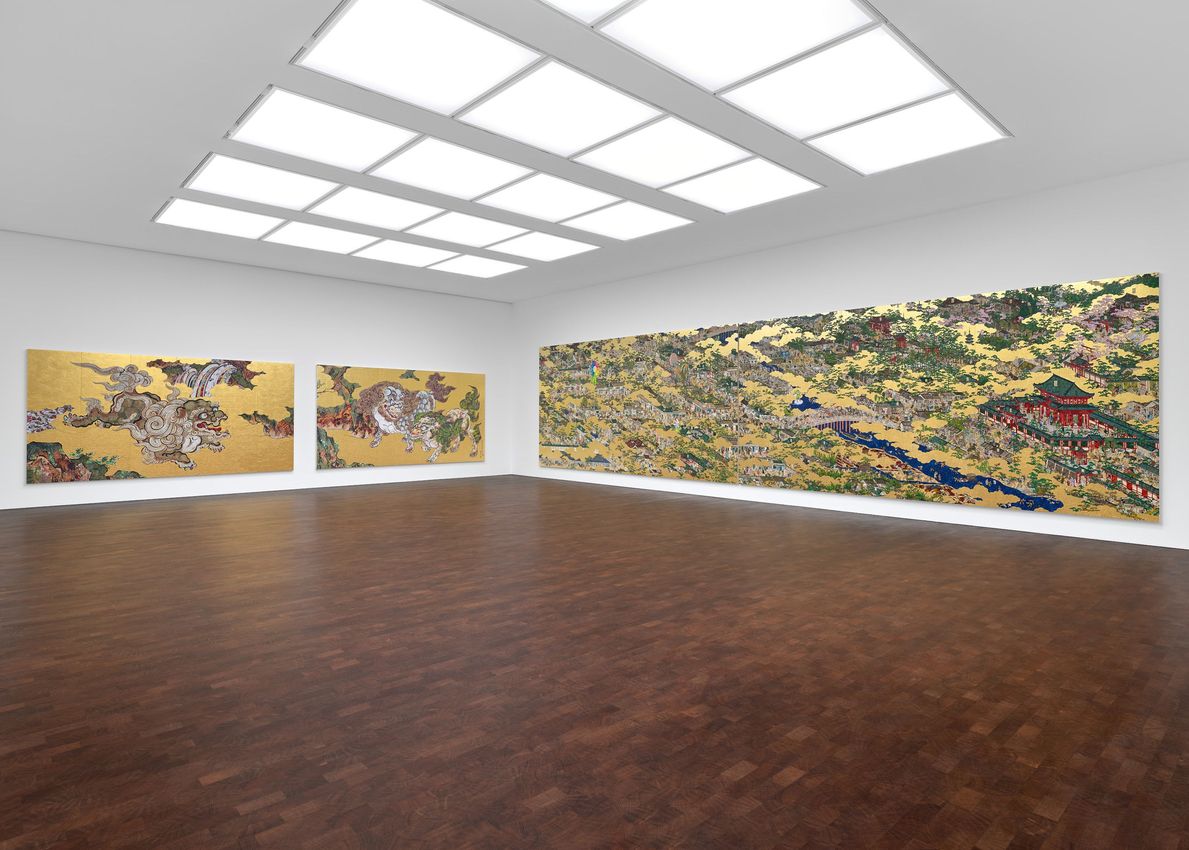
Gagosian is pleased to announce Japanese Art History à la Takashi Murakami, an exhibition of new paintings by Murakami at its Grosvenor Hill gallery in London. In this presentation, the artist pursues his fascination with the narrative of Japanese art by offering his own interpretations of historical paintings. By “Murakamizing” these iconic images, he ponders the erosion of the nation’s ancient splendor; he also considers the ways in which it has been impacted by new aesthetics and values associated with its opening to the West after the end of the Edo period (1603–1868).
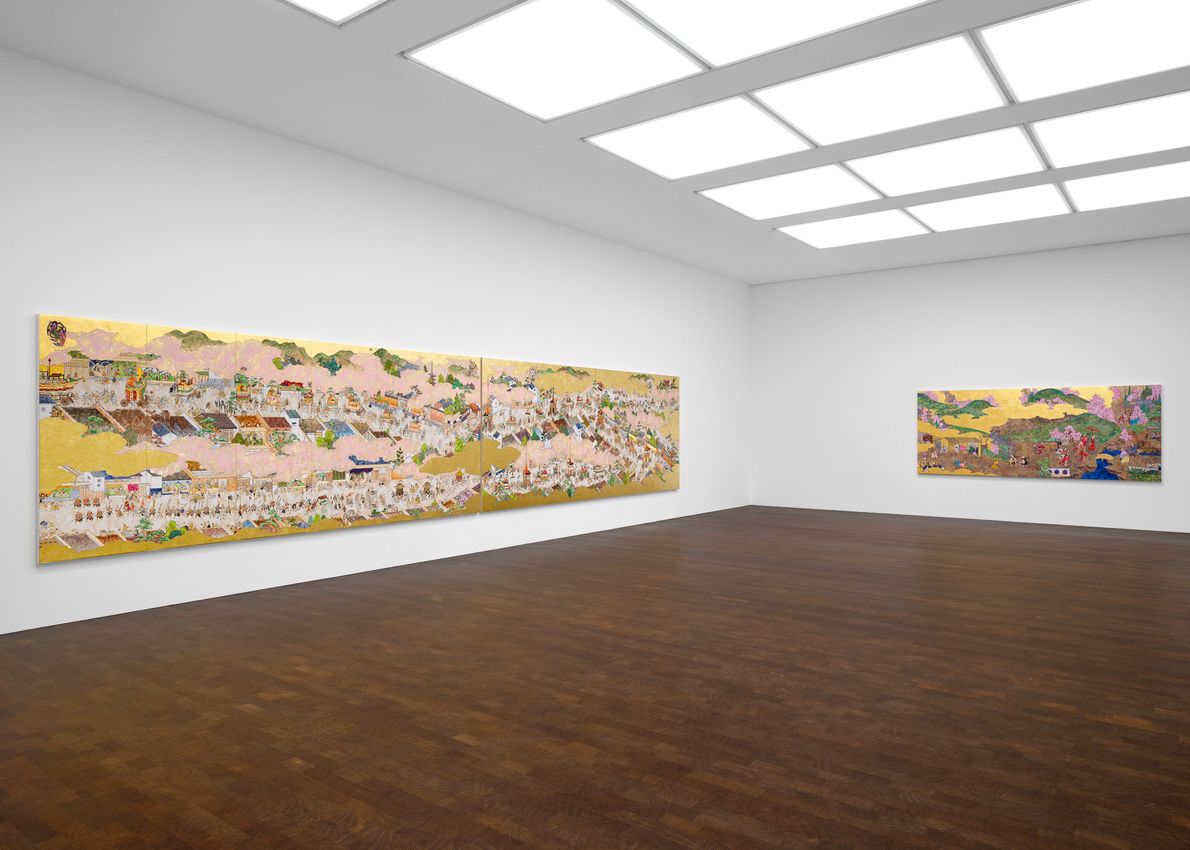
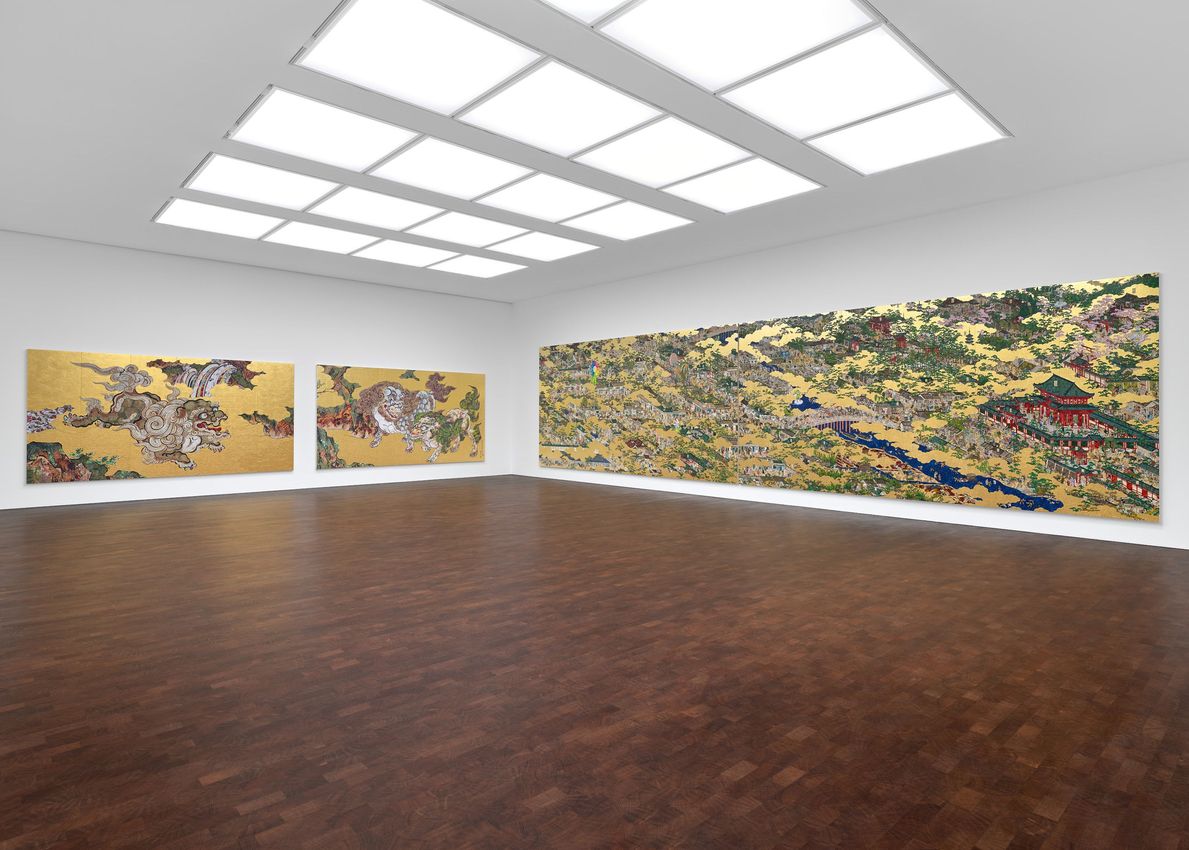
Rakuchū-Rakugai-zu Byōbu: Iwasa Matabei RIP (2023–24) is modeled on Iwasa Matabei’s Rakuchū-Rakugai-zu Byōbu (Scenes in and around Kyoto) (Funaki Version)__from the collection of the Tokyo National Museum. The original seventeenth-century work depicts the city in extraordinary detail across two six-panel folding screens. Murakami’s version, which was commissioned for his exhibition Mononoke Kyoto at the Kyoto City Kyocera Museum of Art, populates its gold-leaf clouds with skulls, a memento mori inspired by a visit to the Toribeno burial ground. He also integrates examples of his own iconography including smiling flower-faced figures and his familiar Mr. DOB character.
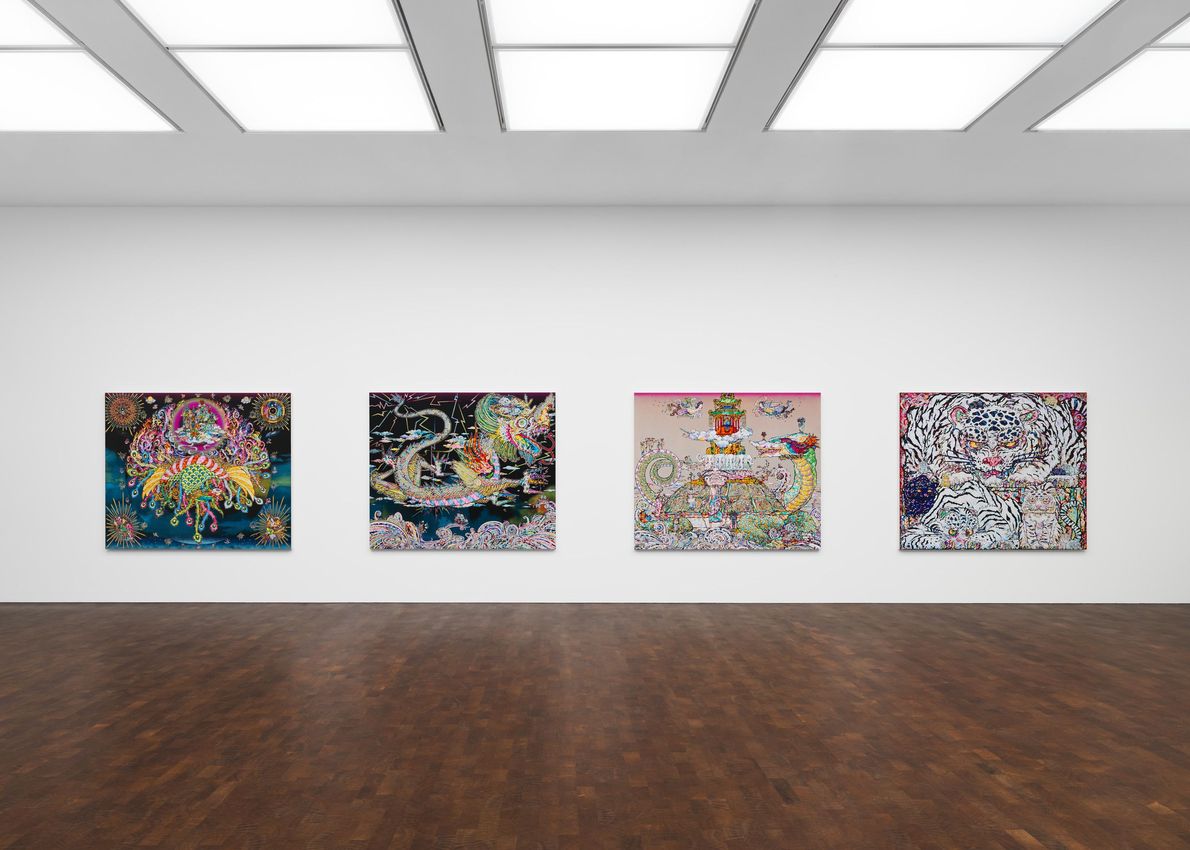
Murakami’s paintings of the Four Symbols, mythical guardians of Kyoto, pair each of their subjects with metropolitan locations aligned with the four compass directions: the Black Tortoise is associated with Mount Funaoka and Mount Kitayama in the north of the city; the Blue Dragon with the Kamo River in the east; the Vermilion Bird with Ogura Pond in the south; and the White Tiger with the San’indo Highway in the west. To arrive at these juxtapositions, Murakami combined his own sketches with AI-generated images and fragments of his earlier works in a process that parallels the inventiveness of earlier artists in depicting unfamiliar or imaginary creatures.
Another diptych pictures the gods of wind and thunder in the blend of classical Japanese painting techniques with Pop, anime, and otaku graphics that Murakami terms “Superflat.” This paired depiction employs the same motifs and composition that Tawaraya Sōtatsu (dates unknown), Ogata Kōrin (1658–1716), and Sakai Hōitsu (1761–1828) each revisited roughly a century apart. At the same time, it allows viewers to observe the development of the Kyoto-based Rinpa school. In the premodern artists’ paintings, the subjects are depicted as Buddhist deities or attendants; today, they sometimes even appear on commercial packaging in the form of cartoonlike icons, a transformation reflected in Murakami’s treatment.
Among the other works in the exhibition are figure and flower paintings, including a tondo. In one, Murakami reworks a set of Daigo Hanami‐zu screens from the collection of the National Museum of Japanese History in Sakura that depicts a cherry blossom viewing event on the grounds of Kyoto’s Daigoji Temple; in another, he reinterprets a pair of Kiku‐zu screens by Kōrin that portray chrysanthemums in white, green, black, and gold. A version of an additional screen by the same artist features bunches of hollyhocks in red, pink, and white, while a work inspired by a screen from the collection of the Artizon Museum, Tokyo, reproduces a composition of hollyhocks and peacocks. The tondo features aqueous patterns, or “Kōrin Water,” and repeating chrysanthemums, motifs developed by Kōrin that sometimes also appear on kimono fabric. In this bridging of art and fashion, Kōrin, who was the son of a kimono merchant, could be considered Murakami’s creative forerunner.
A limited number of copies of Takashi Murakami: An Arrow through History, a new catalogue documenting the 2022 exhibition of the same title at Gagosian New York, which comes with a trading card designed by the artist, will be available at the gallery.
Also opening on December 10, and on view concurrently with the exhibition, Murakami is taking over Gagosian Burlington Arcade. Five new paintings featuring the artist’s smiling flowers are on view in the gallery, while the Shop offers prints and merchandise.
The artist will be in conversation with Hans Ulrich Obrist at 4pm on Wednesday, December 11, at the Benjamin West Lecture Theatre at the Royal Academy of Arts, London. The pair will discuss Murakami’s interpretation of ancient Japanese art, including his reworking of Matabei’s Rakuchū-Rakugai-zu and the Rinpa school.


‘We want to see the newest things. That is because we want to see the future, even if only momentarily. It is the moment in which, even if we don’t completely understand what we have glimpsed, we are nonetheless touched by it. This is what we have come to call art.’—Takashi Murakami


A respected voice in contemporary art discourse.
Focusing on ambitious storytelling and insightful art-world commentary. Ocula Magazine publishes in-depth interviews, critical essays and timely analysis on the artists, exhibitions and ideas driving the global art world.
Learn more about Ocula Magazine
Showcasing the best of the art world.
Ocula partners with galleries from around the world to highlight their artists, artworks and exhibitions. Gallery membership is by application and invitation, with each member vetted by an independent panel.
Learn more about Ocula Membership

Specialises in the sale of major artworks.
Led by a team with deep ties to the world’s leading auction houses, galleries and collectors. Ocula’s advisory team offers bespoke services to high-net-worth clients from around the world who are looking to acquire the best of contemporary and modern art.
Learn more about our team and services