



Venus, morning star, sweet potato, I have the silver and you have the gold.—Jean-Michel Basquiat
Basquiat saw the world differently. He had a great grasp of the history of art and visual culture and was brilliant at bringing the past to life in his paintings. His work reminds us of the common chords and resonances of beauty and identity throughout art history. Seeing his painting in dialogue with this ancient Venus sculpture reminds us of the enduring energy and sophistication of his work.—Larry Gagosian
Gagosian is pleased to announce Venus, a pairing of two rarely seen masterpieces from different millennia: Untitled (1982), a significant painting from Jean-Michel Basquiat’s acclaimed Modena series, is shown in dialogue with an Imperial Roman sculpture of the goddess Venus loaned from the Torlonia Collection in Rome, the world’s largest private collection of Roman art. This is Gagosian’s eleventh exhibition dedicated to Basquiat and demonstrates the gallery’s ongoing commitment to the artist’s legacy.
Highlighting how Venus has been a muse across centuries, the exhibition is on view from October 17 at Gagosian’s gallery at 9 rue de Castiglione and offers an uncommon gallery setting for classical and contemporary masterworks in central Paris.
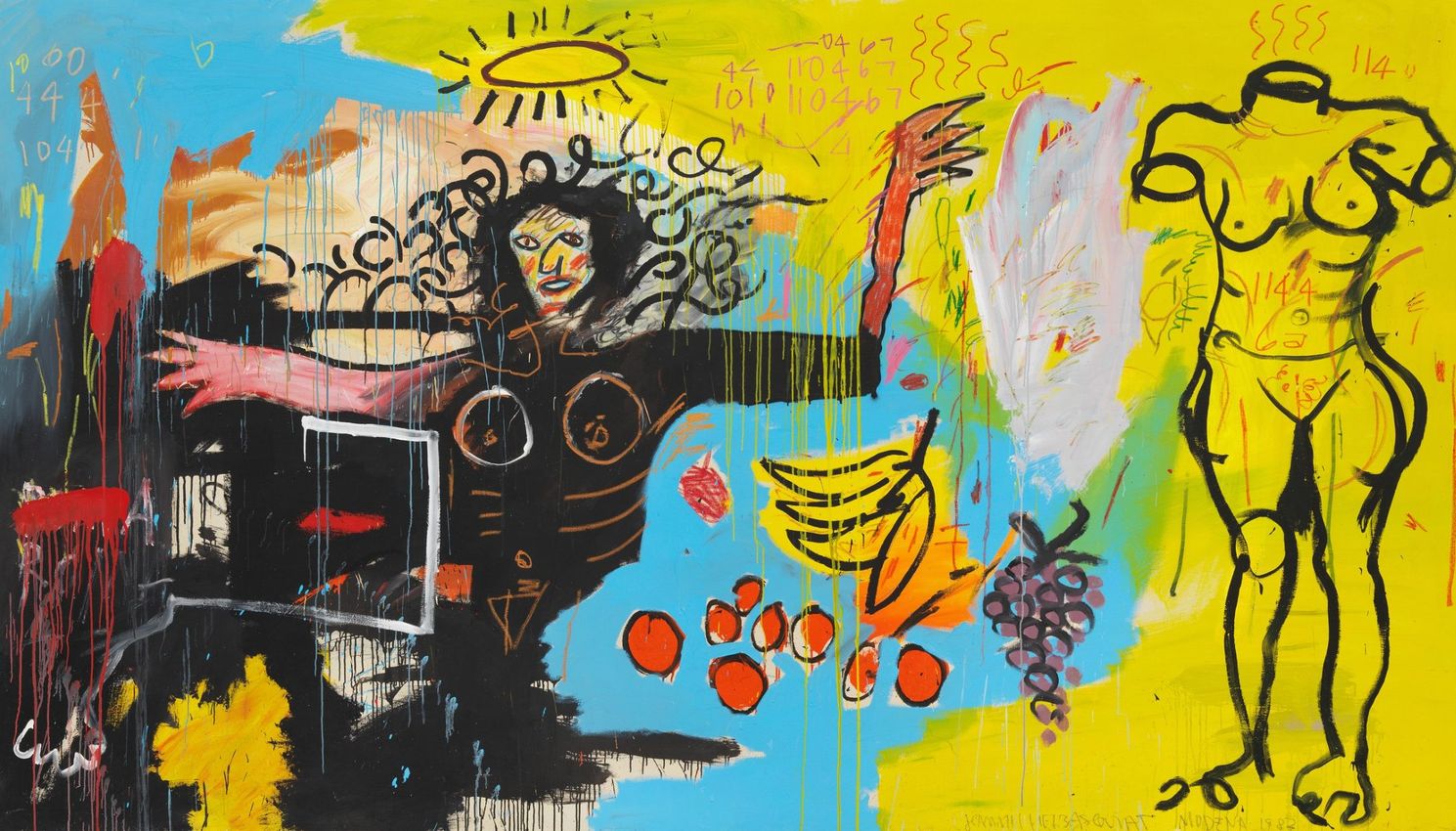
Untitled is one of eight large-scale paintings that Basquiat made in Modena, Italy, in the summer of 1982 at the age of twenty-one. Produced at the invitation of collector and art dealer Emilio Mazzoli for an exhibition that never came to fruition, the works were not shown together until they were reunited last summer at Fondation Beyeler in Riehen/Basel, more than four decades after they were made.
The paintings that comprise the Modena series are some of the most expressive and vivid of Basquiat’s career; ripe with ideas and complexity, they collectively give the impression of an opera with multiple acts. With heavy, dripping brushstrokes and compositions dominated mostly by single figures, the canvases share a fiery, emotional intensity, conveying a dynamic narrative told through the impassioned gestures of the main characters: angel, devil, prophet, miser, farmhand, and Venus. Untitled is the only work from the series to feature a female figure and alludes most directly to classical mythology.
Before his stay in Modena, Basquiat traveled to Rome with Suzanne Mallouk, his girlfriend at the time, whom the artist was known to call “Venus.” The artist’s connections to Mallouk as companion and muse suggest a personal meaning to this work beyond its engagement with Venus as archetype.
Untitled unites Basquiat’s command of color and energetic composition with references to art of the past. Two female figures emerge from passages of vigorously applied teal, yellow, and black paint amid cipher-like marks and numerals. The work recalls Sandro Botticelli’s The Birth of Venus (c. 1485), while the figures’ starkly abstracted features play off the Cubist innovations of Pablo Picasso’s Les Demoiselles d’Avignon (1907), as does the still life of fruit arrayed between them.
Gagosian’s exhibition in Paris juxtaposes Basquiat’s painting with a remarkable marble statue of Venus from Imperial Rome, on loan from the Torlonia Collection, Rome, which is considered the most important private collection of Roman art in the world. Through its activity, the foundation aims to preserve and promote this cultural legacy for future generations. Gagosian is proud to embrace Fondazione Torlonia’s mission by supporting the conservation of this sculpture, allowing it to be studied for centuries to come. Holding a robe that drapes around her hips, the elegant standing figure resembles that of the Capitoline Venus—a representation of the goddess that ultimately derives from the work of Praxiteles, the Athenian regarded as the first artist to sculpt a life-size female nude.
Enigmatic American artist Jean-Michel Basquiat was part of a new generation of pop artists coming from the streets of Brooklyn to the institutional art scene in the 1980s. The former street artist’s neo-expressionist paintings and drawings with incorporated textual elements provide biting social commentary and critique on issues of race, class, and identity.


A respected voice in contemporary art discourse.
Focusing on ambitious storytelling and insightful art-world commentary. Ocula Magazine publishes in-depth interviews, critical essays and timely analysis on the artists, exhibitions and ideas driving the global art world.
Learn more about Ocula Magazine
Showcasing the best of the art world.
Ocula partners with galleries from around the world to highlight their artists, artworks and exhibitions. Gallery membership is by application and invitation, with each member vetted by an independent panel.
Learn more about Ocula Membership

Specialises in the sale of major artworks.
Led by a team with deep ties to the world’s leading auction houses, galleries and collectors. Ocula’s advisory team offers bespoke services to high-net-worth clients from around the world who are looking to acquire the best of contemporary and modern art.
Learn more about our team and services