




Press Release

After studying art in Los Angeles in the late 60s, Jack Goldstein (1945–2003) worked in mediums as various as sculpture, performance, film, sound-works, photography and painting. Central in his work are however primarily the 16mm films and records that Goldstein had made in the 70s. After initially focusing on performance-style treatments of single actions Goldstein’s films in the mid to late 70s turned to a pictorial world that derived from the imagery of the Hollywood movie industry and the techniques associated with it. Here Goldstein detaches isolated images or staged sceneries from their context which through this become elements that represent a reality of films and images and that demonstrate the laws that are inherent in them.

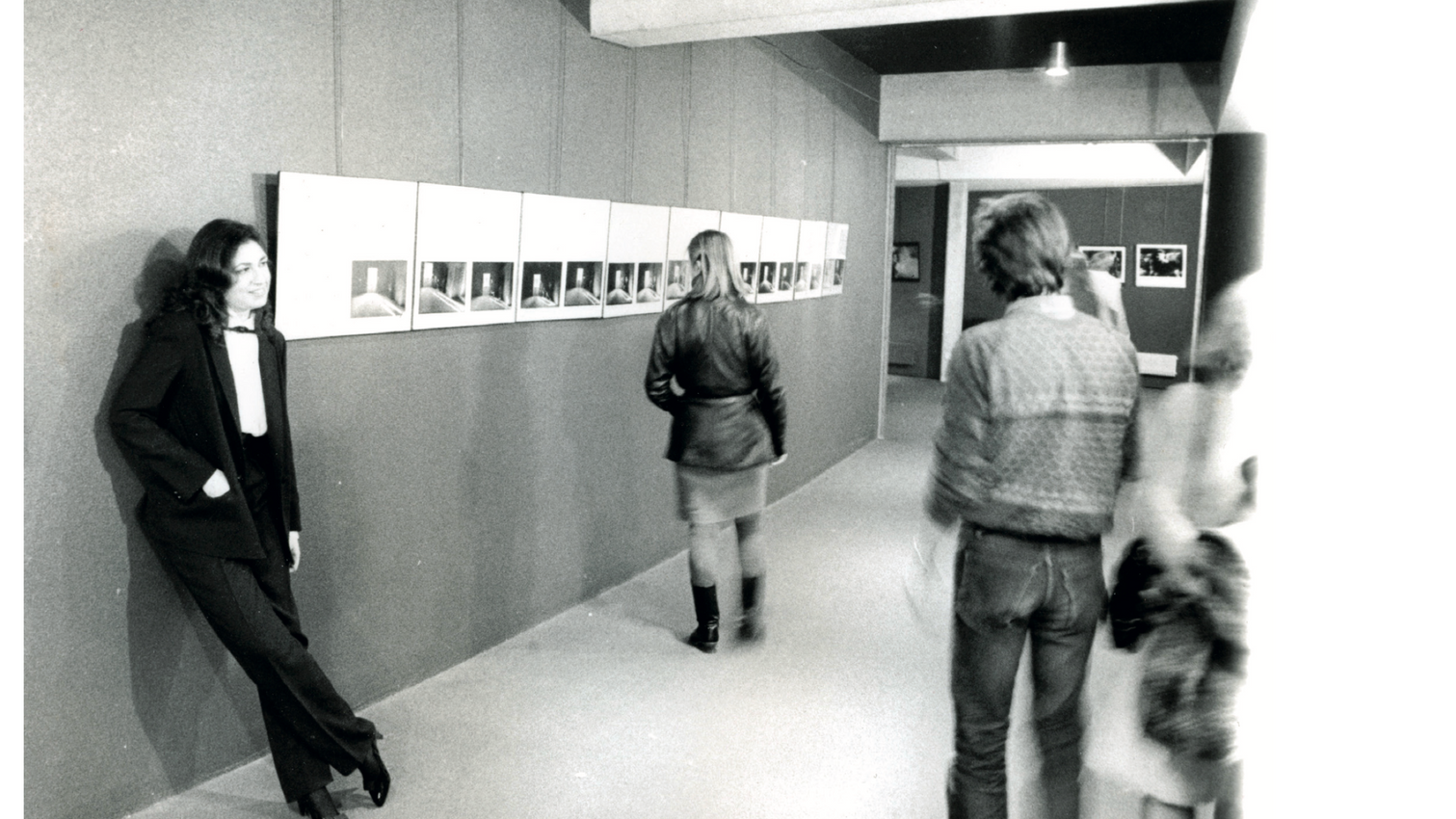
In this third Jack Goldstein solo exhibition at our gallery we are showing a selection of his earlier b/w films like A Glass of Milk (1971), A Spotlight (1972), and the previously rarely seen colour film A Reading (1973), as well as his last film Under Water Sea Fantasy (1983–2003) which Goldstein began in the 80s and completed shortly before his death. Alongside these films we are showing a selection of records and paintings by Jack Goldstein, as well as his text-object Totems (19881990) and a record-sculpture (1999).

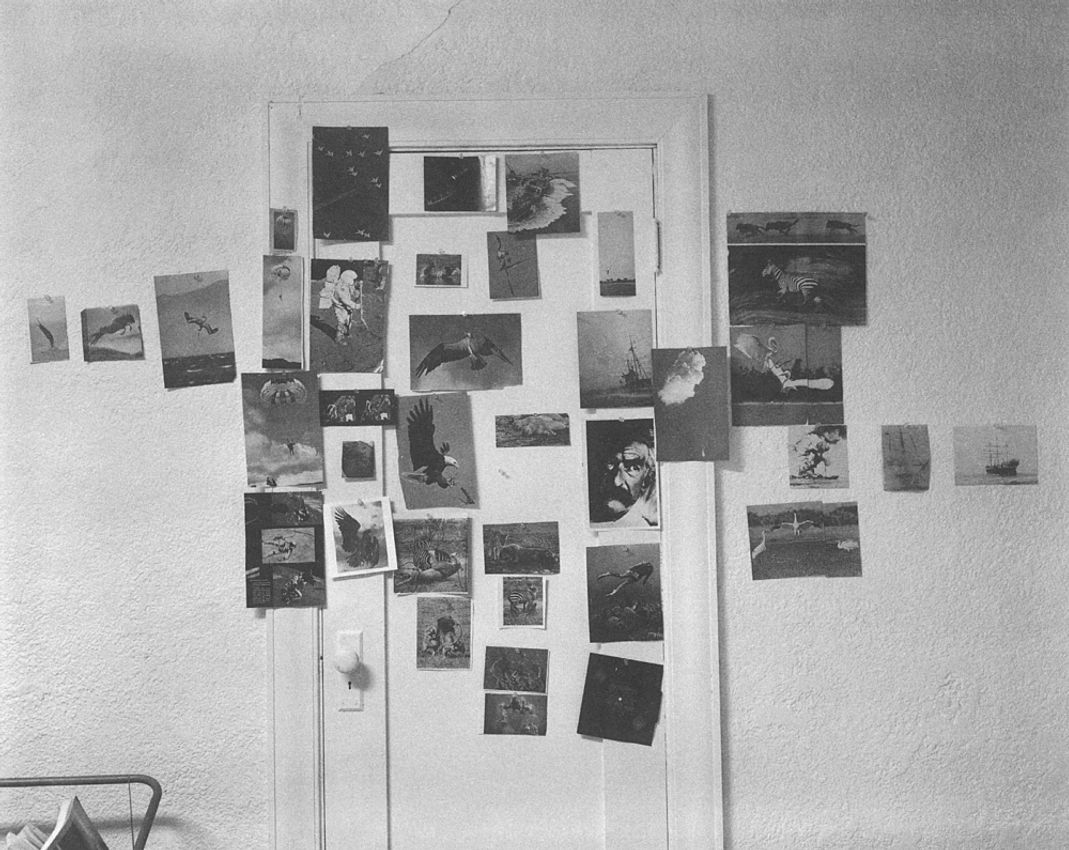
Goldstein’s early b/w films seem to exclusively document the execution of a simple action against its concomitant technical limitations: hammering a tabletop which has a glass of milk standing on it until the milk is spilt; or the artist’s efforts to escape from the beam of a spotlight that follows him. In their simplicity they have a graphic quality that exploits the elements of performance, almost always associating scenes of war and persecution, whether directly in the image (the follow-spot in A Spotlight) or on the soundtrack (the hammering of the fist that simulates detonations in A Glass of Milk). The until now rarely shown colour-film A Reading (1973) can be seen as marking the transition to the artist’s better-known colour films from the mid-70s. Whereas in A Reading (1973) the camera concentrates on a burning sheet of text, while a reader is heard on the soundtrack trying to outpace the advancing flames by reading the text of a theoretical discourse at ever-increasing speed. The colour-film Time (1973) then becomes a totally allegorical film image, and as such is a direct predecessor of better-known Goldstein films like MGM, Shane or The Jump (1975–1978). Under Water Sea Fantasy (1983–2003) is the artist’s last film and was posthumously premiered at the Whitney Biennial in 2003. Jack Goldstein had begun working on this film already before 1983. He bought archive material from nature documentaries, above all underwater films, in order to assemble them into an epic film-montage about natural catastrophes and underwater landscapes. The film was long considered to be incomplete. It was only in the year 2002 that Jack Goldstein started to work on it again, completing it shortly before his death in 2003.

Under Water Sea Fantasy begins with fascinating images of erupting volcanoes which stand out in glorious colour after the monochrome red of the opening shots, while the thunderous roar of the eruptions dominates the sound. The spray from the lava flow slowly cuts to shots of water. The scene moves below the surface of the sea while the sound slowly dies away so that the following images of glittering shoals of fish, grottos, and reefs, as well as jellyfish and octopuses, roll by in total silence. For the picture of the lunar eclipse the camera surfaces above the water again. A mysterious note on a flute is heard as the moon steadily diminishes and then dies away with the last image in silence and total darkness.

The vinyl records which Goldstein recorded parallel to his films from 1976 onwards seem like a further abstraction to his film images. In the 1976 series of 7-inch records the sober descriptions of their titles on the sleeve, like for example that for Two Wrestling Cats, correspond to the sounds to be heard in the recordings. The minimal design of the sleeves and their coloured vinyl transforms these records into abstract objects, which Goldstein also presented in the context of exhibitions alienated from their actual purpose as sound containers, he installed them on the wall without the possibility to play them.

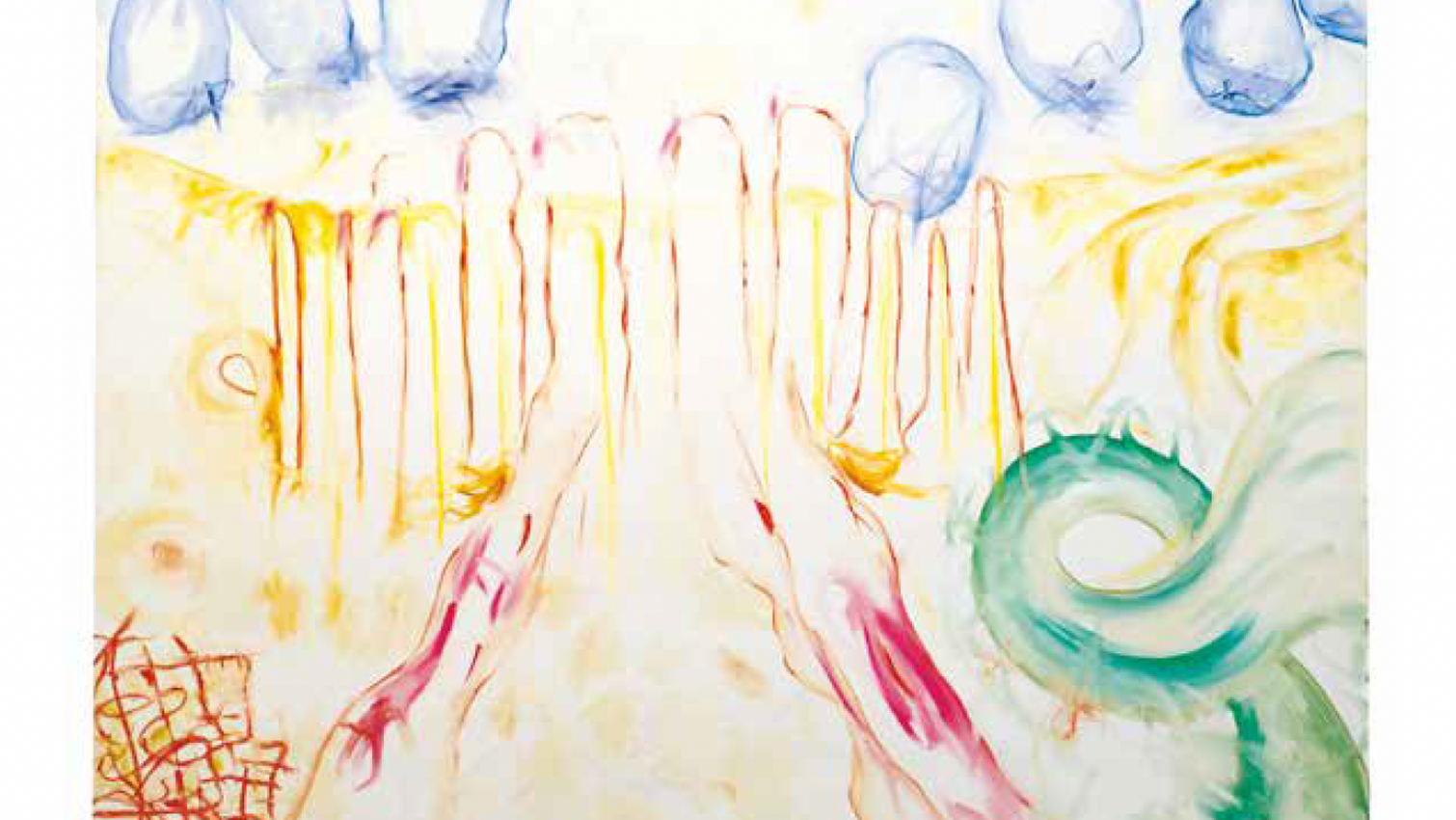
The paintings which Jack Goldstein has been making since the beginning of the 80s are mostly based on found material, just like most of the sounds on the records, and the film images e.g. in Under Water Sea Fantasy, which Goldstein in this instance transfers to canvas using the airbrush technique. The earlier paintings in particular represent almost exclusively scenarios from the Second World War filled with explosions, as well as grandiose natural phenomena.

The text-object Totems (1988–1990), a box Goldstein designed containing 100 pages of computer-generated text and emblematic shapes, which he placed on the pages in the form of totem poles, is a further development of the aphorisms which Goldstein has made in the early 80s.

The three record-sculptures are the only known objects by the artist of this kind. Jack Goldstein presumably worked on them at the end of the 90s. The records, for which he built a sculptural support, are special pressings of his 1977 recording The Quivering Earth. The ambivalence in his works on record in the 70s, between its’ function as sound-carriers and object is taken even further here as the records with their support are transformed from objects into sculpture.

‘My work has always been very much involved with sculpture in the sense that it’s about defining something in space and time, very much about our relationship to it, our distance to that thing. I still feel that I have the same concerns, except that I’ve moved into subject matter. (...) I’m interested in that gap between minimalism and pop art: the objectness and autonomy of minimalism and the subject matter from our culture that’s in pop art. But there is also a link to conceptual art. It’s more about the content than the form, it’s the same whether it’s performance, films, records, etc. and a lot of the experience take place in your head. Real time and real space don’t matter.’

Excerpt from: Morgan Fisher, ‘Talking with Jack Goldstein’, published in: LAICA Journal, No. 14, Los Angeles, 1977

Read More

Also Exhibiting at Galerie Buchholz

About the Gallery

Galerie Buchholz is an art gallery specializing in international contemporary art, with exhibition spaces in Cologne, Berlin and New York City. The gallery was founded in Cologne in 1986 by Daniel Buchholz, and today is run jointly with Christopher Müller.

View Gallery Profile
Address
Neven-DuMont-Str. 17
Cologne
Germany
Opening Hours
Tues - Fri, 11am - 6pm
Sat, 11am - 4pm
(1)
Cologne Neven-DuMont-Str. 17
Galerie Buchholz
Neven-DuMont-Str. 17, Cologne, Germany

Opening hours
Tues - Fri, 11am - 6pm
Sat, 11am - 4pm
The art world in focus
