As it becomes clear that a few dominant technology stacks like GAFA–Google, Apple, Facebook and Amazon–represent a new era of centralisation of the Internet, an alternate Web based on the digital currency Bitcoin and it’s transaction ledger blockchain is being imagined and built. Blockchain entrepreneurs, engineers and marketers talk of a new decentralised’ web, a third generation of the Internet where these centralised giants would be superseded by a different configuration of more distributed systems and applications. Claims of redistributing value, enabling access to investing for the many and ‘democratising’ governance accompany the excitement around blockchain projects like Ethereum.1 In his new work observing this occurrence, Simon Denny explores one of the key metaphors around technology and governance: envisaging networks as ‘centralised’ or ‘decentralised.’
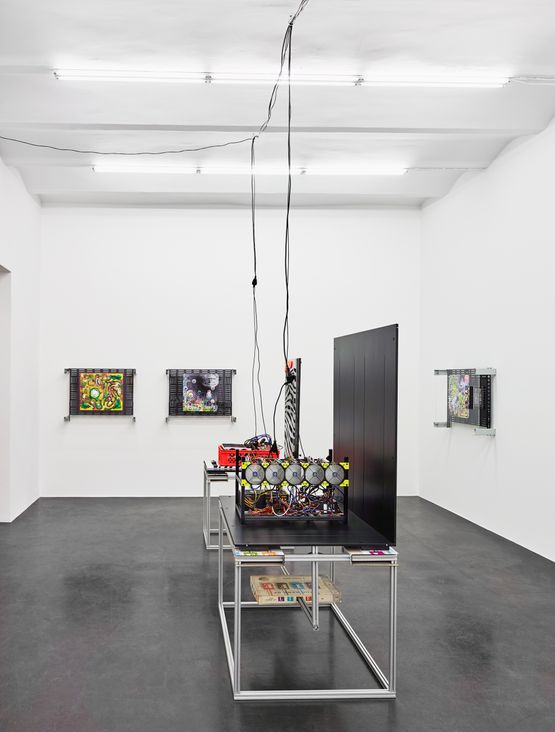
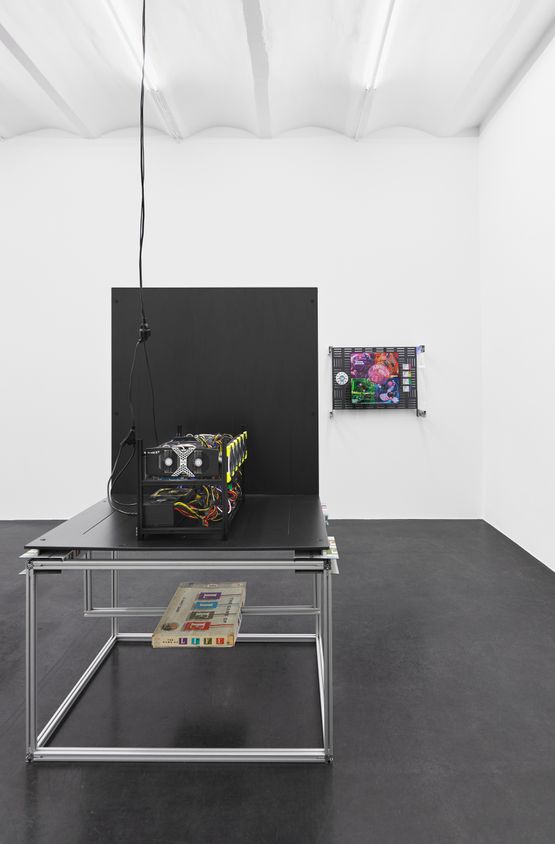
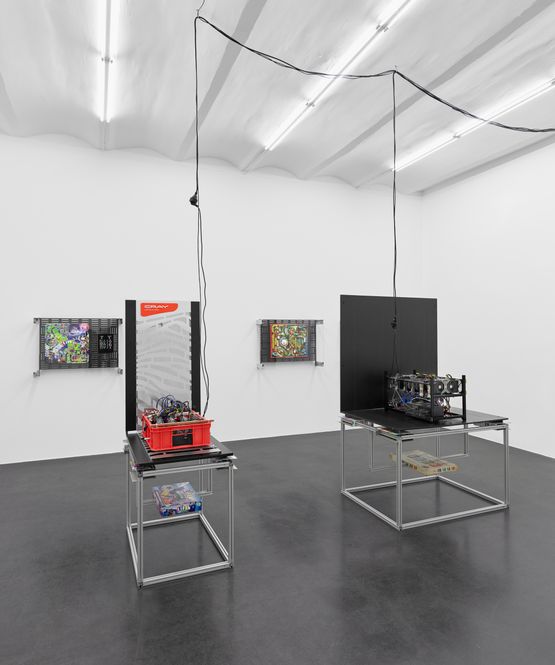
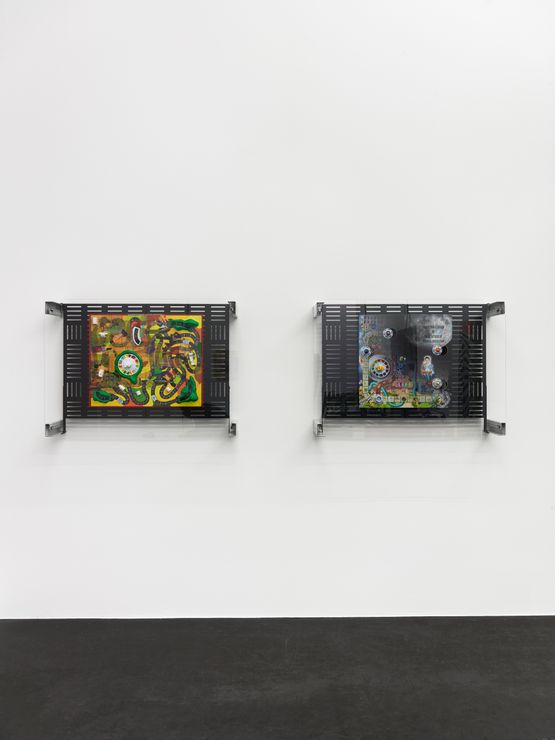
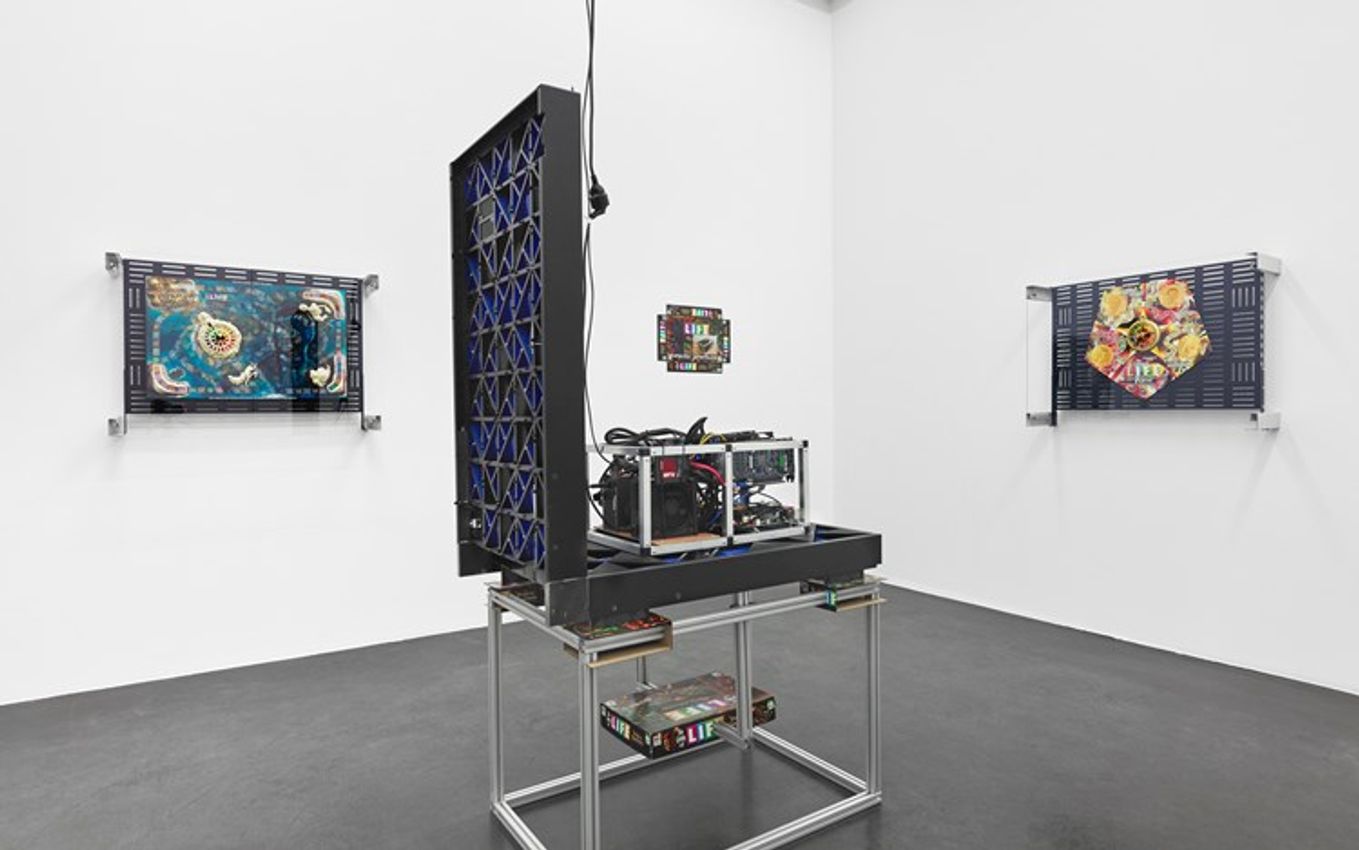
As the influence of cryptocurrencies (like Bitcoin and Ether) expands–evinced not least by their seemingly exponential (though volatile) growth in financial value–a subculture of newly convinced investors and fans has grown around ‘crypto,’ bringing with it a new class of crypto-rich early adopters. Denny addresses this cult-like movement, reflecting on the impact it may have upon the lives of its devout converts and the rest of us in ‘meatspace.’2 New wall works modeling narratives of crypto’s decentralisation expand on his recent practice of reframing tech trends critically through coopting well-known board games. Imagery and rhetoric from crypto Twitter feeds, Medium think-pieces, Reddit fan art and company websites are overprinted digitally onto found game board editions of the Milton Bradley classic The Game of Life. The game’s rendering of a rule-based path of life’s supposed choices and plans, overprinted with a build up of crypto imagery and text, produce maximal, ghostly maps of the decentralised blockchain movement’s societal ambitions and effects. The ‘life’ boards also recall ‘Conway’s Game of Life,’ an infamous cellular automaton ‘zero player game’ sometimes used to illustrate the possible evolution of complex philosophical constructs, such as consciousness and free will, from a relatively simple set of deterministic physical laws. These ‘decentralised’-board-game-collages are housed in sculptural frames made by repurposing ‘centralised’ server rack components–producing decentralisation maps contained in display cases made from the hardware of centralisation.
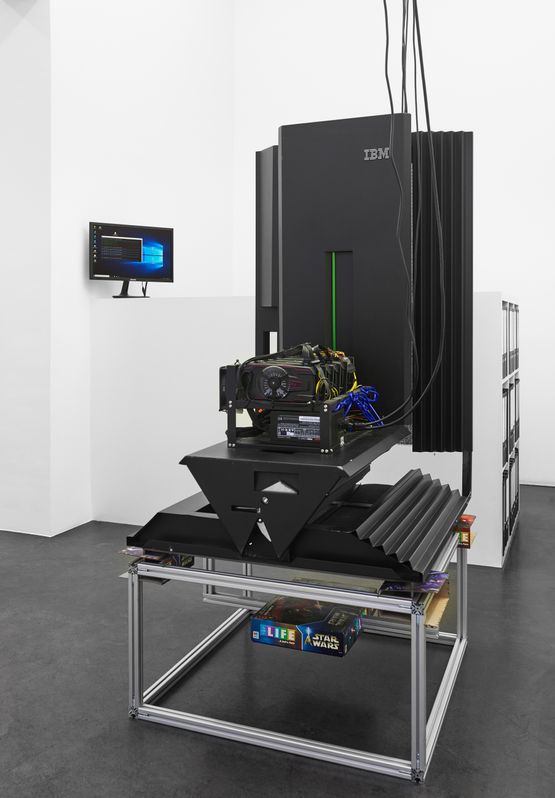
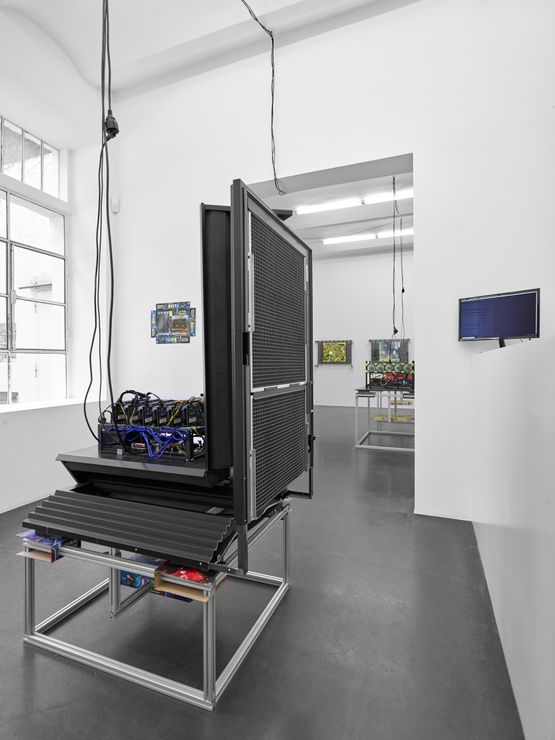
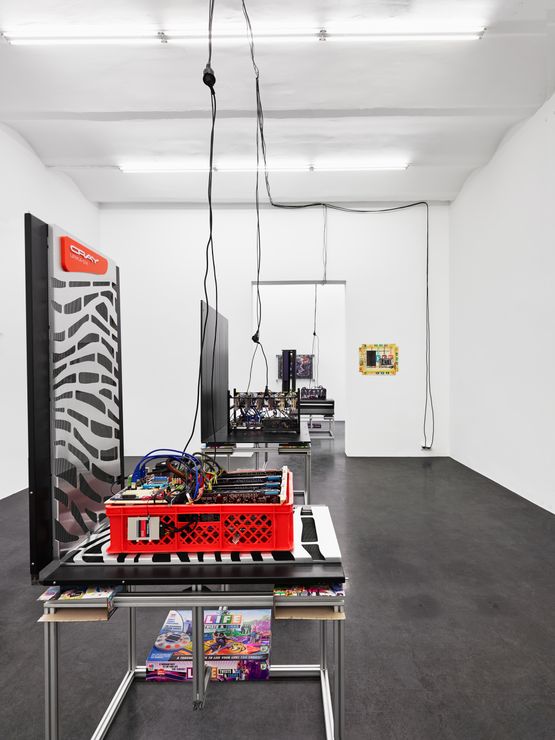
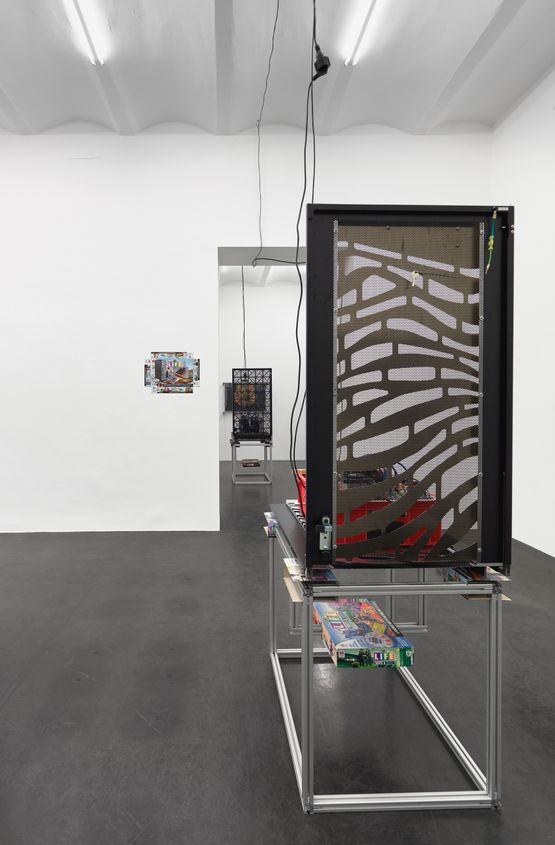
A new group of free-standing sculptures isolate and interface elements of the hardware that centralised and decentralised networks are built with. Graphics Processing Units, (intended for heavy duty graphics processing in gaming PCs, but popularly used to ‘mine’ Bitcoin and other crypto, thus becoming the infrastructure of the emergent decentralised Web) are mounted on dissected doors from a centralised computing hardware icon: the supercomputer server rack. Here, the doors of centralisation support relics of DIY decentralised infrastructure, questioning whether crypto’s decentralised revolution might instead be amoment of ‘re-centralising.’ Is the emergence of crypto mirroring the path of the 90s Internet where the technology, instead of decentralising, enabled a shift in power from one dominant group to a (demographically similar) alternative elite? Will the ‘web of value’3 enable a fairer redesign of monetary systems and data ownership or enable a new generation of extractive practices? Games of Decentralized Life examines the power of the metaphor of ‘centralisation’ vs. ‘decentralisation’ as a rhetoric: a familiar, seductive story underwriting yet another chapter in the expansion of the influence of the people who design and build the Internet.
1. The largest and most visible blockchain-based project outside of Bitcoin, which is designed including a Turing-complete programming language that enables the writing of automated contracts. Ethereum is intended as a platform for companies to build 3rd party decentralised applications–or Dapps–on top of, and is one of the top contenders for the software infrastructure underpinning the new ‘decentralised’ Internet.
2. Popular term in crypto and related tech circles to describe ‘offline’ or ‘IRL’ (In Real Life) life distinct from the online or internet enabled world.
3 One of the names used to describe the emergent, blockchain-enabled internet–alongside the ‘third web,’ the ‘financial web’ and others.
Simon Denny is a New Zealand artist based in Berlin whose installations, paintings, sculptures, videos, and digital works examine the social and political implications of technology, from startup culture and social media to blockchain and cryptocurrency.


Galerie Buchholz is an art gallery specializing in international contemporary art, with exhibition spaces in Cologne, Berlin and New York City. The gallery was founded in Cologne in 1986 by Daniel Buchholz, and today is run jointly with Christopher Müller.

A respected voice in contemporary art discourse.
Focusing on ambitious storytelling and insightful art-world commentary. Ocula Magazine publishes in-depth interviews, critical essays and timely analysis on the artists, exhibitions and ideas driving the global art world.
Learn more about Ocula Magazine
Showcasing the best of the art world.
Ocula partners with galleries from around the world to highlight their artists, artworks and exhibitions. Gallery membership is by application and invitation, with each member vetted by an independent panel.
Learn more about Ocula Membership

Specialises in the sale of major artworks.
Led by a team with deep ties to the world’s leading auction houses, galleries and collectors. Ocula’s advisory team offers bespoke services to high-net-worth clients from around the world who are looking to acquire the best of contemporary and modern art.
Learn more about our team and services