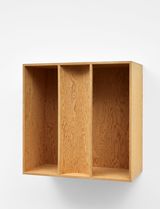
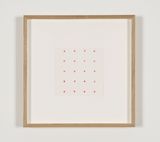
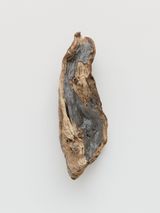
With this presentation, we have chosen to construct a discourse around a seminal work by Donald Judd, namely 91-7 Ballantine (1991). This sculpture, composed entirely of American pine plywood, functions as the focal point of the exhibition, both in terms of its physical prominence and its conceptual significance. Its rigid, geometric configuration and material specificity establish a definitive framework for engaging with a diverse selection of artists spanning multiple movements and theoretical paradigms.
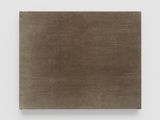
The presentation situates 91-7 Ballantine as a critical reference point, fostering interrelations with other works in terms of materiality, spatial dynamics, and intellectual inquiry. While Judd’s oeuvre is deeply embedded within the minimalist canon, its conceptual implications extend beyond the formalist concerns of the movement, intersecting with broader artistic and philosophical discourses. Figures such as James Ensor, Richard Tuttle, Louise Lawler, Shirley Jaffe, and On Kawara serve as critical interlocutors, offering contrasting yet intellectually rigorous perspectives that underscore the evolving trajectories of form, expression, and critique within modern and contemporary art.
Theoretical Contrasts: Judd and His Artistic Counterparts
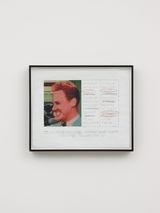
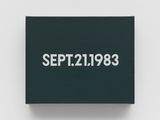
Judd’s work, including 91-7 Ballantine, foregrounds permanence, structure, and spatial coherence. In contrast, On Kawara’s Today Series (a systematic practice of inscribing the date in a standardised format) interrogates time as an ephemeral yet systematic construct. Kawara’s conceptual approach destabilises the material fixity characteristic of Judd’s sculptural practice, redirecting attention towards the transient, ritualistic nature of artistic engagement. Where Judd’s plywood constructions assert their presence through material integrity, Kawara’s works exist as markers of temporality and existential notation.
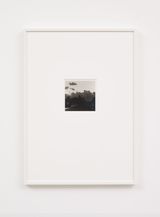
Louise Lawler’s photographic interventions present a direct counterpoint to Judd’s autonomous objects. While Judd sought to extricate interpretation and contextual contingency from his works, allowing them to function as self-sufficient entities, Lawler problematises such autonomy by embedding her work within the socio-economic frameworks of the art world. Her documentation of artworks in collectors’ homes, museum storage facilities, and gallery spaces reveals the contingent nature of meaning as shaped by institutional, financial, and cultural forces. In this light, Judd’s 91-7 Ballantine, in its precise placement and material construction, represents a self-contained ontological statement, whereas Lawler’s work interrogates the fluidity and instability of such assertions.
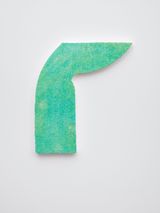
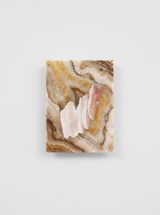
Richard Tuttle’s delicate, often ephemeral compositions present a stark divergence from Judd’s systematically structured works. Whereas Donald Judd’s oeuvre asserts itself through weight, scale, and repetition, Tuttle’s interventions embrace imperfection, organic irregularity, and a rejection of conventional material hierarchies. This juxtaposition highlights a fundamental tension within the legacy of minimalism, between the authoritative presence of geometric abstraction and the possibility of a more nuanced, materially contingent aesthetic.
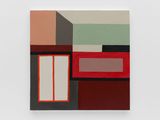
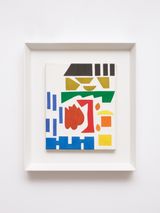
Shirley Jaffe’s vibrant, gestural compositions challenge the constraints of Judd’s rigid, modular systems. While Judd’s sculptures operate within a predefined visual lexicon of repetition and material specificity, Jaffe’s work engages with asymmetry, spontaneity, and chromatic dynamism. Her paintings disrupt the notion that abstraction must conform to a strict rationalist framework, presenting an alternative mode of formal investigation that privileges expressive variation over systemic regularity.
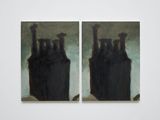
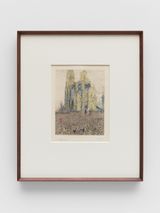
In high contrast James Ensor’s La Cathédrale (1887) represents an extreme departure from Judd’s minimalist aesthetic, engaging with grotesque, chaotic visuality that defies the clean, industrial logic of minimalism. Ensor’s work, steeped in psychological depth and historical allegory, stands in stark contrast to Judd’s material and spatial clarity. However, the proximity of Ensor’s surreal, ornate imagery with 91-7 Ballantine compels a reconsideration of how different artistic movements engage with ontological and societal conditions across historical epochs.
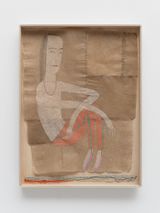
Beyond these key dialectics, the presentation includes works by Katinka Bock, Edith Dekyndt, Robert Barry, John Baldessari, Catharina Van Eetvelde, Nathalie Du Pasquier, Suzan Frecon, Robert Adams, Mitsuko Miwa, Jef Geys, Sophie Nys, Robert Mangold, Terry Adkins, Yun-Fei Ji, and Jacob Kassay. Each of these artists contributes to an expanded theoretical engagement with Judd’s minimalism, further complicating the discourse around materiality, spatiality, and conceptual rigor.
Katinka Bock and Edith Dekyndt, for example, explore the organic and durational properties of materials, introducing an element of temporal flux that subtly subverts Judd’s industrial precision. Robert Barry and John Baldessari employ language and conceptualism to challenge the privileging of objecthood in minimalist discourse, while Catharina Van Eetvelde and Nathalie Du Pasquier interrogate abstraction through strategies that simultaneously align with and disrupt Judd’s structural logic.
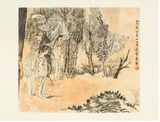
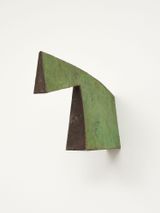
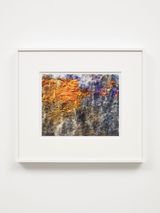
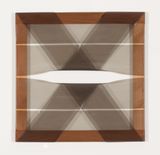
Suzan Frecon and Robert Adams engage, in the most different way, with surface, light, and texture, echoing Judd’s material sensitivity but in vastly different aesthetic registers. Mitsuko Miwa, Jef Geys, Yun-Fei Ji and Sophie Nys introduce additional critical perspectives that deconstruct, expand, or invert Judd’s minimalist ethos, whereas Robert Mangold and Terry Adkins investigate geometric abstraction and sculptural presence in ways that operate in parallel yet remain distinct from Judd’s practice.
Jacob Kassay and Robert Grosvenor further complicate minimalist discourse by integrating elements of narrative, process, and erasure, challenging the perceived finality and self-sufficiency of Judd’s forms.
This presentation seeks to resist the ossification of art-historical narratives into rigid terminologies and static classifications. Minimalism, frequently defined through retrospective categorisation, risks becoming an eroded concept when detached from its broader theoretical implications. By situating Judd’s work in direct dialogue with artists across historical and ideological spectra, this presentation problematises the stability of artistic movements and invites a more nuanced interrogation of meaning, materiality, and perception within contemporary critical discourse.
Rather than reiterating conventional art-historical canons, this assemblage of works endeavors to illuminate the broader, often unforeseen dimensions of minimalism and its continued resonance. In this context, 91-7 Ballantine is not merely a historical artifact but a catalyst for renewed theoretical engagement with the evolving complexities of form, context, and artistic intent.
A respected voice in contemporary art discourse.
Focusing on ambitious storytelling and insightful art-world commentary. Ocula Magazine publishes in-depth interviews, critical essays and timely analysis on the artists, exhibitions and ideas driving the global art world.
Learn more about Ocula Magazine
Showcasing the best of the art world.
Ocula partners with galleries from around the world to highlight their artists, artworks and exhibitions. Gallery membership is by application and invitation, with each member vetted by an independent panel.
Learn more about Ocula Membership

Specialises in the sale of major artworks.
Led by a team with deep ties to the world’s leading auction houses, galleries and collectors. Ocula’s advisory team offers bespoke services to high-net-worth clients from around the world who are looking to acquire the best of contemporary and modern art.
Learn more about our team and services