Galerie Greta Meert is pleased to present innermost, the third solo exhibition of German artist Johannes Wald with the gallery. Wald’s sculptural works present themselves in a nascent state as if resulting from of a process of perpetual ‘becoming.’ By approaching sculpture as a conceptual practice that entails a provisional standpoint, the artist challenges the relationship between sculptural materials and their historically assigned meaning and assumed objecthood.
The works in this exhibition directly relate to the artist’s studio as a physical space that literally supports and sustains his artistic, personal, and at times quasi existential inquiries—a space where the centrality of the self is at once proclaimed and confronted. Handmade mirrors and reflective objects made from structural elements removed from his studio epitomise this duality. Throughout the exhibition, a series of mirrors made of glass panes removed from the windows of Wald’s studio and transformed into mirrored surfaces using the silver from ancient coins, reflect the environment of the gallery and return the gaze of the viewer.
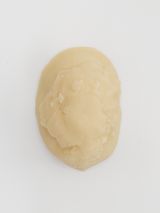
A brick removed from the artist’s former studio underwent another laborious process involving sanding, burnishing, gold and platinum glazing, and resulting in its transformation into a reflective object with a metallic surface. While such material and formal experiments give lieu to seemingly finite objects that become the containers for allegorical meaning to exist in a more tangible form, these objects also retain an uncanny level of opacity in spite of their reflective properties. Titled after Jacques Lacan’s psychoanalytic concept of the mirror stage, Wald’s reflective sculptures highlight their own developmental phase by simultaneously showing and concealing the artist’s labour while merging the object’s process of becoming reflective with his own ‘stade du miroir’ as an artist.
Other works in the exhibition bring forth the presence of the body in the studio in a more direct way through casting and imprints while evoking the daily practice of the artist. A bronze cast of Wald’s feet layered on top of another version of the same cast exerts a distorted mirroring effect; a shadowing whereby his presence is felt and doubted at the same time. Along with a thickly layered imprint of his face in wax and fibreglass, this double pair of feet acts like a stand-in for an unseen actor. In Wald’s practice, the function of the studio is called into question by likening to a stage where the fourth wall can either be a tangible brick wall or just its negative «silicone rubber» imprint folded on itself in a corner of the room. The implications of this mutability requires us to approach his artistic gestures with a renewed sense of awareness towards our subjective impressions and physical experiences.
Johannes Wald (b. 1980 in Sindelfingen, Germany) lives and works in Berlin. Recent solo exhibitions include, innere Räume, Daniel Marzona, Berlin, Germany, 2019; body of stone, Schwartzsche Villa, Berlin, Germany, 2019; forming a self, Baril Gallery, Cluj Napoca, Romania, 2019; Giovanni Bosco, Galerie Rolando Anselmi, Rome, Italy, 2018; Whatness, a two-person exhibition with Esther Kläs, Kunsthalle Bielefeld, Germany, 2015; Geste und Gefühl / attempts at forming appropriate finds, Museum Kurhaus Kleve, Germany, 2014; in the shade of absence, Albertinum, Staatliche Kunstsammlung Dresden, Germany, 2013.
Johannes Wald works in the conceptual tradition where the work of art has lost its relevance as a mere material realisation. His focus lies on the process more than the finished thing. He aims for an unfinished stage of intermediate forms and non-recyclable refuse.
Over the past 30 years, Galerie Greta Meert established itself as one of Brussels’ leading contemporary art galleries. Founded in 1988 as Galerie Meert Rihoux, it was subsequently renamed after its founding director Greta Meert in 2006. Located in the center of Brussels, the gallery occupies a five-story Art Nouveau building designed by Louis Bral and renovated for the gallery by renowned Belgian architects Hilde Daem and Paul Robbrecht. Since 2012 three floors of the building are dedicated to exhibitions, making it possible to maintain an expanded exhibition schedule.

A respected voice in contemporary art discourse.
Focusing on ambitious storytelling and insightful art-world commentary. Ocula Magazine publishes in-depth interviews, critical essays and timely analysis on the artists, exhibitions and ideas driving the global art world.
Learn more about Ocula Magazine
Showcasing the best of the art world.
Ocula partners with galleries from around the world to highlight their artists, artworks and exhibitions. Gallery membership is by application and invitation, with each member vetted by an independent panel.
Learn more about Ocula Membership

Specialises in the sale of major artworks.
Led by a team with deep ties to the world’s leading auction houses, galleries and collectors. Ocula’s advisory team offers bespoke services to high-net-worth clients from around the world who are looking to acquire the best of contemporary and modern art.
Learn more about our team and services