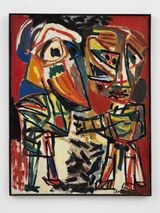
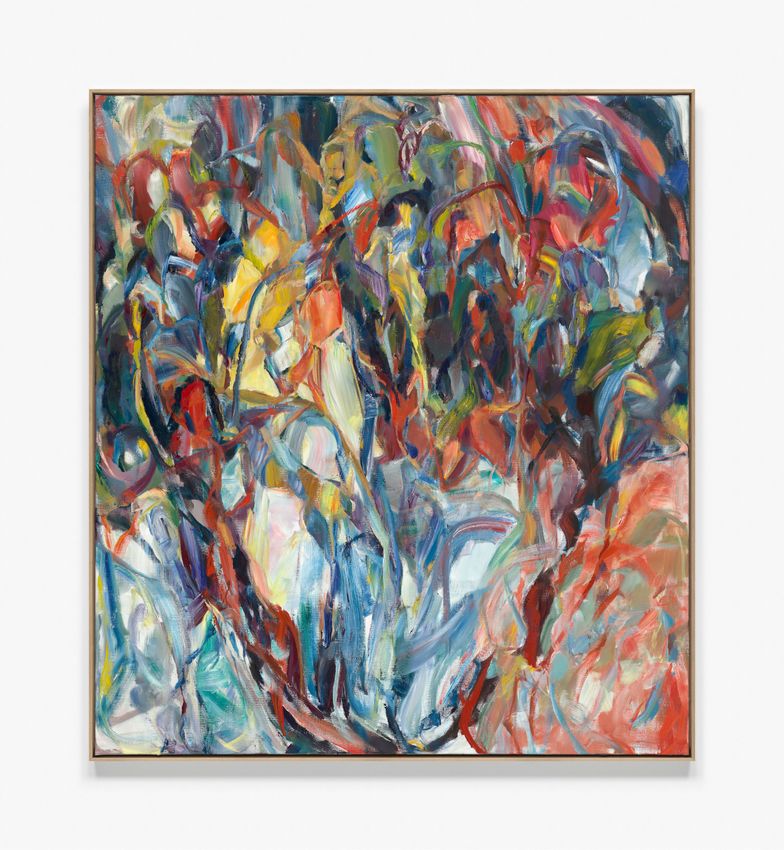
Galerie Max Hetzler is pleased to present The Classic Themes, an exhibition of paintings and works on paper by Karel Appel at Bleibtreustraße 45 in Berlin. Building on the artist’s important retrospective at the Gemeentemuseum Den Haag (today Kunstmuseum Den Haag) in 2016, The Classic Themes marks the sixth exhibition of Karel Appel at the gallery.
‘The major Karel Appel retrospective at the Gemeentemuseum Den Haag in 2016—ten years following the artist’s death—was set to radically renew the traditional view of Appel’s extensive oeuvre. Within its thematic structure, only one of the six large halls was dedicated to the CoBrA movement, while three of the others focused on very classical themes—nude, landscape or portrait. The prominence given to these classical themes flagrantly contradicted CoBrA’s primitivism. In addition, it was shown for the first time that Appel did not always paint ‘spontaneously’, but very often started from drawings, selected from the graphic diversity of his constantly active, visual thought process. This, too, shed a new light on Appel’s traditional image, which is usually associated with the intuitive improvisation that set the tone for the avant-gardes of the fifties and sixties: the CoBrA Group, the Nouvelle École de Paris and Abstract Expressionism.
The exhibition at Galerie Max Hetzler concentrates on these three classic themes and, where preliminary drawings can be linked to the paintings on display, they are presented alongside them. The Classic Themes thus offers new insights into Karel Appel’s working method, inviting a reassessment of established stereotypes. Due to the show’s thematic and therefore non-chronological structure, works from different stylistic phases are exhibited side by side.
The exhibition begins with a very early ‘portrait’ from 1946. Its style appears related to what the French critic Michel Ragon would later call ‘post-cubism’. Appel and his friend Corneille had come across a publication that had appeared for an exhibition at the Galerie de France featuring five ‘post-cubist’ painters. The plan to visit one of them – namely Édouard Pignon, a close friend of Picasso – triggered the two young artists’ first trip to Paris in 1947.
The show’s initial two rooms are also dedicated to the portrait theme. The first brings together portraits of poets with whom Appel had lifelong friendships, including two Belgians, Emmanuel Looten (1908–1974) and Hugo Claus (1929–2008), as well as the best-known representative of the American ‘Beat Generation’, Allen Ginsberg (1926–1997). The second room shows portraits of two women with whom Appel was crucially connected during the most striking early phases of his career: Tonie Sluyter (1929–2012), Appel’s partner during the CoBrA years, and Machteld van der Groen (1935–1970), his companion over the first ten years of his international fame.
The third room combines nudes from three different phases of his work: the beginning of the sixties, the mid-nineties, and the year 2000. The last room presents landscapes, again from different phases: a relief whose style is reminiscent of Pop Art; a four-and-a-half-metre-wide triptych from the eighties, when Appel took up the landscape theme quite decidedly as a panorama; and two pictures from the late nineties, one of which seems to have been painted spontaneously, while the preliminary drawing for the other gives insight into Appel’s process of developing templates for monumental paintings from found pictures.’


Galerie Max Hetzler is a global contemporary art gallery representing nearly sixty artists across six spaces in Berlin, Paris and London, with an exhibition space and artist residency in Marfa. Established in Stuttgart in 1974, in its early years the gallery championed the generation of influential German artists emerging at the time including Albert Oehlen, Günther Förg and Martin Kippenberger and their international counterparts Christopher Wool, Jeff Koons, Robert Gober and Cady Noland amongst others.

A respected voice in contemporary art discourse.
Focusing on ambitious storytelling and insightful art-world commentary. Ocula Magazine publishes in-depth interviews, critical essays and timely analysis on the artists, exhibitions and ideas driving the global art world.
Learn more about Ocula Magazine
Showcasing the best of the art world.
Ocula partners with galleries from around the world to highlight their artists, artworks and exhibitions. Gallery membership is by application and invitation, with each member vetted by an independent panel.
Learn more about Ocula Membership

Specialises in the sale of major artworks.
Led by a team with deep ties to the world’s leading auction houses, galleries and collectors. Ocula’s advisory team offers bespoke services to high-net-worth clients from around the world who are looking to acquire the best of contemporary and modern art.
Learn more about our team and services