Press Release
Galleria Continua is delighted to present the first solo show of Zhuang Hui, curated by Colin Siyuan Chinnery, in its Beijing space.

Throughout Chinese history there has been a tradition for scholars or artists to retreat into the mountains in order to escape the chaos of troubled times. Owing to China’s sheer amount of turbulent history, the landscape genre in painting has become one of the most central and enduring in Chinese culture. For Zhuang, being in nature means being outside of society, allowing him to contemplate something much older and larger than man, and leaving the every day logistics of society has been important for him to connect with something more fundamental than the subject matter he had become known for. To achieve this, Zhuang has been traveling to the mountains he saw growing up in Yumen – the Qilian mountain range.

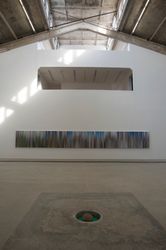
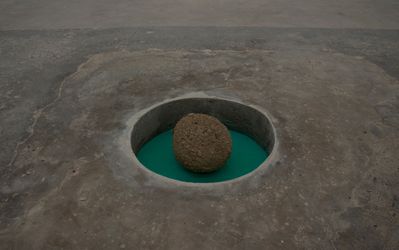
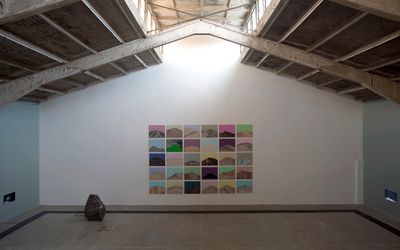
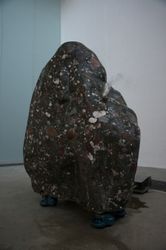
Nearly all the works contained in Zhuang Hui: Qilian Range resulted from his trips to the Qilian Mountains and were made between 2014 and 2016. The works displayed in the main exhibition hall at Galleria Continua can be understood as a microcosm of Zhuang’s experiences in the mountains. Qilian Range – 03 consists of thousands of photographs taken during all his various trips to the region, each photo compressed to just a few pixels wide - a visual representation of his entire project up to this point. In stark contrast to this compressed abstraction, Qilian Range – 08, consists of seven monitors each showing the footage taken from small cameras left in the landscape for days or even weeks, activated only by nearby movement. During the day, the animals that trigger the motion sensors are often invisible, overwhelmed by the weather inflected landscape. But by night the animals seem to take over in the ghostly negative night vision, suggesting the existence of another world. A group of 30 photographs of mountain peaks silhouetted against vivid monochrome skies make up Qilian Range – 11. For each of the 30 images, the unnatural color of the sky has been selected to bring out the particular texture and color of the landscape photographed, creating a complementary clash between artist and nature. In the middle of all these seemingly disparate elements there stands a lone rock, Qilian Range – 12; an amazingly smooth conglomerate rock blows out steam from holes like a parody of natural phenomenon.

Two videos dominate the second floor. They show Zhuang performing the act of ‘drawing from nature’ or perhaps ‘drawing nature’ itself. He is shown with his back to the camera, one video during winter and the other during summer. Nature has been Chinese artists’ primary model throughout its art history, but Chinese artists never painted directly from nature. Zhuang Hui’s painting performance emphasizes the predicament he faces as a Chinese artist making contemporary art. On the one hand he wants to establish a relationship with the landscape of his childhood in order to connect with a fundamentally Chinese idea of what it means to be an artist. But on the other hand that tradition has been lying dormant for nearly a century, buried deep beneath a complex history of cultural interaction.

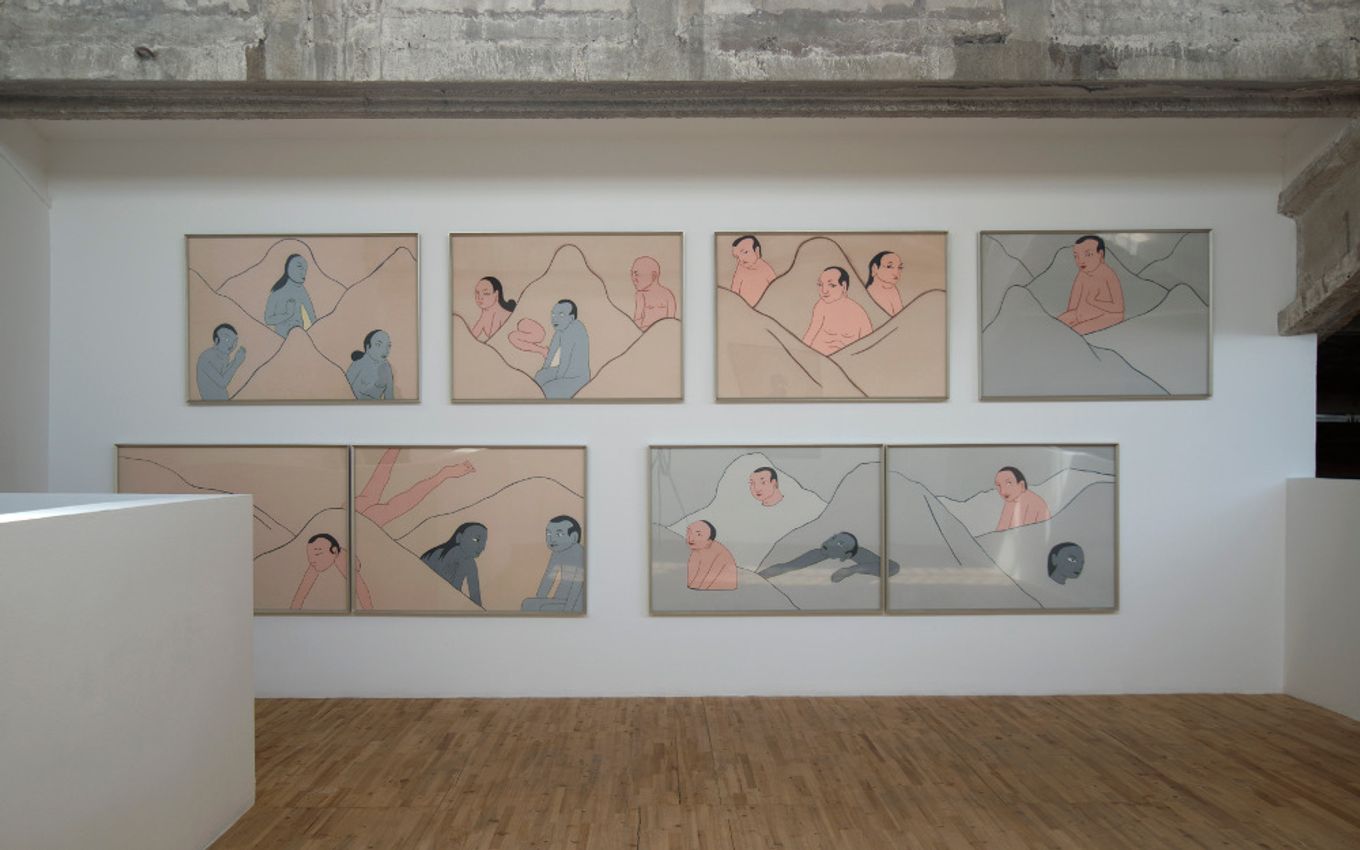
On the top floor of the gallery, Zhuang has added a personal homage to the strange indigenous culture of the region. Temple murals that he visited showed people and mountains of equal dimension, with people straddling mountain ranges as if sitting on a chair, or emerging out of a mountain like getting out of bed. The people of Qilian Mountains have a symbiotic relationship with their landscape to the extent that they have become indistinguishable from it, becoming a part of it. Zhuang has painted these murals using pastels on handmade paper, inserting his own image into their compositions, almost like one of his childhood dreams come to life.

The exhibition Zhuang Hui: Qilian Range is the first step in a long-term project engaging ideas of landscape. By spending six years simply observing and experiencing the Qilian landscape, Zhuang is gradually forming a personal connection with a part of his cultural heritage that has perhaps been lying dormant.


Zhuang Hui was born in 1963 in Yumen Town, Gansu Province, China. He left his hometown to study in Luoyang City at the age of thirteen and started to study painting by himself. In 1979, after graduating from high school, he became a worker at the state-run Luoyang No.1 Tractor Factory. During that period, he travelled extensively to experience first hand the many facets of Chinese society in transformation. In 1992 Zhuang Hui created his first major public art project Serve the People. In 1995, he started a series of works examining the roots of Chinese socialist class structure and his place within it, first with Thirty and One and also his most celebrated series of photographs - self-portraits with entire work units such army battalions, villages, or hospitals, comprising up to hundreds of people. With projects such as Longitude 109.88 E and Latitude 31.09 N, Zhuang expanded his examination of the transformation of Chinese society to larger socio-political issues, and with the photography project Ten Years he documented his own peripatetic and unconventional life. After 2000, Zhuang continued his portrayal of the troubled side of China’s economic development with a series of sculptural installations such as Chashan County and Factory Floor. In 2006, Zhuang Hui started working with Dan’Er, with whom he developed a number of projects including the Yumen Project for which they opened a photography studio in his hometown, creating a social portrait of the inhabitants of a city in decline. Zhuang started regularly visiting the Qilian Mountain range, and in 2014 started making work arising from the relationship he has formed with the landscape there, which has since developed into a longterm project.

During his engaged and fruitful artistic career Zhuang Hui participated in a number of exhibitions including Xi’an Art Museum (2015); Galleria Continua, Beijing (2014); Folkwang Museum, Bonn (2014); 9th Shanghai Biennale, Power Station of Art, Shanghai (2012); Today Art Museum, Beijing (2011); YUZ Museum, Jakarta (2010); Salt Lake Art Center (2009); The Groninger Museum, Groningen (2008); Tate Modern, Liverpool (2007); Galleria Continua, Les Moulins (2007); Galleria Continua, San Gimignano (2006); Haus der Kulturen der Welt, Berlin (2005); Kunstmuseum Bern (2005); Musée d’art contemporain de Lyon (2004); Centre Pompidou, Paris (2003); Deichtorhallen Hamburg, Hamburg (2002); Beyeler Art Museum, Basel (2001); Ghent Art Center (1999). He also participated in the 48th International Art Exhibition Venice Biennale (1999).

Installation Views

About the Gallery

It was in the year 1990 that three friends, Lorenzo Fiaschi, Mario Cristiani and Maurizio Rigillo, decided to open a gallery in a quite unexpected location, far from the big cities and smoothly running art circuits – in San Gimignano, a town steeped in history and somehow out of time, in the heart of Tuscany. Over these 25 years of activity, generosity and altruism have formed the basis for numerous and multifaceted artistic collaborations.

View Gallery Profile
Address
Dashanzi Art District 798 #8503,
2 Jiuxianqiao Road
Chaoyang District
Beijing
China
Opening Hours
Tuesday – Sunday,
11am – 6pm
(1)
Beijing Dashanzi Art District 798 #8503,, 2 Jiuxianqiao Road
Galleria Continua
Dashanzi Art District 798 #8503,, 2 Jiuxianqiao Road, Chaoyang District, Beijing, China

Opening hours
Tuesday – Sunday,
11am – 6pm
The art world in focus