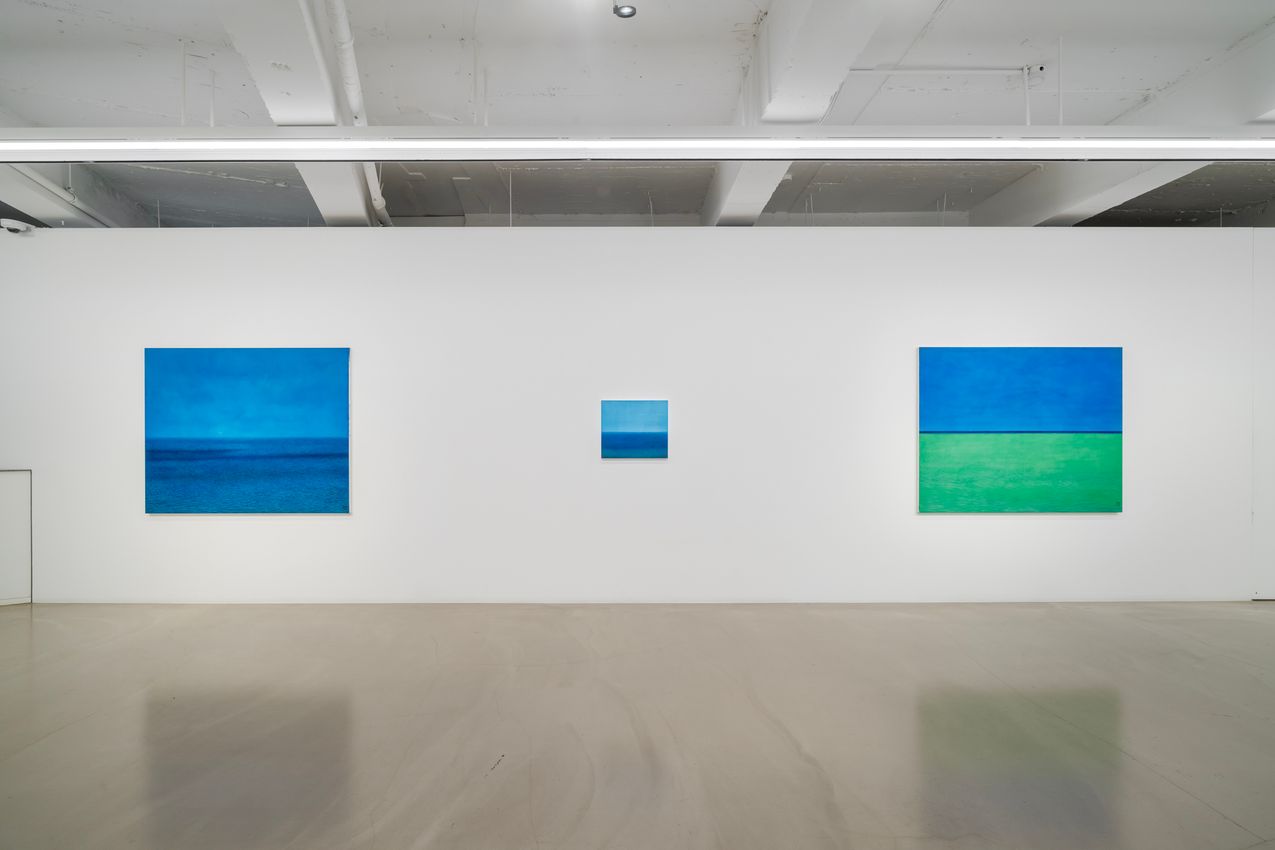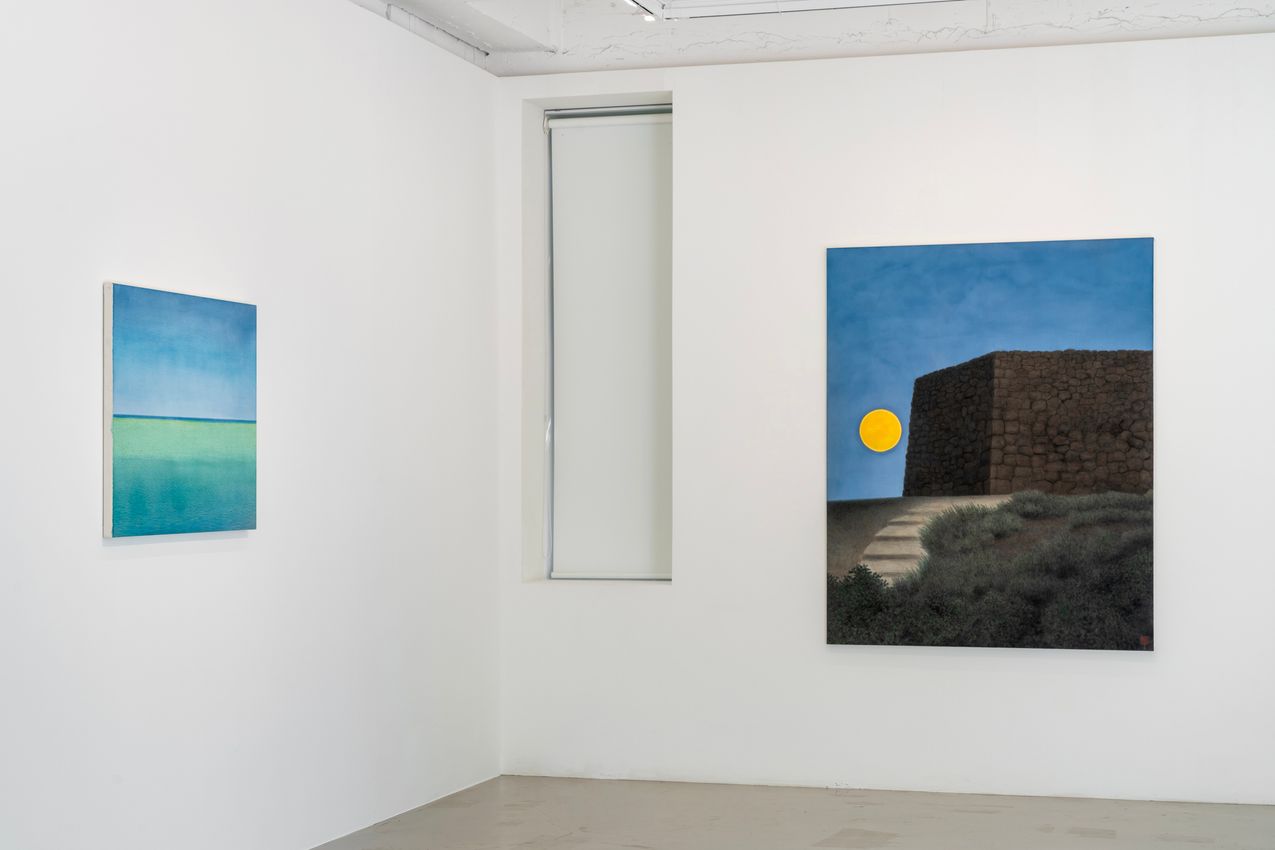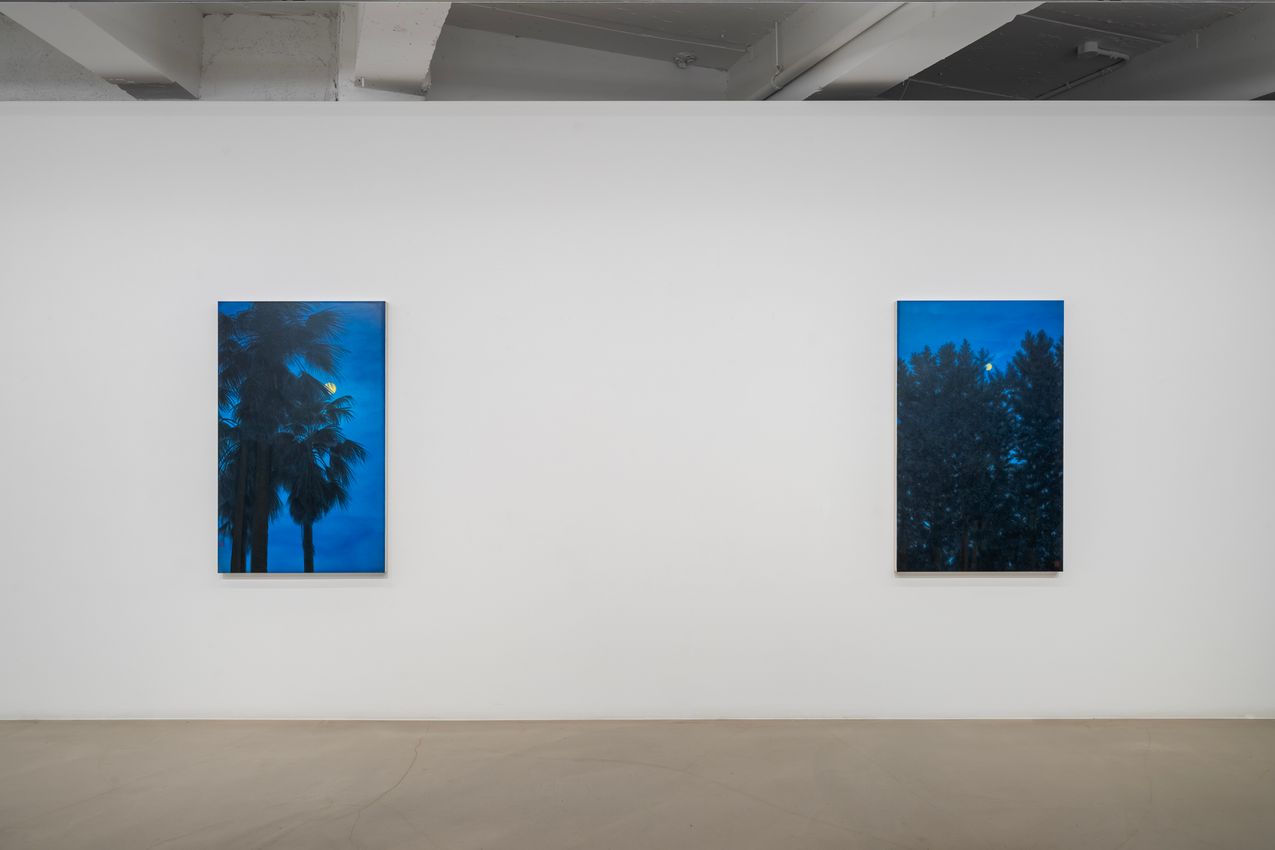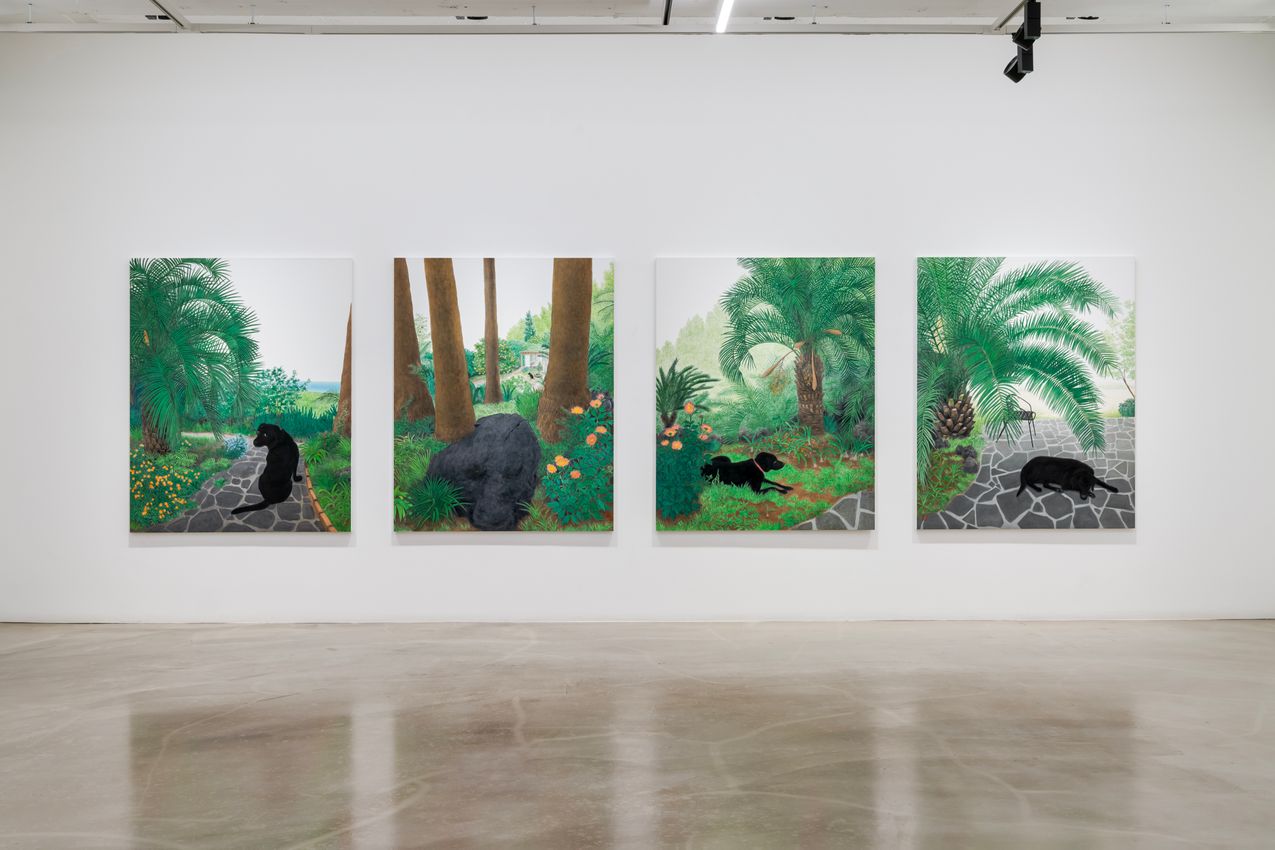
Gallery Baton is pleased to announce Towards, a solo exhibition of Kim Bohie (b. 1952) from 30 May to 1 July 2023 in Hannam-dong, Seoul. While her previous solo exhibitions at Kumho Museum of Art (2020) and Jeju Museum of Contemporary Art (2022), which attracted considerable attention from the public and critics, included the signature practice revealing her core philosophy, the exhibition at Gallery Baton consists of new paintings whose subjects are intimate and peaceful landscapes where Kim’s warm gaze stays upon, including the nature surrounding the artist’s studio in Seogwipo and her dog, Leo.
Kim Bohie, a prominent figurative painter, has constantly sought to bring contemporary sensitivity to Korean painting with her exquisite visual languages developed through extensive research and analysis of the traditional styles of Korean and Western paintings. Kim delicately conveys innocent and natural aesthetics closely observed in daily life, such as plants, gardens, seascapes, and surrounding sceneries in colour ink. Embracing the conservative composition and perspective of Western painting, she attempts to achieve an organic combination of each element in her work by accepting Eastern approaches that emphasize liveliness and harmony.
In her early phases, Kim focused on experimenting with diverse traditional painting techniques with coloured ink to depict landscapes, human figures, and still-life objects from a moderate and contemplative point of view. From the early 2000s, she steadily established a particular pictorial landscape called Kim Bohie-style dot painting by applying more colours to typical ink landscape paintings. The most evident tendencies in this stage were her experiments on possibilities in the bird’s eye view composition and the two-dimensional interpretation of landscapes; the investigation consequently made a new sort of extension in Korean traditional paintings.
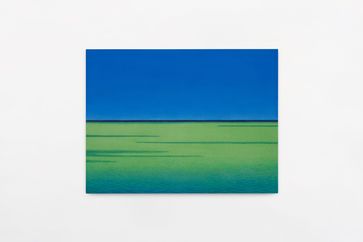
Since she settled in Seogwipo, Jeju island, her practice has faced a significant changeover period. At last, the natural and everyday features—a variety of tropical flora, the nearby promenades, the sky, and the horizon seen between palm trees—have gradually inhabited her green and blue dominant canvases. As the paintings produced in this period show an organic dynamic of familiar scenes and fragments that have accumulated in her memory for a long time, they can be acknowledged as a modern reinterpretation of JinKyoung Sansu, the Korean true-view painting style which prioritizes describing inherent characteristics of the nature, and the 18th-century European landscape paintings pioneered by John Constable (1776–1837).
Especially the ‘Leo’ series, displayed in the center of the gallery space, unfolds separate narratives of four different pieces despite the equivalent presence of Kim’s black Labrador Retriever, but at the same time, its four paintings share a connected scenery as their background. Although how she puts emphasis on the several postures of Leo resting in the close-range views and depicts nature with the broad spectrum of green towards the distant view is similar to the juxtaposition of the traditional Sansu Byeongpung (folding screen with a painting of landscape), her employment of exotic yet controlled colours and arrangement allows Kim Bohie-style landscapes to have more expanded external formats guaranteeing the sense of contemporaneity.
Take a look at Beyond (2023). Presenting a dense demonstration of the full moon beside a beacon mound of Sanbangsan Mountain is one of the new works which reveals Kim’s attitude as a truth-seeker who has committed to manifesting the aesthetical analysis and interpretation of a newly found target after a long-pending study on it in terms of technique and composition. The moon was often used as a temporal indicator for the night or a light source to assist in discerning the given scenes in pre-modern paintings, whereas, in this work, it plays a leading role in raising a surrealistic ambience over the transition moment when the sun’s influence is still remaining. Contrasted to the detailed description of the mound and the reed field in the lower section, the densely and regularly painted moon causes a certain acute tension, as though its surface barely managed to hold the overwhelming force and light emitting from the center of its yellow sphere.
Like the yellow plate functioning as a counterweight balancing one axis of the entire structure in Red and Yellow Vane (1934), one of the early mobiles by Alexander Calder (1898–1976), the moon seemingly defying the perspective, placed in the exact middle of the left half-part, successfully operates as a centripetal body ceaselessly drawing attention inwards and re-releasing it outwards within the canvas.


Kim Bohie, a prominent figurative painter, has continued to explore bringing modernity to Korean painting through her exquisite visual languages that she has developed while researching the traditional styles of Korean and Western paintings. Kim Bohie delicately expresses beauty and purity of nature closely observed in daily life such as plants, gardens, seas, and surrounding sceneries. Embracing the composition and perspective of Western painting, she continues to work on an organic combination of each element in her work by accepting Eastern approaches that emphasize vividness and harmony.
Since its founding in 2011, Gallery Baton has gained international recognition as a leading contemporary art gallery in Korea. Distinguishing itself with a dynamic and refined program, Baton consistently strives for an in-depth understanding of current paradigms within the complex and ever-changing landscape of contemporary art.

A respected voice in contemporary art discourse.
Focusing on ambitious storytelling and insightful art-world commentary. Ocula Magazine publishes in-depth interviews, critical essays and timely analysis on the artists, exhibitions and ideas driving the global art world.
Learn more about Ocula Magazine
Showcasing the best of the art world.
Ocula partners with galleries from around the world to highlight their artists, artworks and exhibitions. Gallery membership is by application and invitation, with each member vetted by an independent panel.
Learn more about Ocula Membership

Specialises in the sale of major artworks.
Led by a team with deep ties to the world’s leading auction houses, galleries and collectors. Ocula’s advisory team offers bespoke services to high-net-worth clients from around the world who are looking to acquire the best of contemporary and modern art.
Learn more about our team and services