Press Release

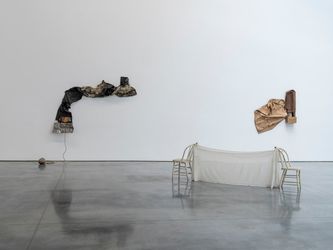
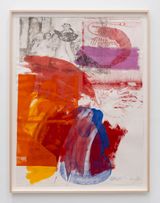
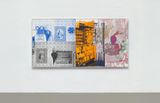
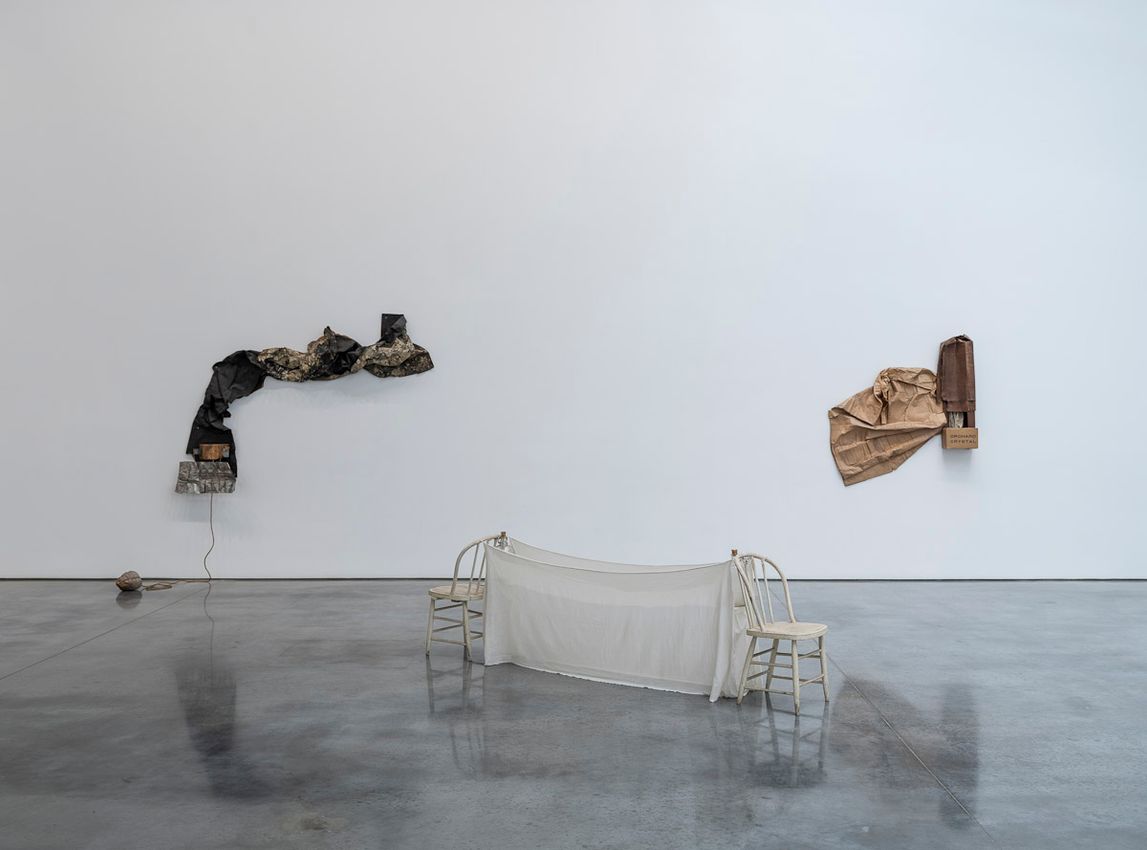
In collaboration with the Robert Rauschenberg Foundation, Gladstone presents an exhibition of rarely seen sculptural works from the height of Rauschenberg’s oeuvre. Spread across Gladstone’s Chelsea galleries, this show reveals Rauschenberg’s significant place in helping to define the history of post-Minimalist sculpture, seeing beyond what others decided should be the limits of art.

Rauschenberg (1925–2008) famously stated that ‘painting relates to both art and life,’ and he wished to work within the ‘gap between the two.’ For over sixty years, Rauschenberg traveled, collaborated with performers and artists, and worked through many subjects, mediums, and techniques to find and understand art’s meaning. Born in the small town of Port Arthur, Texas, Rauschenberg went on to serve in the US Navy. With the assistance of the GI Bill, he studied at the Kansas City Art Institute and the Academie Julian in Paris. In 1948, he enrolled at the highly influential Black Mountain College, where he studied under Josef Albers and communed with like-minded artists including his future wife Susan Weil, Cy Twombly, John Cage, and Merce Cunningham, whom he would go on to collaborate with in New York and around the world.

From the start, Rauschenberg was an artist who pushed beyond the traditional idea of working in a single medium. Reminiscent of his found-object Combines of the 1950s and 1960s, the ‘Venetian and Early Egyptian’ series blur the line between sculpture and painting, between waste and conservation, and between everyday objects and artworks. The exhibition at Gladstone will be one of the first focused exhibitions on these works since their debut at Leo Castelli gallery in 1972 and 1973.

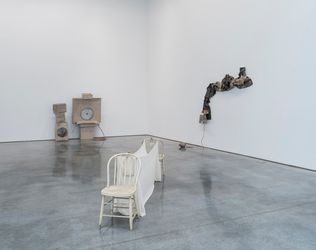
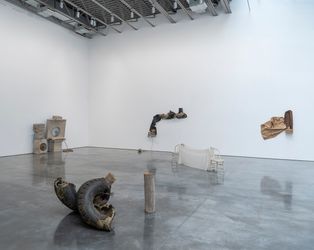
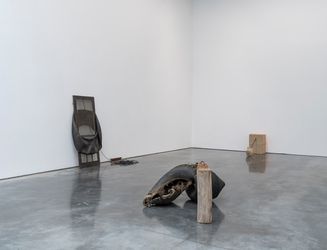
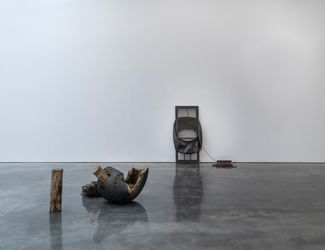
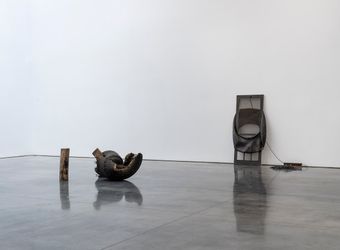
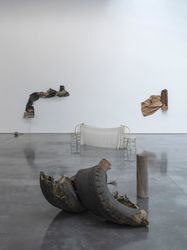
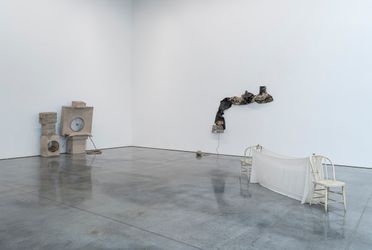
In 1970, Rauschenberg left New York City and relocated to the remote island of Captiva off the Gulf Coast of Florida, where he remained for nearly four decades. With the move came a new palette of readily accessible materials that embodied a shift away from motley urban density toward rural seclusion. On view are key works from Rauschenberg’s historic Venetian series (1972–1973). In the spring of 1972, Rauschenberg accompanied his dealer at the time, Ileana Sonnabend and her husband on a trip to Venice. While in Italy, Rauschenberg was struck by the juxtaposition of the city’s grandeur and elegance, in contrast to its concurrent fragility and decay. In the works on view, Rauschenberg uses the technique of assemblage, incorporating a range of household and natural found objects, from leather and rubber, to wood utility poles and tire treads, bringing them together in strange yet poetic formations. Immersing these common objects in an artistic dimension and following the Dada and Duchampian concept of the Readymade, these works function as a point between art, life, painting, assemblage, and everything in between.

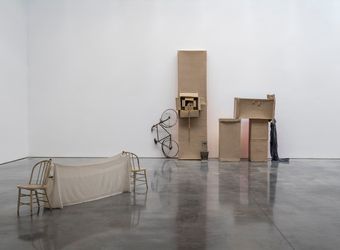
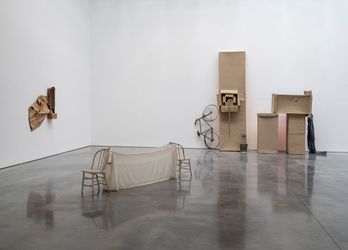
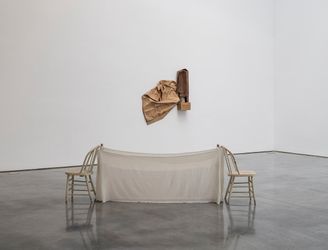
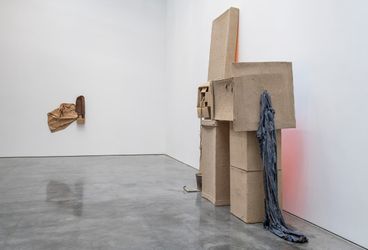
Inspired by the surroundings of his coastal studio, Rauschenberg made new bodies of work, including the Early Egyptian series (1973–1974). Radically different from his earlier practice, these works orchestrate the no color, neutral tonalities of sand, wood, bicycle wheels, and cardboard into ascetic opulence. While imageless, viewers still encounter signature Rauschenberg objects including repurposed furniture and the tire tread he made iconic. Reflecting on cardboard’s varied historical, cultural, and economic properties, Rauschenberg shrouded and transformed the material in the Early Egyptian series. Reminiscent of his Elemental Sculptures of the 1950s, these works play with the idea of trompe l’oeil, employing cardboard, glue, and sand as analogous to stone and sediment. In Untitled (Early Egyptian) from 1974, four large rectangular boxes standing side by side are all painted a bright, reflective orange on the back, casting a coloured glow on the wall behind. They are propped up by smaller cardboard boxes covered in sand, and bring to mind the Great Sphinx of Giza in form and composition. It in fact references a motif of four sun-worshipping baboons that once formed the pedestal for an obelisk in Luxor, now in the Egyptian collection of the Louvre, where Rauschenberg saw it and made this work in response. Engaging affordable and accessible material, Rauschenberg was able to create works that recall the great Egyptian temples, or in other cases, a towering angular mummy sarcophagus. Inspired by his interest in ancient Egypt, Rauschenberg transformed the cardboard material, which is associated with waste, consumerism, and labor, into luminous and precious artifacts, containers for nothing that recall so much of the past.

This exhibition is presented in cooperation with the Robert Rauschenberg Foundation. Two other gallery exhibitions coincide with Robert Rauschenberg: Venetians and Early Egyptians, 1972-1974 at Gladstone: Robert Rauschenberg: Exceptional Works, 1971-1999 at Mnuchin Gallery from May 3–June 11, 2022 and Robert Rauschenberg: Japanese Clayworks at Galerie Thaddaeus Ropac, Salzburg from April 8 - July 9, 2022.

Read More

Installation Views

About the Artist

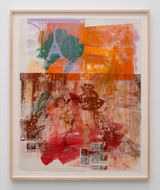
Perhaps best known for his mixed media ‘Combines’, Robert Rauschenberg was an influential American avant-garde painter, and multi-disciplinary artist. From the late 1950s to the early 1970s he pioneered conceptual and technical developments in painting and assemblage as well as a slew of other disciplines.

View Artist Profile

Also Exhibiting at Gladstone

About the Gallery
Gladstone is known for its commitment to artists whose prescient approaches and experimental practices have defined the contours of contemporary art. The gallery has long been an active partner in the cultivation of iconoclastic careers, fostering a roster of artists recognized for their ground-breaking contributions. Headquartered in New York and including outposts in both Brussels and Seoul, Gladstone’s impact extends globally, enabling both the presentation of new bodies of work, and an amplification of the international reach of its artists. Alongside its work with contemporary artists, the gallery is steward to the legacies of pivotal historical artists and serves as an advocate for the enduring power of art. Gladstone is led by a team of partners who spearhead its long-term vision and program, building on the values of its founder Barbara Gladstone.
View Gallery Profile
Address
530 West 21st Street, New York
New York
United States
Opening Hours
Tuesday - Saturday
10am - 6pm
(1)
New York 530 West 21st Street, New York
Gladstone
530 West 21st Street, New York, New York, United States
+1 212 206 7606
http://gladstonegallery.com

Opening hours
Tuesday - Saturday
10am - 6pm
The art world in focus