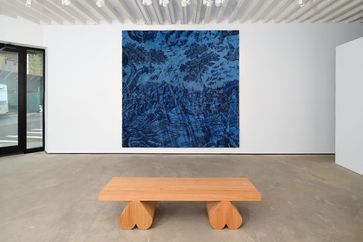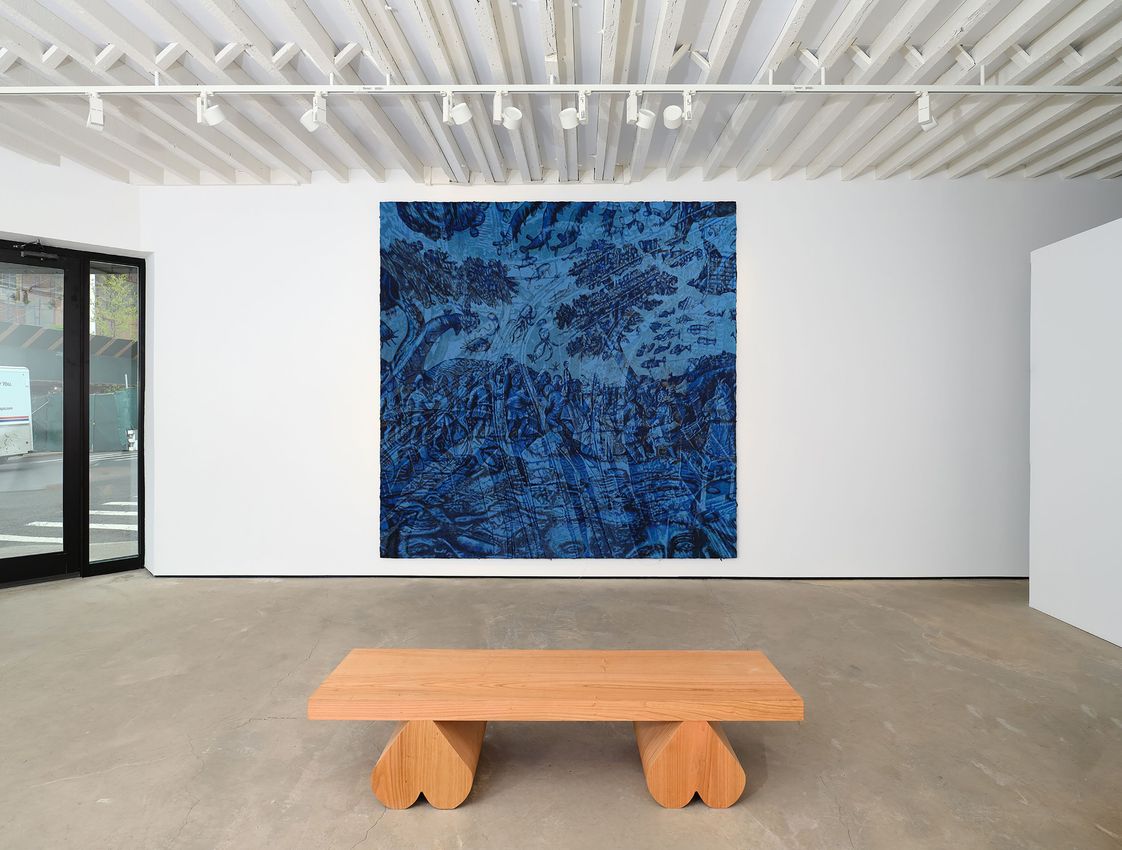
Adrian Schachter’s paintings are resolutely opened up to the world. His visual forms are arbitrated through the interplay of abstraction and found images. Schachter adapts William Burroughs’s literary style into the visual realm, with the writer’s revelatory cut-up techniques as clear precursor to the painter’s exploration and mediation of space. Complete images are broken down and repackaged with other forms, as Schachter traces the ways in which painting suffers ‘little deaths’ and reincarnations. He also absorbs the conceits of Jorge Luis Borges’s The Library of Babel, holding that life’s unknowability should be embraced rather than resisted. Schachter’s framework mimics the conceits and illustrations of this story, as he expands upon the notions set forth by Borges, submitting to the limitations of human understanding.
Schachter’s world is thus a customised one. His textures embrace those of Anselm Kiefer and Jack Whitten, while the content is culled from a mass of inspirations. Folklore and real histories intersect, eventually giving way to Schachter’s divination of a new reality. This personal spin on the way things go is rendered in collages of loose reproductions and invented imagery. Safety in numbers notably embraces Hendrik Hondius’s 1518 engraving Dancing Plague, Strasbourg, Alsace. 1518, which depicts a scene of crazed dancers who were driven into inexplicable delirium. This craze came to be known as ‘dancing plague,’ and was a periodic occurrence in medieval Europe. Hondius’s own work was itself inspired by one of Pieter Brueghel’s drawings and, as such, Schachter implicates himself in a particular lineage of representation.
A thoughtful relationship between foreground and background is of particular interest in Schachter’s practice, as he cultivates textural grit and well-honed content. The foundation of his compositions developed out of his ceramic practice, as he mines sculptural principles within a largely wall-bound medium. Schachter notably attaches ‘skins’ from drying paint to the surface of his canvases, forming them into peaks and valleys, then applying paint on top in service of the compositional structure. The line, however, is constantly blurred between the two. This is represented well in some faith where two suited figures cast a shadow against the composition’s background. This produces a blurring effect through which the overwhelming image is rendered concretely solely within the confines of the central bodies and is dissolved beyond the edges. This main image finds its referent in an anonymous image work depicting the 1212 Children’s Crusade, an event led by a young boy attempting to spread the word of God throughout Europe, assembling a group of children to do the same. These young people made their own reality, completely abandoning former belief systems and pushing past the limits of conceivable truths. Schachter mirrors this teleological excursion in his artistic output, as he continues to establish new ideas about truth and storytelling.
One can easily get lost in the fields of representation and abstraction, and between the different grounds. Schachter utilises his robust inventory of reference points to prompt the AI machine, DALL·E, which then churns out a completely new visual framework. The alliance of artist and machine is a collaboration that provides painting with future viability, as new tools infuse the medium with potential. Just as Francis Picabia indoctrinated photography - a new technology at the turn of the 20th century - in his ‘transparencies,’ Schachter instills his body of work with a concern for the future. The integrity, however, is maintained through reverence for tradition. Schachter uses aquazol, mimicking the quality of egg tempera as a move to further inscribe the work with classical elements.
For this new series of paintings Schachter employs a largely monochromatic palette as a move to invest more weight in the linework. The relationship between content and concept emerges from his mode of building one image out of another, and the establishment of a new order out of preexisting fragments. He develops this particular language through the intermix of different stylistic passages and material grit. These are what Schachter refers to as “slow paintings,” due to their expansiveness. The viewer must navigate in and around discernable parts and forms, experiencing fields of color alongside detailed formal agendas.
Adrian Schachter is a painter and ceramicist who researches mythology, obscure phenomena, and anomalies to challenge the notion of absolute truth beyond the boundaries of conventional reality. He is particularly interested in the Medieval era, when religious and esoteric beliefs overshadowed the influence of science. For over two years, Schachter has employed Artificial Intelligence (AI) tools, deepening his exploration of unconventionally gathering and understanding information. While embracing new technologies, Schachter upholds the integrity of his craft by referencing and drawing inspiration from history. Schachter has a BFA from the School of Visual Arts (SVA), New York.
A respected voice in contemporary art discourse.
Focusing on ambitious storytelling and insightful art-world commentary. Ocula Magazine publishes in-depth interviews, critical essays and timely analysis on the artists, exhibitions and ideas driving the global art world.
Learn more about Ocula Magazine
Showcasing the best of the art world.
Ocula partners with galleries from around the world to highlight their artists, artworks and exhibitions. Gallery membership is by application and invitation, with each member vetted by an independent panel.
Learn more about Ocula Membership

Specialises in the sale of major artworks.
Led by a team with deep ties to the world’s leading auction houses, galleries and collectors. Ocula’s advisory team offers bespoke services to high-net-worth clients from around the world who are looking to acquire the best of contemporary and modern art.
Learn more about our team and services