Press Release

Green Art Gallery is pleased to present Domestic Compositions, a solo exhibition by Kamrooz Aram, opening on 16 November 2025.

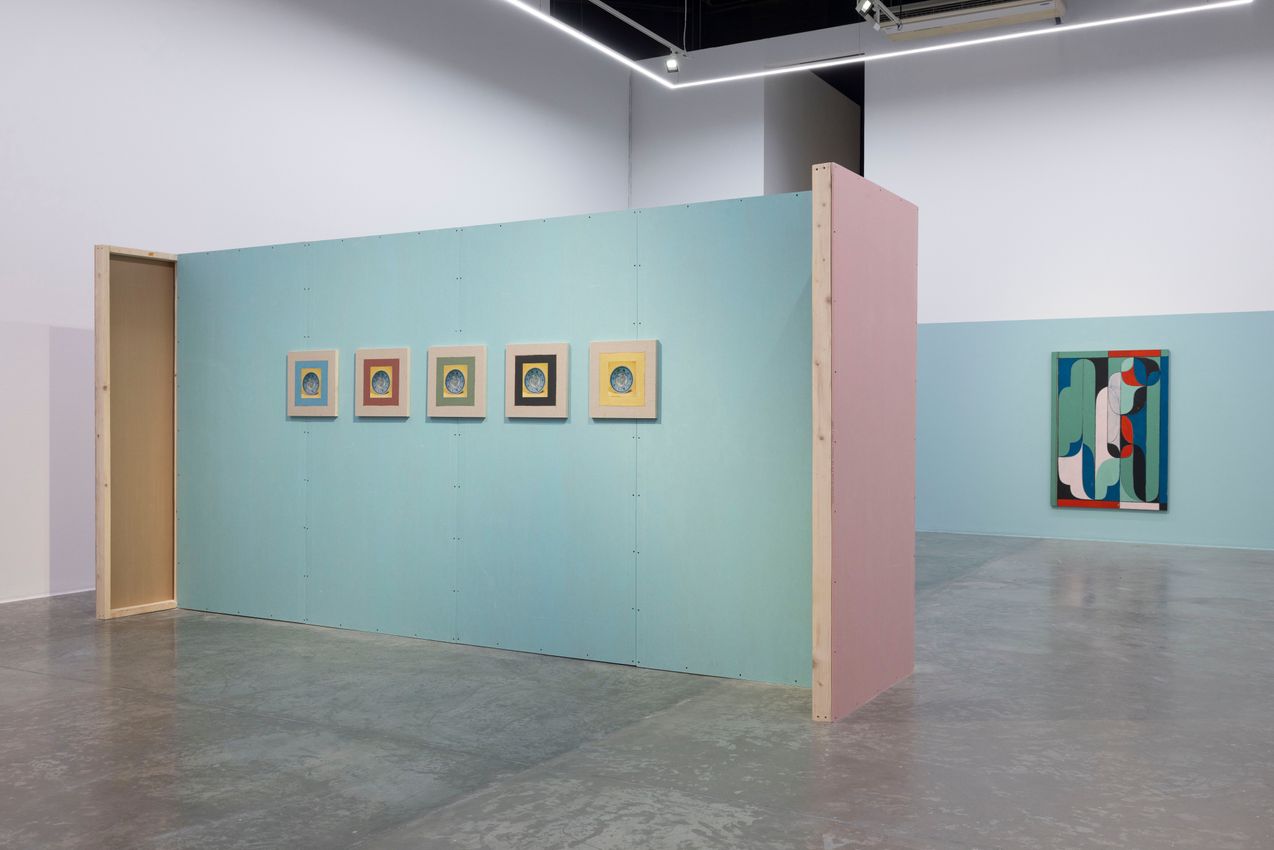
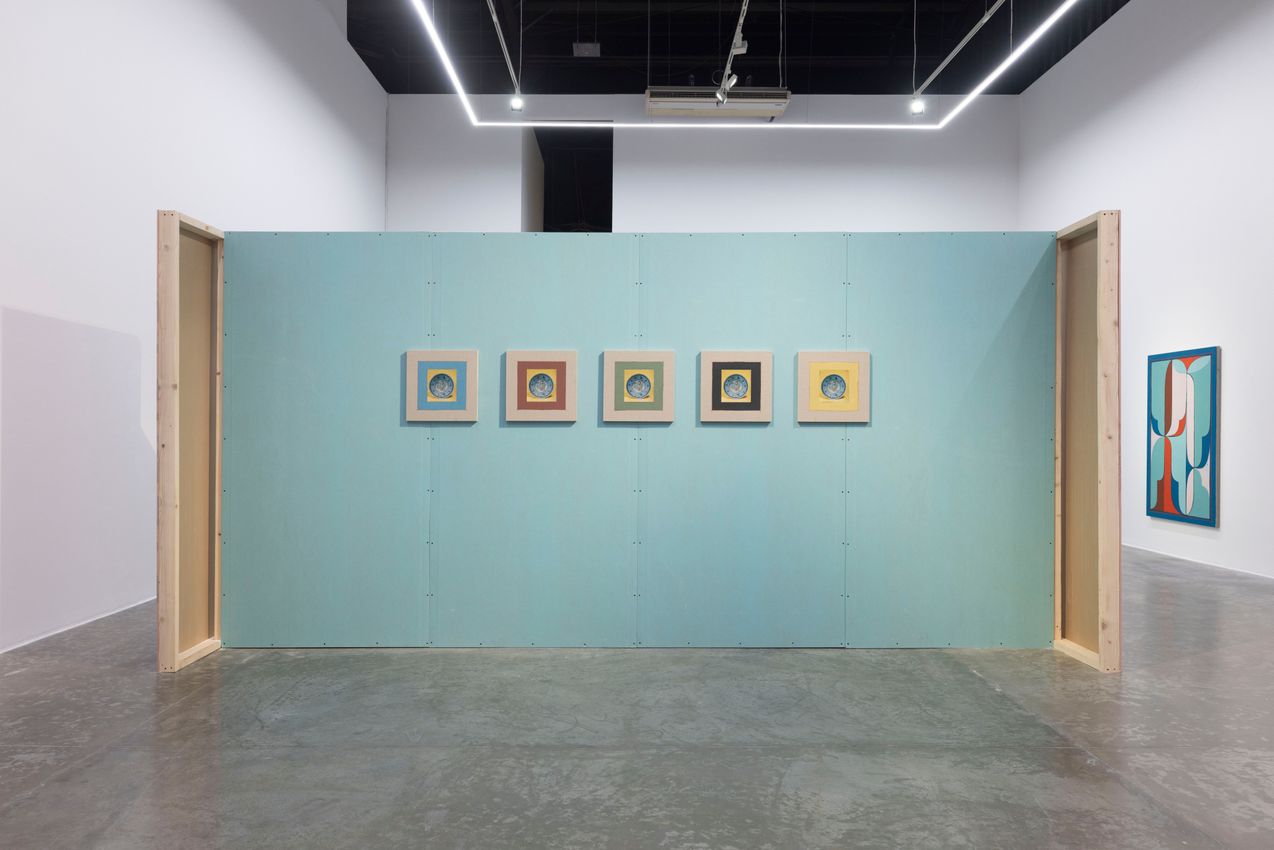
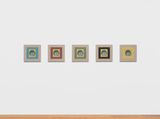
At the centre of five collages, hanging in a row and each containing nested squares of colour, is a repeated photo reproduction. The image depicts a turquoise ceramic bowl, on which a painted central figure plays a lute, while, fringing the figure, an audience of figures appears in cloud-like vignettes composed of freehand lines. The photo is in turn framed by a painted square which is rimmed with a thin red pencil line, drawn with alacrity. Beyond the red line appears an open linen surface.

Zooming into this primary document, the photograph captures a colonialist indexical logic, one that artist Kamrooz Aram re-orders in his own way. The photo is the kind of color plate typical of Western art history books from the mid-to late 20th century, part of a decidedly Western taxonomy of museological and cultural representation–its own kind of artifact. In making this series, Aram excised the photo of the bowl from several copies of a publication he deliberately does not name. In his collage works, the artist uses images from his collection of books documenting Iranian art, with the rule that they must have been published before 1978, the year that Edward Said’s Orientalism was published, engendering the field of Postcolonial studies and offering a clear epistemic and paradigmatic before-and-after.

In Variations on Turquoise Bowl, 2025, Aram systematically isolates a color from within the photo reproductions, and in each instance, paints the square border to match it. The colour of the photograph will be survived by the painted square as the printed book page will fade more quickly over time. The relative vibrancy of the paint over the reproduction speaks to the primacy of the bowl. It alludes to the exhaustion of the larger colonialist rubric, from which follow museums and acquisitions and, only eventually, the object itself, trafficked alongside other antiquities in the museum halls. To quote Edward Said in the opening of his discourse, ‘Orientalism, therefore, is not an airy European fantasy about the Orient, but a created body of theory and practice in which, for many generations, there has been a considerable material investment. Continued investment made Orientalism, as a system of knowledge about the Orient, an accepted grid for filtering through the Orient into Western consciousness...’ (Orientalism, p.7) A simple internet search reveals that the bowl is held in the Metropolitan Museum of Art’s Islamic art collection, catalogued as ‘Turquoise Bowl with Lute Player and Audience, from late 12th–early 13th century.’

Variations of colour and echoed shapes radiate from the centre of each composition and then vibrate down the line. Notably, in his collage series, Aram also cleverly nods to Joseph Albers’ Homage to the Square and in that allusion, indeed, points to entire art histories that have been counterposed—namely Eastern aesthetic traditions and Western modernism. Pitted into binary oppositions of value, and above all constituting a devaluation of Eastern and African aesthetic innovation at the hands of Western modernism’s narratives of innovation, individualism, and neutrality. If the invention of European Modernism depended on the appropriation of those cultural traditions which preceded it, we realise that in Aram’s compact framing device he has diagrammed a whole system not only of formal and color relations, but of the cultural scripts and power imbalances that produced these photo-derivatives.

In his dramaturgy of depictions of ‘heritage’ artefacts and art histories as they collide with the presence of paint, carefully mixed colours enframe the photo: lamp black, butter yellow, a dusty green closely resembling sage, terracotta, and the iconic turquoise blue associated with Persian pottery. As the final element to Aram’s collage squares, the eyes arrive at the red perimeter line surrounding the painted square. It is a threshold, a virtual edge, a clue to the collages’ making.

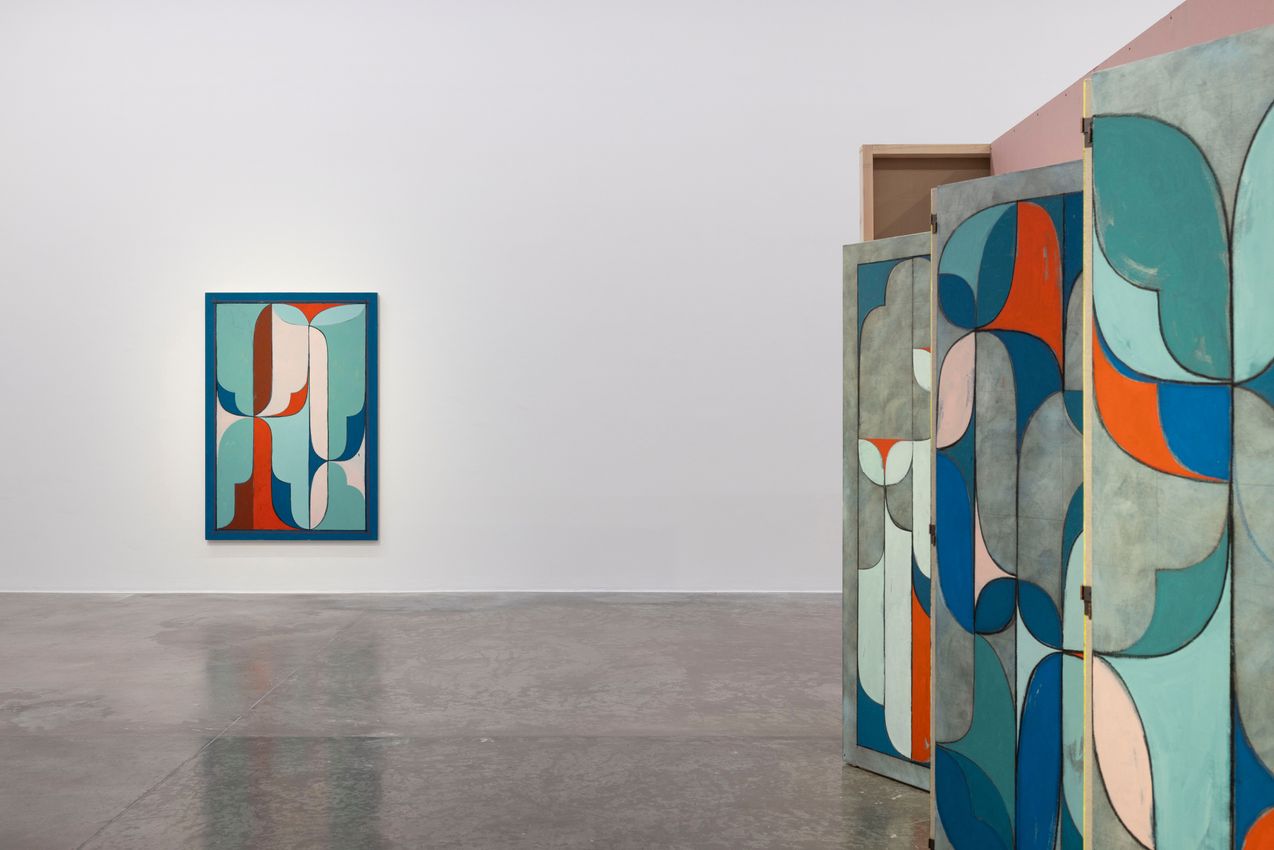
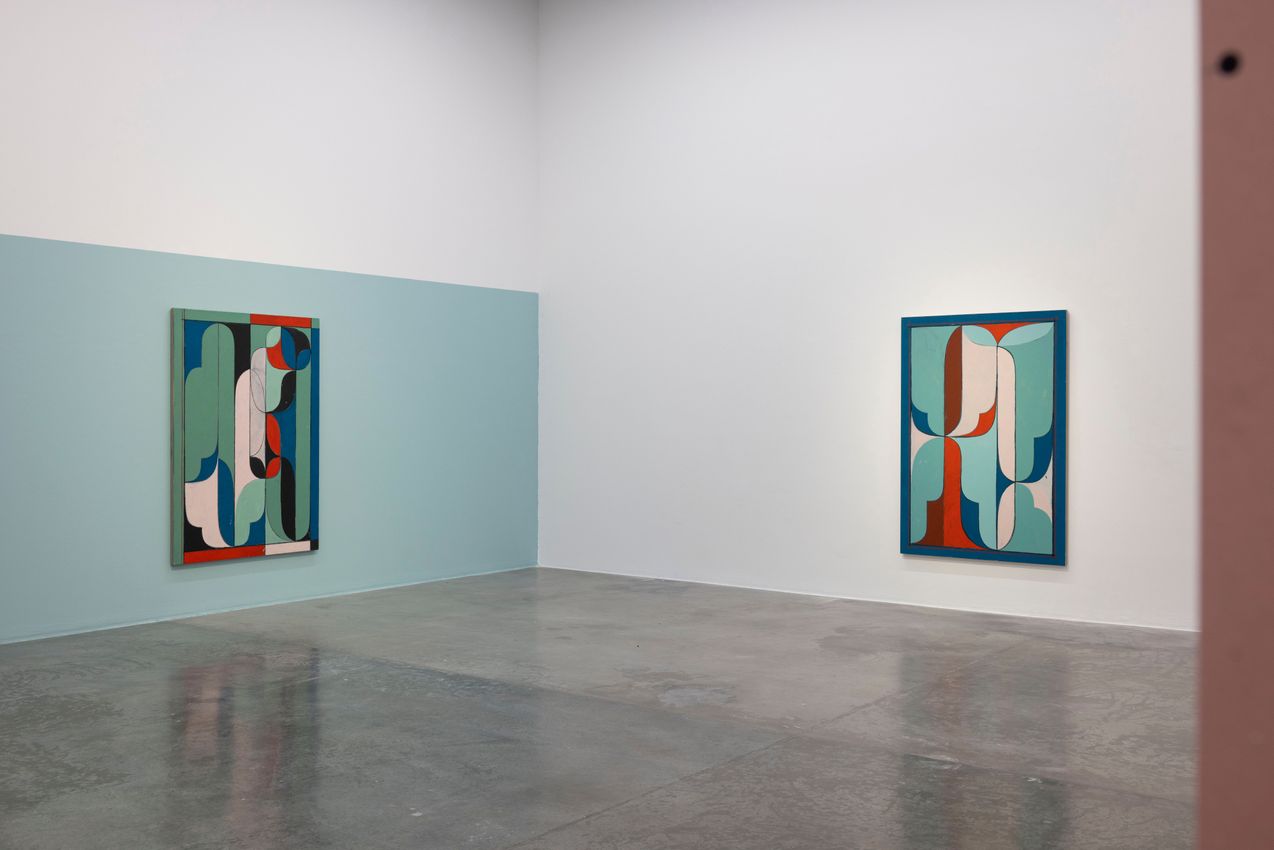
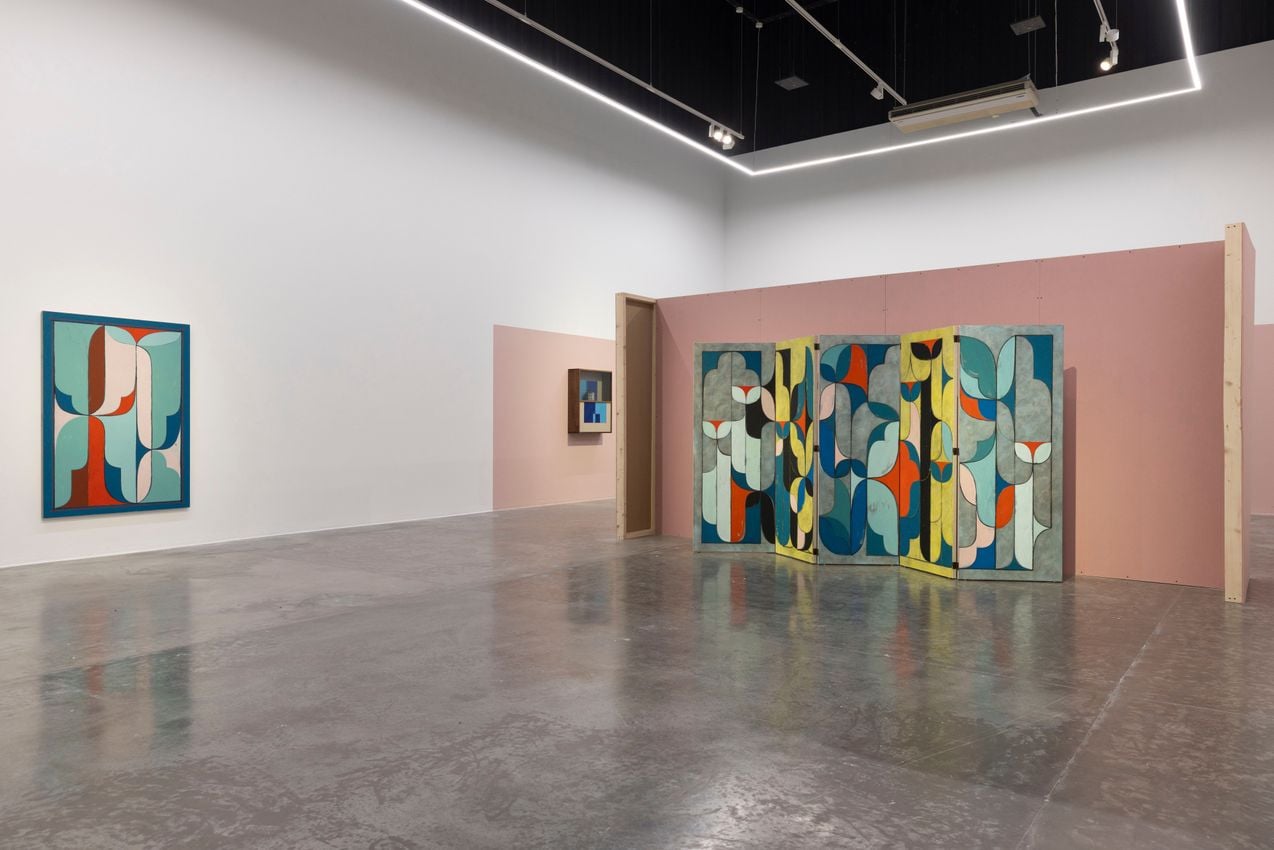
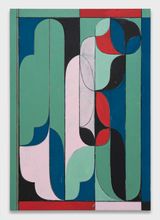
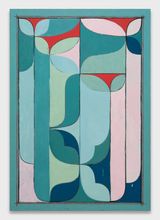
That same red line reemerges in the three paintings featured in this exhibition, a key to the artist’s practice of building up a surface of interrelated shapes. Aram begins in these paintings to rehearse and invent morphologies of the ‘arabesque’, a nomenclature pretending to neutrally describe a stylistic affinity to floral and botanical pattern but freighted with cultural stereotype and generalisation. He outlines a grid in pencil on linen and begins to draw curvilinear edges and lines with oil crayon, creating shapes that are erased, redrawn and syncopated as layers of color are laid down. The grid serves as a scaffold to the image, one which dips in and out of view, oscillating between embedded logic and emergent visual presence, between scumbled areas of colour and transparent underpaintings and drips as a palimpsest reveals the inner workings and vestiges of a process.

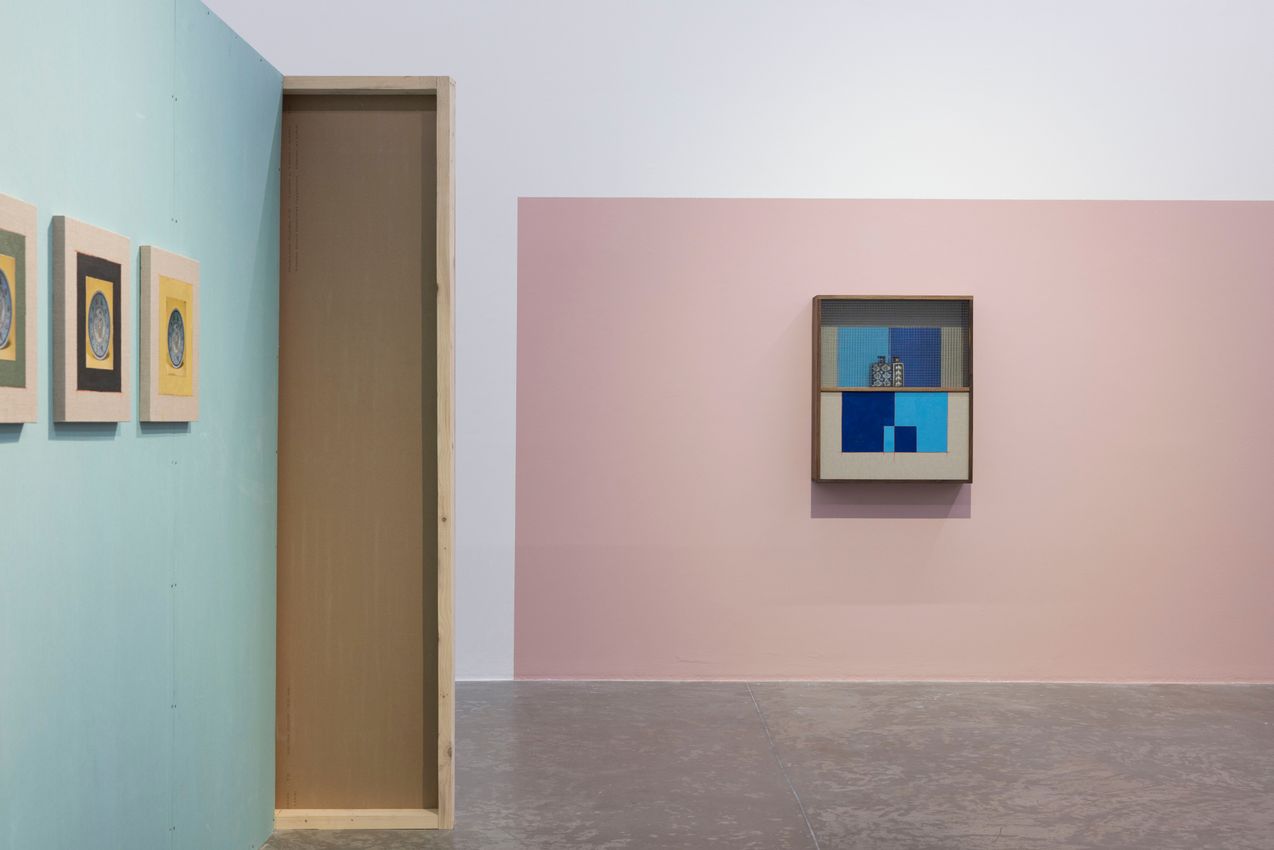
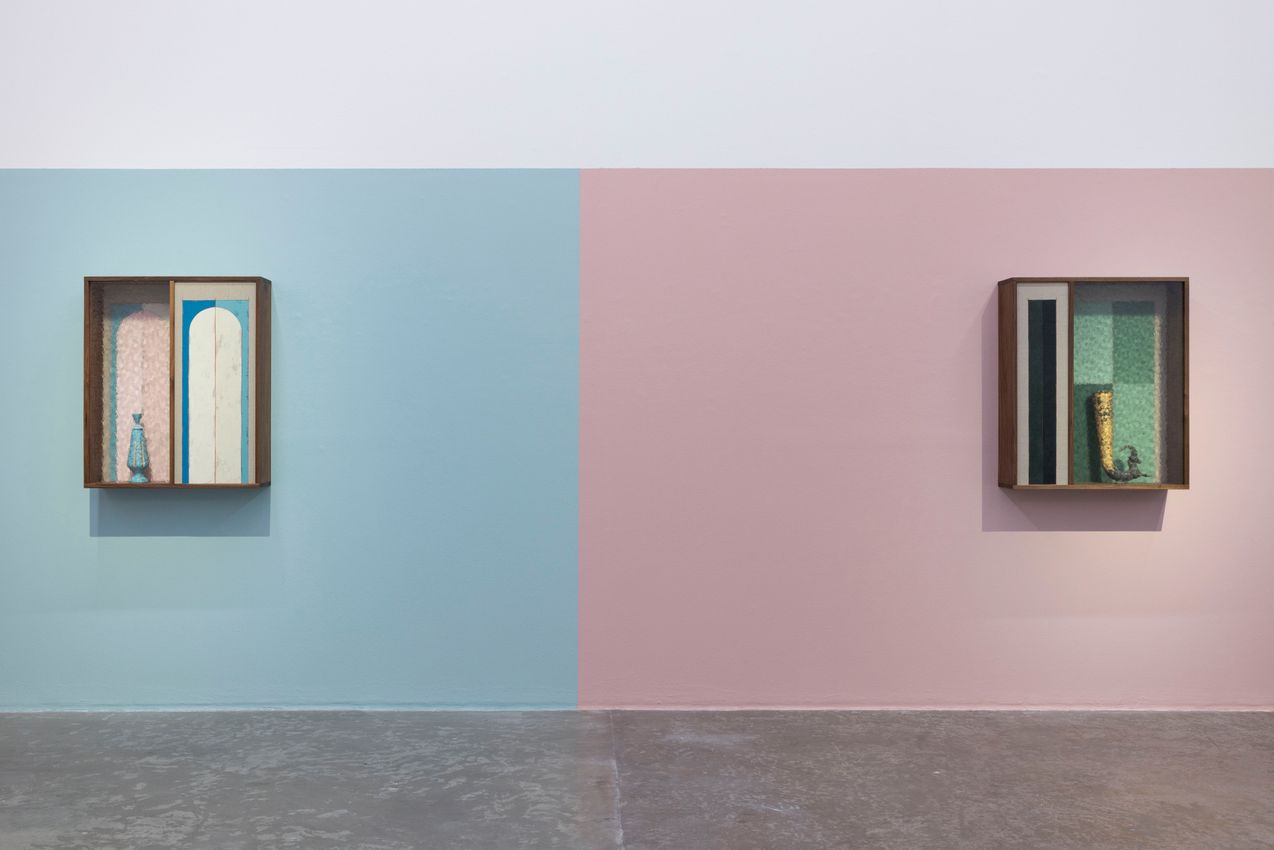
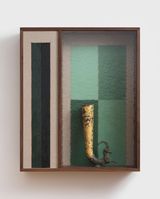
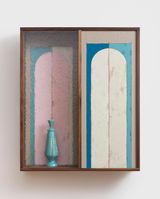
While cultural artifacts, photographs and linear elements all project an authority of knowledge, Aram blurs edges further and complicates any facile reading that would leave behind the subjective and sensual dimension of the unconscious, of desire. His Domestic Compositions, hybrid sculpture-paintings, also double as display furniture holding some of the artist’s collected objects. Here too, Aram works with the vernacular of geometric shapes, consisting of painted arabesque motifs on linen, wood, and these collected objects, now in three dimensions. He then partially obfuscates his collected artifacts behind a screen of textured architectural glass. At times the objects are placed on the shelf without the glass filter, in relation to painted backgrounds in the square of the shelf, but the viewer is consistently unable to see the object contained therein in the round, a frustration of desire.

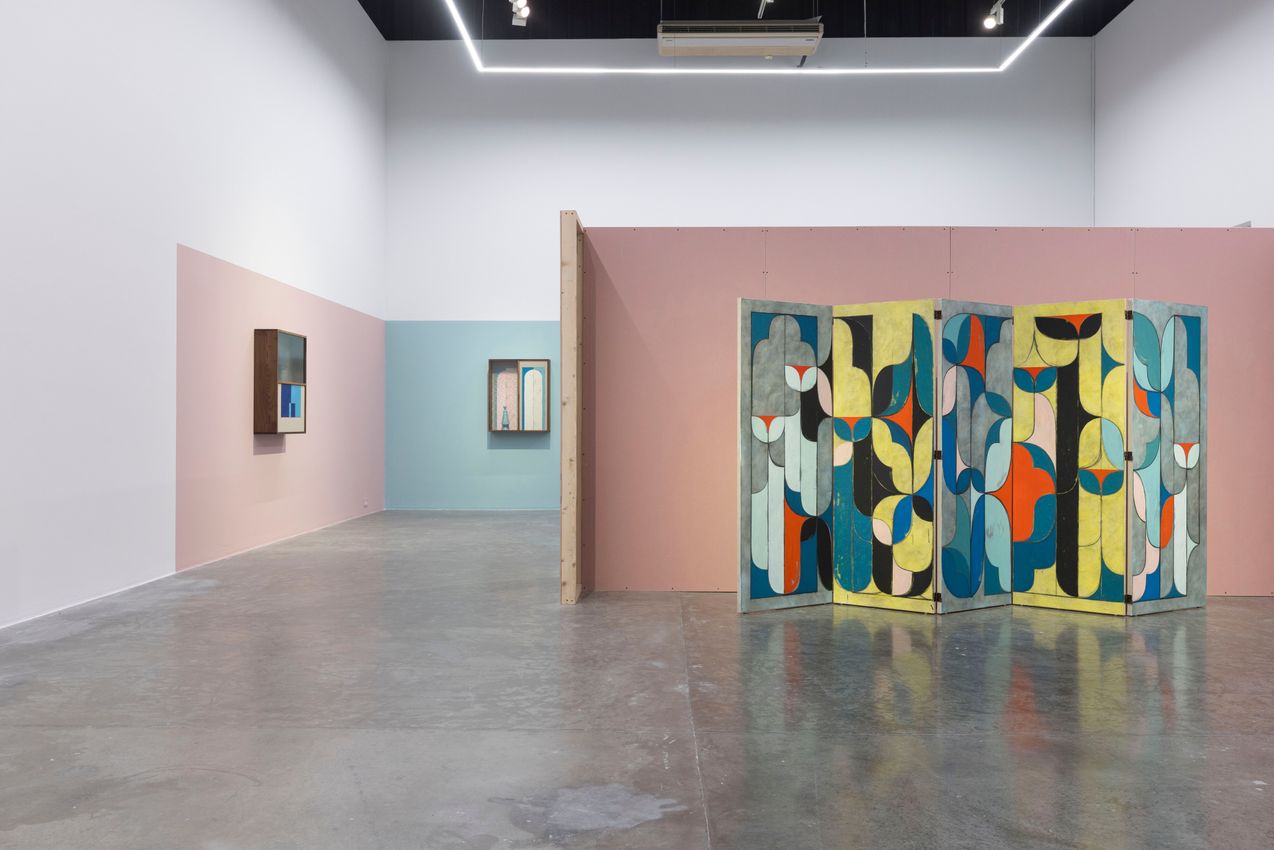
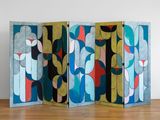
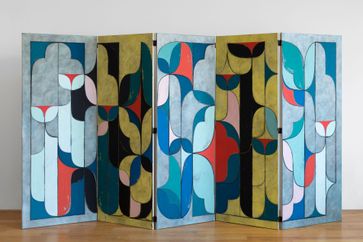
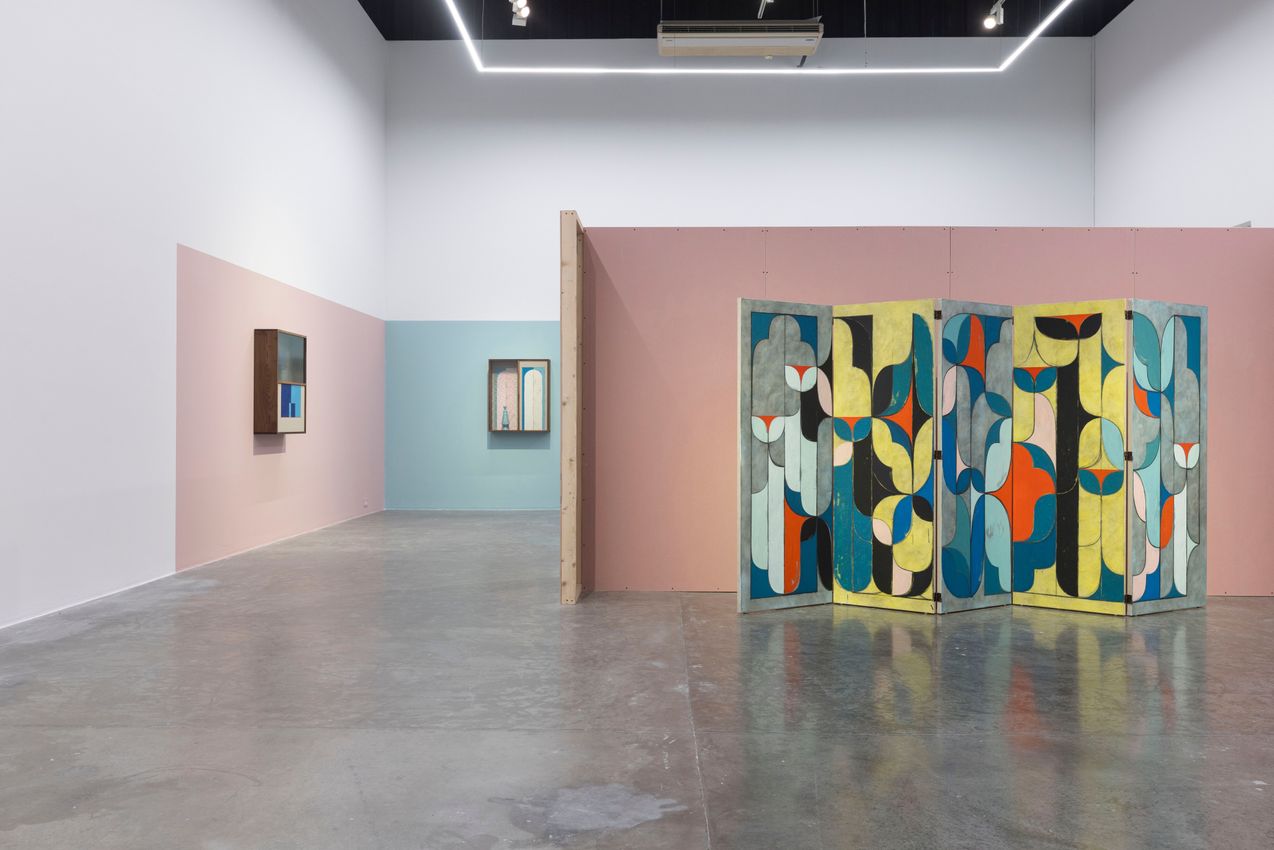
Aram’s final work in show is another multiform object: a painted paravent, an accordioned series of five hinged, painted panels referencing domestic screens and partitions. Alternating two colorways of paintings, three panels, consisting of cool hues of blues, black and grey with pinks and reds hold one spatial plane. Two panels of yellow, black, green and red cut across another plane. The modulation of these angled, patterned, and variously colored compositions seem to exaggerate the effects of recession and projection. The optical effects of the painting fold in space, collapsing differences between domestic function and public display.

Panning out finally to the gallery space, we see how Aram takes keen interest in histories of exhibition design and mediation, working to recuperate overlooked aspects of cultural and knowledge production by activating walls, floors, creating scrims, pedestals and spatial colour programs. His final dramaturgy is the orchestration of art with the built environment surrounding it. In this show, the exposed seams of a sheetrock wall, the pale greens and pinks of the construction materials refer to the paintings hanging, zigzagging on the floor and extruded from the wall. A set of relational practices reverberate in the space, organised by colour, memory, time.

For Josef Albers’ lucid, diagrammatic, and visually exhilarating Homage to the Square his contribution was showing how colour is inherently relational, defined by adjacency and interdependence, not negation. This is as close to a politics as I imagine colour theory can provide: sovereign, yet interdependent particles vibrating with each other, redefining each other. With some critical additions: for Aram, colour is also culturally specific and geographically local in its materiality (he has used lapis lazuli pigment in some of his compositions); colour is a medium of aesthetic pleasure, an engine of mood and atmosphere that is not only bounded by the canvas, and that can be arrayed on the walls, plinths, pedestals and shelves which support objects, so as to alter the architectural environ. In Aram’s holistic approach to artmaking that integrates sculpture, painting, and architecture, he creates a context for viewing cultural artefacts anew, bringing them back into the circulation of our vibrating, living present. There is a reciprocity between each element in this system of relations. Call it interdependence or kinship; call it an incantatory solidarity.

—text by Cora Fisher

Read More

Installation Views

About the Artist

Kamrooz Aram’s work is rooted in the history and practice of painting, which he expands to include collage, photography, sculptural works and exhibition design. His work engages the complicated relationship between Modernism and ornament, often with reference to non-western ornamental art, which he sees as a parallel to painting. Aram’s work sets out to renegotiate the art historical hierarchy that places these ornamental artforms in a category of value beneath fine art.

View Artist Profile Kamrooz Aram contemporary artist
About the Gallery

Green Art Gallery is a contemporary art space featuring a multi-generational mix of artists whose practices are rigorously researched, idea-led, and representative of our current moment. The gallery now represents a multi-generational mix of artists from the Middle East, North Africa, South Asia and beyond, including Turkish artists Hale Tenger and Hera Büyüktaşcıyan; Iranian artists Kamrooz Aram and Nazgol Ansarinia; and Shadi Habib Allah, Seher Shah, and Alessandro Balteo-Yazbeck, who are Palestinian, Pakistani and Venezuelan respectively. In this geographic mix, the gallery reflects Dubai’s position as a cosmopolitan—as well as artistic—entrepôt, even as it boasts of a strong parallel Arab Modernist program.

View Gallery Profile
Address
8 17th Street, Al Quoz
Alserkal Avenue, Unit 28
Dubai
United Arab Emirates
Opening Hours
Saturday – Thursday
10am – 7pm
(1)
Dubai 8 17th Street, Al Quoz, Alserkal Avenue, Unit 28
Green Art Gallery
8 17th Street, Al Quoz, Alserkal Avenue, Unit 28, Dubai, United Arab Emirates
+971 4 346 9305
http://www.gagallery.com/

Opening hours
Saturday – Thursday
10am – 7pm
The art world in focus