





MARK BRADFORD
b. 1961, United StatesMark Bradford is a world-renowned American contemporary artist best known for his monumental abstract paintings and installations, which fuse discarded urban debris and paint into dense, map-like surfaces that probe the sociopolitical structures of race, class, and gender in urban America.
Working across media from painting and collage to video, he draws inspiration from his surroundings often using materials such as billboard posters, street signage, and end papers from his mother’s hair salon to create layered compositions that hover between abstraction, mapping, and political and social commentary. He is widely recognised for works including Black Venus (2005), an early breakthrough painting that weaves beauty-salon materials and merchant posters into a densely collaged field, and Helter Skelter I (2007), a vast, map-like canvas in the collection of The Broad in Los Angeles. His work has been presented in major solo exhibitions at institutions such as Hamburger Bahnhof – Nationalgalerie der Gegenwart in Berlin and shown internationally by representing galleries including Hauser & Wirth. Bradford’s honours range from the 2009 MacArthur ‘Genius Grant’ to representing the United States at the 57th Venice Biennale in 2017.
Early life and Career
Bradford’s art practice is closely tied to his own history as a Black artist from Los Angeles. Born in South Los Angeles in 1961, he spent much of his childhood in his mother’s beauty salon, Foxy Hair, in Leimert Park, a historically Black neighbourhood whose social life continues to shape both his materials and his community-focused projects. His adolescence unfolded against the background of the AIDS crisis, the crack cocaine epidemic, and rising violence and policing in the city, sharpening his sense of how race, class, and health structure everyday experience. After high school, he worked in the salon, immersed himself in nightclub and drag cultures in Los Angeles and travelled to Europe, before enrolling at the California Institute of the Arts (CalArts), where he completed a BFA in 1995 and an MFA in 1997 under the mentorship of Conceptual artist Charles Gaines.
Relationship with Art History
At CalArts, Bradford was drawn to Abstract Expressionism, and critics have noted how his accumulations of found material echo Robert Rauschenberg‘s Combines, how his heroic, all-over canvases recall the scale and energy of Jackson Pollock‘s drip paintings, and how his inscribed, scarred surfaces suggest Cy Twombly‘s graffito-like marks; yet his skepticism about painting’s supposed purity ultimately led him toward the materially dense, socially grounded abstraction that defines his mature practice.
Materials and methods of Social Abstraction
On his solo show Thievery by Servants (19 February–4 April 2026) at Lévy Gorvy Dayan in New York, Bradford remarked, ‘I want my materials to actually have the memories—the cultural, personal memories that are lodged in the object. You can’t erase history, no matter what you do. It bleeds through’.
For his materials, Bradford mainly draws from the streets that surround his South-Central Los Angeles studio, using posters, flyers, and other street signage reflective of local economies for his large-scale collages. In Daddy, Daddy, Daddy (2001)—in the collection of the Solomon R. Guggenheim Museum—layers of scorched permanent-wave end papers and hair-dye cellophane create an irregular grid where translucent colour suggests intimacy and nostalgia, while the burned beauty materials and obsessive, manual process recall the pressures of imposed beauty standards and connect to Bradford’s own history and the politics of Black hair. Calling his work a form of ‘social abstraction’, he positions it between art history and everyday life, transforming common ephemera into reflections on how Black and other marginalised communities experience space, power, and erasure.
Bradford’s signature large-scale canvases are built through an additive and subtractive process: sheets of printed paper are glued, sanded, cut, and peeled or pulled back (often using embedded rope) to create multi-layered, topographical surfaces that can resemble aerial maps, weather systems, or scarred ground. Viewers encounter fragments of typography, grids, and colour fields that allude to city streets, maps, or redlining-inflected zones of conflict, making the paintings read simultaneously as abstract fields and as documents of social and historical forces. Scorched Earth (2006), held at The Broad in Los Angeles, exemplifies his approach: its dark, cratered surface responds to the 1921 Tulsa Race Massacre, with layers of paint and paper scraped back to evoke both burnt architecture and the erasure of Black histories from public memory. In Pickett’s Charge (2017) at the Hirshhorn Museum and Sculpture Garden, Bradford reworked reproductions of Paul Philippoteaux’s 19th-century cyclorama of the Battle of Gettysburg, cutting, collaging, and overpainting the images into a continuous, immersive frieze nearly 400 feet long that turns a heroic Civil War narrative into a fractured meditation on truth, representation, and the persistence of conflict.
Bradford’s Monumental Site-Responsive Projects
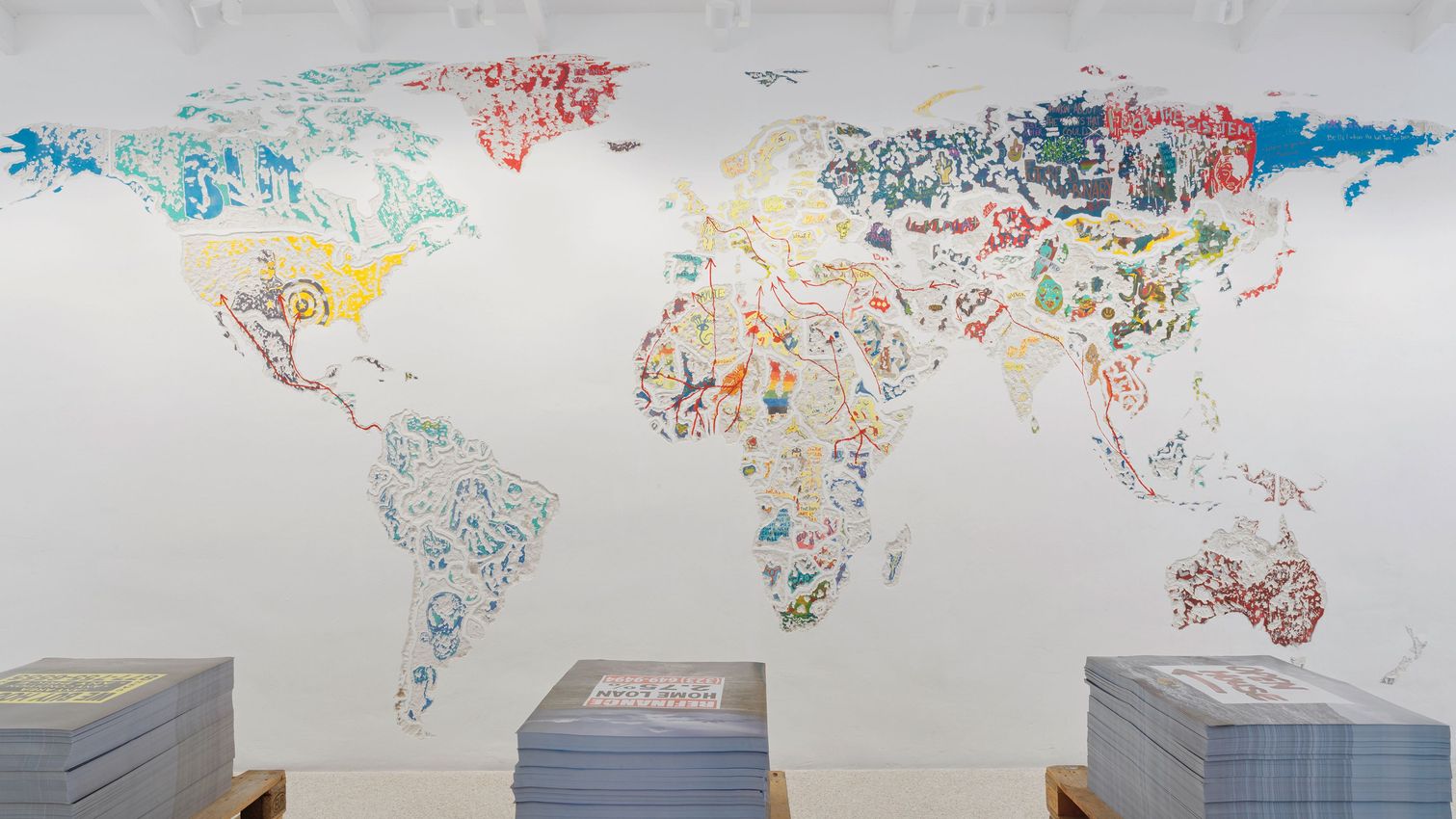
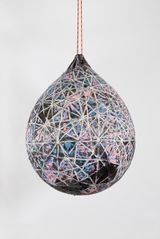
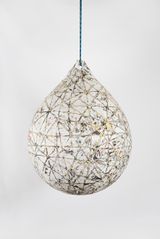
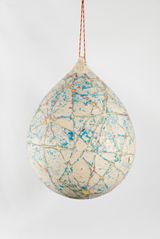
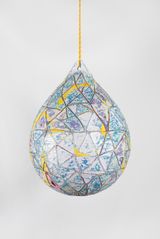
Bradford has developed ambitious installations and site-specific projects across museum and gallery spaces that extend his interest in mapping and social space. For Masses and Movements at Hauser & Wirth Menorca in 2021, he presented globe sculptures, a site-specific wall painting, and canvases based on a 16th-century world map thought to feature the first printed use of the name ‘America’, alongside an education initiative focused on immigration and local communities. In Mark Bradford. Keep Walking at Hamburger Bahnhof – Nationalgalerie der Gegenwart in Berlin (2024–25), he expanded this vocabulary of grids, cuts, and colour in paintings, sculptures, installations, and video tracing routes of migration and colonial expansion, juxtaposing fractured cartographic forms with signs of protest and state power. Across such work, his richly layered compositions conjure shifting terrains and contested borders, underscoring how journeys across land are entangled with fear, possibility, and geopolitical power.
Politics and Social Practice Through Art + Practice
Bradford has never shied away from politics, and the materials he uses are saturated with the realities of race and class, resulting in work that moves away from pure abstraction to and toward explicit social critique. Take Finding Barry (2015), a lobby-wall commission at the Hammer Museum, which saw a map of the United States carved into layers of paint, and inscribing state-by-state AIDS diagnosis rates, or the video Practice (2003), which tackles questions of queerness, Black masculinity, and spectatorship by filming Bradford in a Los Angeles Lakers jersey and an enormous hoop skirt, repeatedly attempting to shoot baskets on a windy outdoor court, the costume both tripping him and turning the performance into a reflection on how Black bodies are read on and off the court.
Bradford’s commitment to social practice extends beyond the studio through Art + Practice, the nonprofit space he co-founded in Leimert Park in 2014 with Allan DiCastro and Eileen Harris Norton, which pairs a contemporary art programme with support services and life-skills training for transition-age foster youth. This parallel work reinforces the ethical stakes of his art, translating questions of representation, access, and care into sustained civic engagement. His social commitments also appear in large-scale public projects such as Mithra (2008), a 70-foot-long, ark-like sculpture built from salvaged posters and plywood for the Prospect.1 New Orleans triennial, conceived as a makeshift refuge in the wake of Hurricane Katrina.
Collections and Recognition
Bradford has exhibited widely in museums and biennials worldwide, and his work is held in major public collections including:
- The Broad in Los Angeles;
- The Solomon R. Guggenheim Museum in New York;
- Tate in the United Kingdom;
- Museum of Modern Art (MoMA); and
- The Metropolitan Museum of Art in New York.
Alongside landmark projects such as Pickett’s Charge (2017) at the Hirshhorn Museum and Sculpture Garden in Washington, D.C., his practice has been the focus of major institutional surveys that underline his influence on contemporary abstraction and socially engaged art, including End Papers at the Modern Art Museum of Fort Worth (2020), Mark Bradford. Keep Walking at Hamburger Bahnhof – Nationalgalerie der Gegenwart, Berlin (2024–25), travelling to the Amorepacific Museum of Art, Seoul (2025–26), his first solo exhibition in South Korea.
Tomorrow is Another Day’ at Venice
In 2017, Bradford represented the United States at the 57th Venice Biennale with the solo exhibition Tomorrow Is Another Day in the U.S. Pavilion. The pavilion’s neoclassical architecture is modelled after the estate of former president Thomas Jefferson, who owned enslaved people, and Bradford had audiences enter from the side—an entrance historically used by servants—reframing the building’s symbolic power. Five exhibition rooms showcased works that combined myths, grand historical narratives, and personal experiences; for instance, Spoiled Foot (2017) evokes lesions associated with AIDS, while the narrow spaces left around his works intensified viewers’ awareness of marginalisation and constraint.
Mark Bradford FAQs
What is Mark Bradford best known for?
Mark Bradford is best known for his large-scale abstract paintings and installations composed of layered paper and found materials that resemble maps of urban space while addressing race, history, and social inequality. Works such as Scorched Earth (2006) and Pickett’s Charge (2017) exemplify his ability to turn historical events and local ephemera into formally complex, politically charged compositions.
What themes does Mark Bradford explore in his work?
Mark Bradford’s work explores themes of race, migration, urban development, and the impact of economic and political systems on Black and other marginalized communities in the United States, and around the world. He frequently addresses historical events like the Great Migration and the Tulsa Race Massacre, alongside broader questions of visibility, erasure, masculinity, and queer identity. Projects such as Tomorrow Is Another Day (U.S. Pavilion, 57th Venice Biennale, 2017) and later bodies of work consider how bodies move through, and are held in place by, legal, economic, and architectural systems, using fractured grids, circling routes, and unstable cartographies as formal stand-ins for these pressures.
How does Mark Bradford make his paintings?
Mark Bradford builds his paintings by layering billboard paper, posters, end papers, and other printed matter with paint, then cutting, sanding, pulling and peeling back the surface to reveal intricate, weathered strata. This labor-intensive process creates textured, cartographic compositions that echo streets, fault lines, and zones of tension within the city.
Where can I see Mark Bradford’s work?
Mark Bradford’s work is held in major public collections and can be seen in institutions such as the Solomon R. Guggenheim Museum and the Museum of Modern Art in New York, The Broad in Los Angeles, and Tate Modern in London, all of which own key paintings. Represented by leading galleries, he shows regularly in the commercial sphere, with recent solo exhibitions including Exotica (2024–25) at Hauser & Wirth in Hong Kong and Thievery by Servants (2026) at Lévy Gorvy Dayan in New York. In 2026, Mark Bradford. Keep Walking showed at the Amorepacific Museum of Art in Seoul (2025–26), his first solo exhibition in South Korea.
Why is Mark Bradford’s work referred to in the context of ‘social abstraction’ and ‘Black abstraction’?
Bradford has described his practice as ‘social abstraction’ because, while it draws on abstraction, it remains grounded in specific histories of race, land, and economic inequality. Positioned in dialogue with Abstract Expressionism and the modernist grid, as well as later debates around social practice, Bradford retools these lineages into a form of Black abstraction that insists on scale, density, and public visibility—whether in canvas works like Scorched Earth (2006) or immersive environments such as Pickett’s Charge (2017) and Masses and Movements (2021). By pulling in materials from beauty salons, community noticeboards, and street advertising—end papers, flyers for bail bonds or credit repair, hand-lettered signs for cheap rooms—he renders visible the informal economies and survival strategies that structure daily life in South Los Angeles. As he has remarked, even the most non-figurative composition cannot be separated from these origins: ‘Race, gender and class will always cling to the material’.
What is Mark Bradford’s Merchant Poster series about?
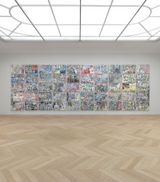
Bradford’s ‘Merchant Poster’ series, begun around 2005, uses brightly coloured, text-heavy posters that advertise quick cash, legal aid, cheap rooms, and other services in his South Los Angeles neighbourhood; he collects these adverts and transforms them into layered, sanded, and cut collages in which fragments of language and colour flicker like the visual noise of the street, turning throwaway ephemera into maps of predatory finance, precarious housing, and everyday survival. Works in this vein, such as the seminal multi-panel grid piece Thievery by Servants (2013), shown in New York in the exhibition Mark Bradford: Thievery by Servants at Lévy Gorvy Dayan, use posters advertising a ‘slip-and-fall’ lawyer to probe how legal and financial systems target vulnerable communities and to draw out older class anxieties embedded in the phrase ‘thievery by servants’.
What is Mark Bradford’s ‘Pickett’s Charge’ about?
Pickett’s Charge (2017) by Mark Bradford is a monumental installation at the Hirshhorn Museum that reworks reproductions of a 19th-century cyclorama depicting a pivotal Civil War battle. By cutting, collaging, and overpainting the original imagery into a nearly 400-foot frieze, Bradford turns a heroic narrative of Confederate history into a fragmented reflection on memory, conflict, and who is centred in official accounts of the past.
Ocula | 2026

Recently Exhibited



Exhibiting Elsewhere

Works Elsewhere









Mark Bradford in Ocula Magazine







Explore and Follow Artists Shaping Contemporary Art
A respected voice in contemporary art discourse.
Focusing on ambitious storytelling and insightful art-world commentary. Ocula Magazine publishes in-depth interviews, critical essays and timely analysis on the artists, exhibitions and ideas driving the global art world.
Learn more about Ocula Magazine
Showcasing the best of the art world.
Ocula partners with galleries from around the world to highlight their artists, artworks and exhibitions. Gallery membership is by application and invitation, with each member vetted by an independent panel.
Learn more about Ocula Membership
Specialises in the sale of major artworks.
Led by a team with deep ties to the world’s leading auction houses, galleries and collectors. Ocula’s advisory team offers bespoke services to high-net-worth clients from around the world who are looking to acquire the best of contemporary and modern art.
Learn more about our team and services