Press Release

Los Angeles...On view together for the first time in 25 years, ‘Sit So Your Back Isn’t Against The Door’ reunites thelargest group of Glenn Ligon’s Coloring Book paintings since their debut at the Walker Art Center in Minneapolis.

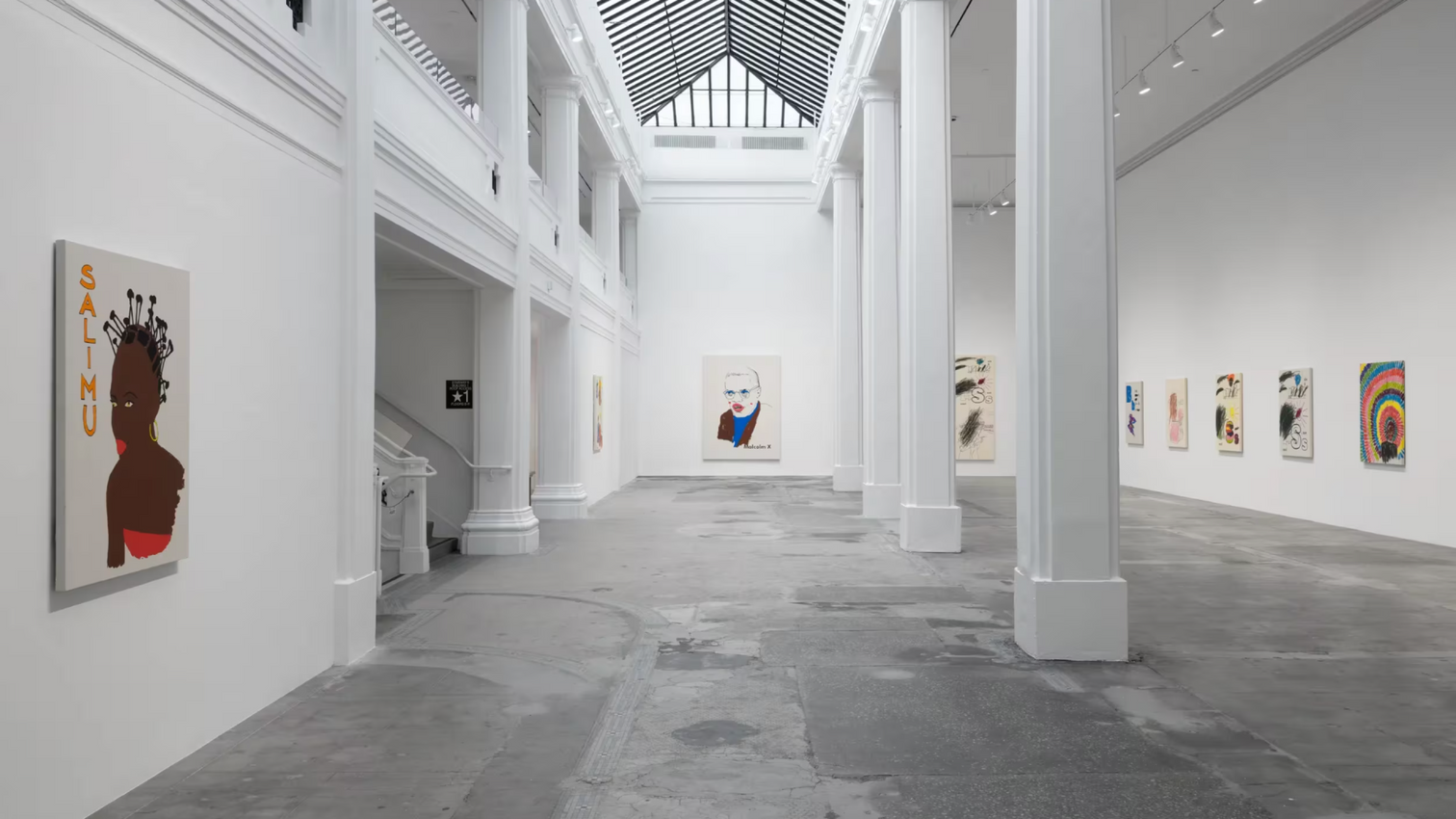
Conceived during the artist’s 1999 – 2000 residency at the museum, the celebrated series draws on Afrocentriccoloring books of the late 1960s and early 1970s. While at the Walker, Ligon invited local schoolchildren tocolor pages from these vintage publications, then reinterpreted their creations in his own hand on large-scalecanvases. The resulting paintings—colorful, uninhibited, deceptively loose—offer a striking departure from themonochromatic, text-based work for which Ligon is best known.

Sourced from the Schomburg Center for Research in Black Culture, the post–Civil Rights-era images that filledthese coloring books were created as tools for teaching children the visual vocabulary of Black pride and selfrepresentation. Ligon, however, removed the historical context, reproducing them as simple coloring sheets toshare with the children in his workshops as an invitation to draw unencumbered. Initially attempting to replicatetheir spontaneous marks precisely at scale, Ligon soon discovered that the children’s wonderfully unguardedgestures could not be replicated. He reinterpreted their drawings, preserving each child’s palette and compositionwhile allowing his own hand to improvise, translating young, unfettered gestures into deliberate marks.

Across his Coloring Book canvases, Ligon isolates and recombines imagery—suns, alphabet letters, streetscenes—with portraits of such historical Black figures as Frederick Douglass, Harriet Tubman and Malcolm X.Multiple versions of paintings come from the same template: marks pile up in dense thickets of pigment in someworks while just a few strategically placed blooms of color are enough to animate a face in others. While Ligon’stactic of repeated templates recalls the mass production of the original educational coloring books, each paintingtakes on its own meaning. The children’s instinctive, unselfconscious marks combined with Ligon’s considered,conceptually informed interventions render layers of meaning and association and invite multiple interpretations.In ‘Malcolm X, Sun, Frederick Douglass, Boy with Bubbles (Version 3) #2’ (2001), both of the titular historical figuresappear with rouged cheeks, a detail taken directly from one child’s drawing. Ligon’s color application recalls thestylized make-up of Andy Warhol’s Mao paintings. But where Warhol drew parallels between propaganda andconsumer culture, Ligon foregrounds education’s role in constructing identity and reinforcing stereotypes. Bothplayful and unsettling, the Coloring Book paintings expose how elusive representation can be, hinging on thetension between children’s untutored imagination and the historically informed perspective only an adult can bear.This friction squares with Ligon’s broader interest in abstraction and legibility, typifying his approach to strippinglegibility not to obscure meaning but to enable its multiplicities to surface.

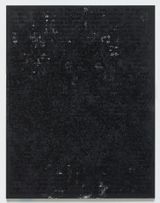
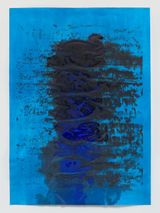
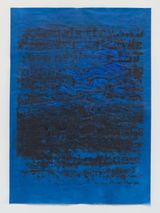
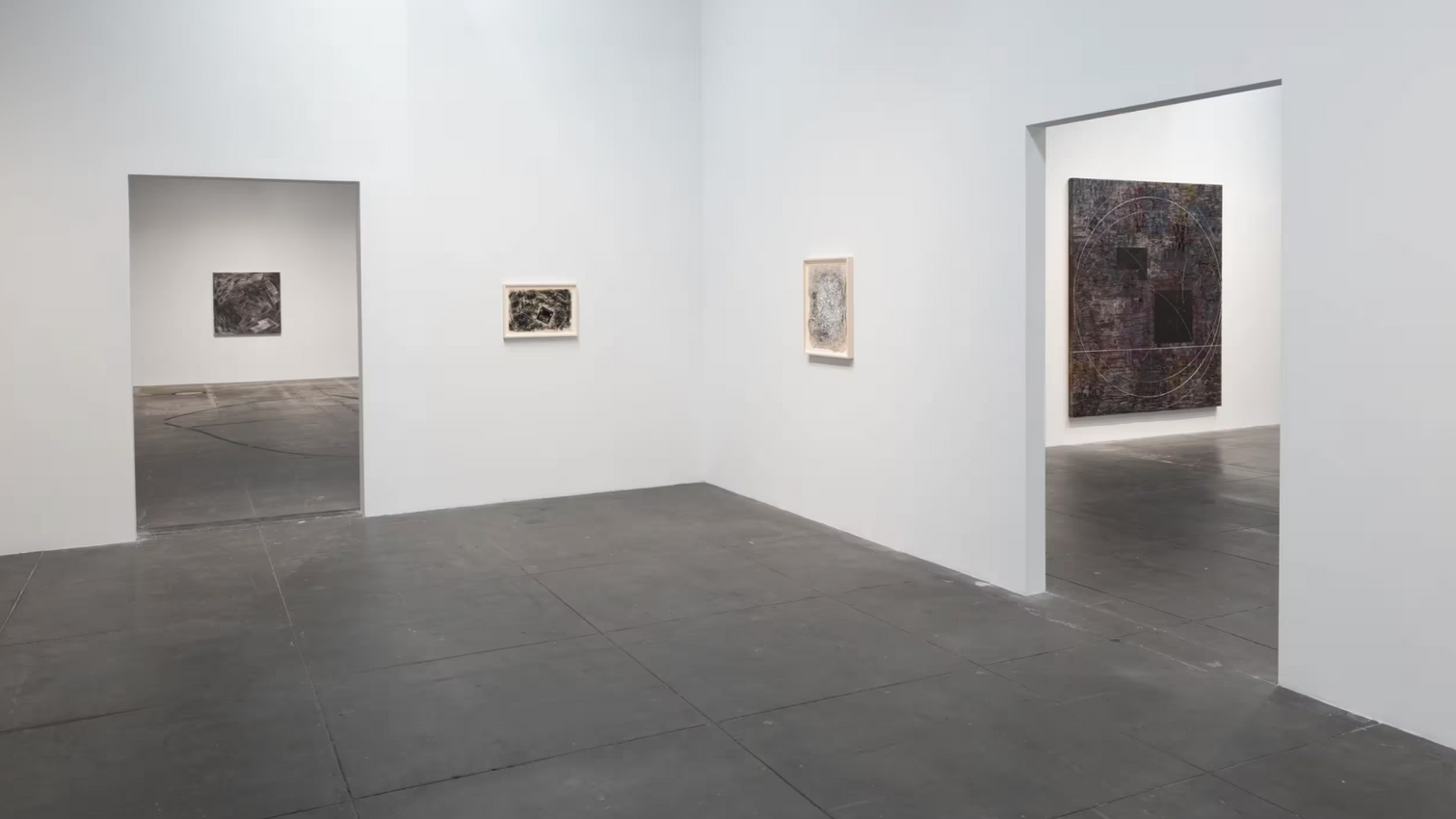
Alongside the Coloring Book paintings, the exhibition at Hauser & Wirth will debut Ligon’s ‘Black Panther ColoringBook #1,’ a new 22-part work based on a political primer for adults illustrated in 1969 by artist Akinsanya Kambonand later circulated by the FBI to discredit the Panthers. Working in black oil stick, Ligon masks each imagebehind a taped-off rectangle, leaving only captions, faint traces of the drawing, and his own fingerprints andsmudges visible. Degrees of concealment shift from page to page in a studied obscurity that turns withholdingitself into a form of meaning.

Throughout ‘Sit So Your Back Isn’t Against The Door,’ Ligon returns to existing historical images as material thatcan be revisited, reinterpreted and transformed, accruing new significance as the context changes.

Courtesy Hauser & Wirth.

Read More

Installation Views

About the Artist

Born in the Bronx, New York, in 1960, Glenn Ligon received a BA from Wesleyan University in 1982. His early practice was grounded in painting, and his canvases of this period built upon the legacies of such Abstract Expressionist artists as Philip Guston, Cy Twombly, Robert Rauschenberg, and Jasper Johns. In 1984–1985, Ligon spent an academic year in the Whitney Museum of American Art’s Independent Study Program, developing a series of representational drawings of iconic sculptures by European artists such as Alberto Giacometti and Constantin Brâncuși, juxtaposed against images of African American hair products rendered in acrylic and ink.

View Artist Profile

Also Exhibiting at Hauser & Wirth

About the Gallery

Hauser & Wirth was founded in 1992 in Zurich by Iwan Wirth, Manuela Wirth and Ursula Hauser, who were joined in 2000 by Partner and Vice President Marc Payot. A family business with a global outlook, Hauser & Wirth has expanded over the past 26 years to include outposts in Hong Kong, London, New York, Los Angeles, Somerset and Gstaad. The gallery represents over 70 artists and estates who have been instrumental in shaping its identity over the past quarter century, and who are the inspiration for Hauser & Wirth’s diverse range of activities that engage with art, education, conservation and sustainability.

View Gallery Profile
Address
901 East 3rd Street
Los Angeles
United States
Opening Hours
Tuesday – Sunday
11am – 6pm
(1)
Los Angeles 901 East 3rd Street
Hauser & Wirth
901 East 3rd Street, Los Angeles, United States
+1 213 943 1620
http://www.hauserwirth.com

Opening hours
Tuesday – Sunday
11am – 6pm
The art world in focus