





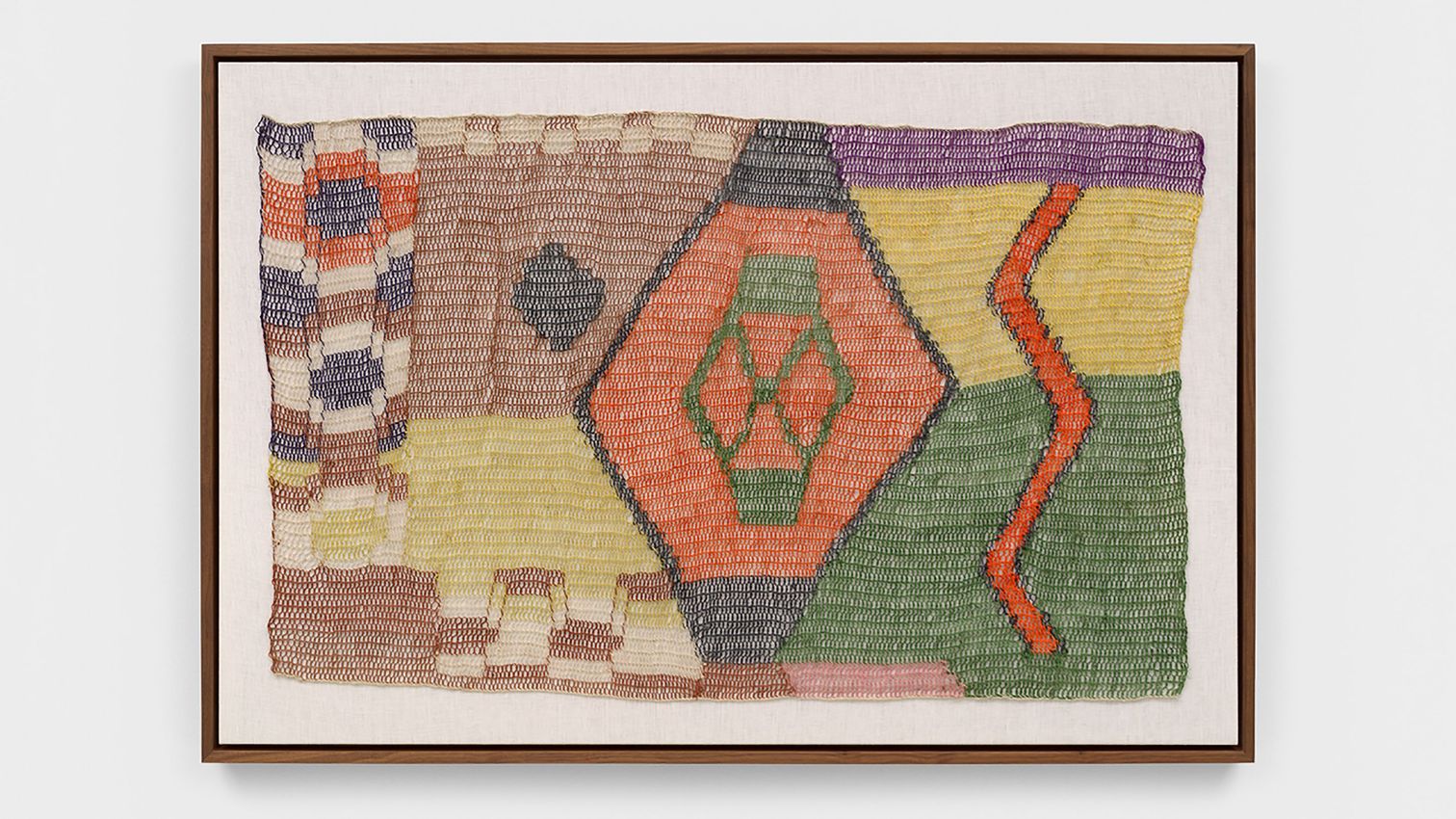
CLAUDIA ALARCÓN
b. 1989, ArgentinaClaudia Alarcón (b. 1989, La Puntana, Salta, Argentina) is an Indigenous Wichí textile artist known for geometric weavings made from hand-spun chaguar plant fibre, created both individually and through the Silät collective, a group of over 100 Wichí women weavers she leads from the Gran Chaco region of northern Argentina. Her work featured prominently in the 60th Venice Biennale (2024) as part of Adriano Pedrosa’s Stranieri Ovunque – Foreigners Everywhere, and in 2025 was acquired by the Solomon R. Guggenheim Museum, New York, as part of the museum’s Latin American Circle programme. She lives and works in the La Puntana community on the banks of the Pilcomayo River, Salta, Argentina.
Early life and Education of Claudia Alarcón
Claudia Alarcón was born in 1989 in the La Puntana community of the Wichí people in the province of Salta, in the Gran Chaco region of northern Argentina. In Wichí culture, girls learn to spin chaguar fibre and weave functional objects from the age of twelve, and Alarcón grew up within this tradition of communal, female-led textile production.
Alarcón is a co-founder of the women’s organisation Thañí/Viene del monte, established to revive ancestral textile traditions across the Salta region. Working closely with curator Andrei Fernández since 2015, she went on to form the Silät collective in 2023, bringing together one hundred women weavers of different generations from the Alto la Sierra and La Puntana Wichí communities. She continues to live and work in La Puntana.
Claudia Alarcón Artworks and Style
Claudia Alarcón and Silät create hand-woven textiles using chaguar plant fibre, natural and aniline dyes, and traditional Wichí stitching techniques including the yica and antique stitch, producing works that range from functional objects to large-scale geometric compositions.
Wichí weaving tradition and chaguar fibre
Chaguar is a bromeliad native to the Gran Chaco, and its processed fibres have been central to Wichí visual culture, narrative history, and economics for centuries. The geometric motifs woven into the textiles are drawn from the surrounding environment — animals, plants, waterways, and celestial bodies — and serve as a method of communicating unspoken thoughts within a culture that values non-verbal expression and the messages found within dreams. The word Silät means ‘information’ or ‘alert’ in Wichí, reflecting the role of textiles as carriers of shared cultural sentiment.
From communal practice to international exhibitions, 2019–2024
Alarcón’s earliest exhibitions took place through the Thañí/Viene del monte organisation, including shows at the Usina Cultural de Salta (2019), the Museo Nacional Terry, Tilcara (2021), and the ifa-Galerie, Berlin (2020). The transition to the international contemporary art world accelerated rapidly: she debuted at arteba in Buenos Aires in 2022 and was the first Indigenous woman to receive a National Salon of Visual Arts prize from Argentina’s Ministry of Culture that same year. In 2024, eight hand-woven textile works by Alarcón and Silät were shown in the Arsenale at the 60th Venice Biennale, marking the collective’s most prominent institutional presentation to date.
Institutional exhibitions and new directions, 2025–2026
In 2025 and 2026, Alarcón and Silät’s visibility has expanded significantly. Tayhin, their first institutional solo exhibition, was presented at the De La Warr Pavilion, Bexhill-on-Sea (June–September 2025), and their work was included in Grounded at the Los Angeles County Museum of Art (LACMA), on view from September 2025 to June 2026. Solo presentations took place at James Cohan, New York (April–May 2025), Cecilia Brunson Projects at Frieze London (2025), and the Gund at Kenyon College, Ohio (July–December 2025). An upcoming group exhibition, Arts of the Earth, is announced at the Guggenheim Museum Bilbao.
Awards and honours of Claudia Alarcón
- 2025 – Acquisition, Solomon R. Guggenheim Museum, New York (Latin American Circle)
- 2025 – ARTnews Emerging Artist of the Year (Claudia Alarcón & Silät)
- 2022 – First Prize in textile discipline, 110th National Salon of Visual Arts, Ministry of Culture of Argentina (first Indigenous woman to receive this honour)
- 2022 – Ama Amoedo Acquisition Prize, Pinta Miami
Exhibitions of Claudia Alarcón
Claudia Alarcón and Silät have exhibited at biennales, museums, and contemporary art galleries across Europe, the Americas, and beyond.
Select solo exhibitions
- 2025–2026 – Everyday Anew, The Gund at Kenyon College, Ohio
- 2025 – Tayhin, De La Warr Pavilion, Bexhill-on-Sea, United Kingdom
- 2025 – Claudia Alarcón & Silät, James Cohan, New York
- 2023 – Claudia Alarcón and Silät, Cecilia Brunson Projects, London
- 2023 – Silät, Hessel Museum of Art at Bard College, Annandale-on-Hudson, New York
Select group exhibitions
- 2025–2026 – Grounded, Los Angeles County Museum of Art (LACMA)
- 2025 – 14th Mercosur Biennial, Porto Alegre, Brazil
- 2025 – Cecilia Brunson Projects at Frieze London (solo presentation)
- 2024 – Stranieri Ovunque – Foreigners Everywhere, 60th Venice Biennale
- 2024 – La vida que explota, MALBA–Puertos, Buenos Aires
- 2024 – Cantando Bajito: Chorus, Ford Foundation Gallery, New York
- 2024 – Spin a Yarn, Guild Hall, New York
- 2023 – Spin a Yarn, Another Space, New York
- 2020 – La escucha y los vientos, ifa-Galerie, Berlin
Collections
Claudia Alarcón and Silät’s work is held in the following public collections:
- Solomon R. Guggenheim Museum, New York (acquired 2025)
- Los Angeles County Museum of Art (LACMA)
- Museu de Arte de São Paulo Assis Chateaubriand (MASP)
- Museo de Arte Latinoamericano de Buenos Aires (MALBA)
- Denver Art Museum, Colorado
- Arkansas Museum of Fine Arts
- Nasher Museum of Art, Duke University
- RISD Museum, Providence
- The Gund at Kenyon College, Ohio
- Museo de Arte Contemporáneo de Salta, Argentina
Website, Instagram, and further reading
Claudia Alarcón and Silät are represented by James Cohan, New York, Cecilia Brunson Projects, London, and Galería Elvira Moreno, Buenos Aires. View artworks, exhibitions, and further reading about Claudia Alarcón on Ocula.
Claudia Alarcón FAQs
Who is Claudia Alarcón?
Claudia Alarcón (b. 1989, La Puntana, Salta, Argentina) is an Indigenous Wichí textile artist who creates geometric weavings from hand-spun chaguar plant fibre, working both individually and as the leader of Silät, a collective of over one hundred Wichí women weavers from the Gran Chaco region of northern Argentina.
What is the Silät collective?
Silät is a collective of over one hundred Indigenous Wichí women weavers of different generations from the Alto la Sierra and La Puntana communities in northern Salta, Argentina, formed in 2023 under the leadership of Claudia Alarcón and working closely with curator Andrei Fernández. The name means ‘information’ or ‘alert’ in Wichí.
What type of art does Claudia Alarcón make?
Claudia Alarcón makes hand-woven textiles using chaguar plant fibre, natural and aniline dyes, and traditional Wichí stitching techniques such as the yica stitch, producing geometric compositions that carry cultural narratives, environmental imagery, and non-verbal messages central to Wichí tradition.
Was Claudia Alarcón in the Venice Biennale?
Claudia Alarcón and Silät exhibited eight hand-woven textile works in the Arsenale as part of Adriano Pedrosa’s Stranieri Ovunque – Foreigners Everywhere at the 60th Venice Biennale in 2024, their first presentation at La Biennale di Venezia.
Is Claudia Alarcón in the Guggenheim collection?
Claudia Alarcón’s work was acquired by the Solomon R. Guggenheim Museum, New York, in 2025 as part of the museum’s Latin American Circle programme, alongside works by Varda Caivano, Ximena Garrido-Lecca, Sara Flores, and others.
Where can I see work by Claudia Alarcón?
Claudia Alarcón and Silät’s work is included in Grounded at the Los Angeles County Museum of Art (LACMA), on view from September 2025 to June 2026, and an upcoming group exhibition, Arts of the Earth, at the Guggenheim Museum Bilbao; their work is also held by MASP, MALBA, Denver Art Museum, and the Nasher Museum, among others.
What awards has Claudia Alarcón received?
Claudia Alarcón became the first Indigenous woman to receive a National Salon of Visual Arts prize from Argentina’s Ministry of Culture in 2022, and was named ARTnews Emerging Artist of the Year in 2025 alongside the Silät collective.
What is chaguar?
Chaguar is a bromeliad plant native to the Gran Chaco region of South America; its processed fibres have been used by the Wichí people for centuries to weave textiles that carry geometric motifs, cultural narratives, and non-verbal messages, and it is the primary material in Claudia Alarcón and Silät’s art practice.
Ocula | 2026

Explore and Follow Artists Shaping Contemporary Art
A respected voice in contemporary art discourse.
Focusing on ambitious storytelling and insightful art-world commentary. Ocula Magazine publishes in-depth interviews, critical essays and timely analysis on the artists, exhibitions and ideas driving the global art world.
Learn more about Ocula Magazine
Showcasing the best of the art world.
Ocula partners with galleries from around the world to highlight their artists, artworks and exhibitions. Gallery membership is by application and invitation, with each member vetted by an independent panel.
Learn more about Ocula Membership
Specialises in the sale of major artworks.
Led by a team with deep ties to the world’s leading auction houses, galleries and collectors. Ocula’s advisory team offers bespoke services to high-net-worth clients from around the world who are looking to acquire the best of contemporary and modern art.
Learn more about our team and services