



Press Release

Jake Grewal’s paintings are suffused with a remarkable melancholy. Faceless figures wander indeterminately through hazy landscapes, their bodies set aflame against brilliant sunsets; dissolving into the oceans; merging sinuously with trees. While many of his immediate peers have espoused scenes of conviviality and revelry, Grewal paints figures in isolation immersed in introspection. When asked about his relationship tot he efflorescence of queer figurative painters in recent years, many of whose works celebrate sociality and the carnal pleasures of the body, Grewal offers Francis Bacon as a forebear instead: independent, bold, moody, and violent. For Grewal, queerness is an interior feeling. It is avast expanse to navigate that does not always offer a comfortable perch upon which to roost.

While Grewal points to Bacon as a more recent reference, many of Grewal’s artistic coordinates are inheritances from longer traditions in British art. In particular, Grewal’s paintings fit within the lineage of such British Romantics as John Constable (1776-1837) and J. M. W. Turner (1775-1851), who were entranced by nature’s vastness, subordinating figures to sublime expanses of land and sea. From slightly farther afield, Grewal points to German Romantic, Caspar David Friedrich (1774-1840), as inspiration. Friedrich’s _Wanderer above the Sea of Fog (_ca.1818) famously highlights man’s diminutive presence in the greater cosmos. The Romantics shared in their rejection of the Enlightenment’s insistence on rationality, celebrating the unknowability of nature and the supreme power of emotion over reason. Noting the pervasive sense of foreboding in his canvases, Grewal agrees that nature is an untameable force worthy of awe.

In And If I Hide Myself, Would He Return? (2026), a lone male figure walks across an endless blue that melts into a cloudy horizon. The figure teeters at the point of sublimation, ready to evaporate into the atmosphere. He is twinned by his attendant reflection, walking instep beneath him. The body mirrored in the ground below suggests a phantom-self that walks alongside us, an accomplice and companion in life’s errant wanderings. Whether he is walking on earth or miraculously on water, it is hard to know, but this metaphorical and biblical valence is deeply poetic. Grewal invokes the historic Romantics once again, using nature to reflect back our longing, our loneliness, and our wonder.

Grewal’s figures are often set along the coast, in close proximity to water. The art historical trope of the nude bather or swimmer gave painters the opportunity to paint unclothed figures, which would have otherwise been indecorous in other settings. Frédéric Bazille (1841-1870) and Gustave Courbet (1819-1877), painting at the height of French Impressionism, are known for their male nudes at the lake or at the bath, while Thomas Eakins (1844-1916) in the United States similarly explored the subject across the Atlantic. The shoreline, for Grewal as for his antecedents, conjures a liminal space between worlds; the water a backdrop upon which to project fantasies and insecurities. The ecological and the psychological are coalesced, and time is diluted or suspended, existing eternally at the cusp of dark and day.

While Grewal’s work fits within a European art historical lineage, he grew up with an Indian father. Having visited to India for the first time only recently, India remained displaced and mysterious for the larger part of his life and training. Like many artists, he has eschewed the art world’s desire to fit him neatly into identitarian categories, in large part because his Indian ancestry existed outside of his lived cultural experience. Yet this friction, between knowing and not-knowing, belonging and unbelonging, seem to weigh heavily upon the characters that populate Grewal’s landscapes.

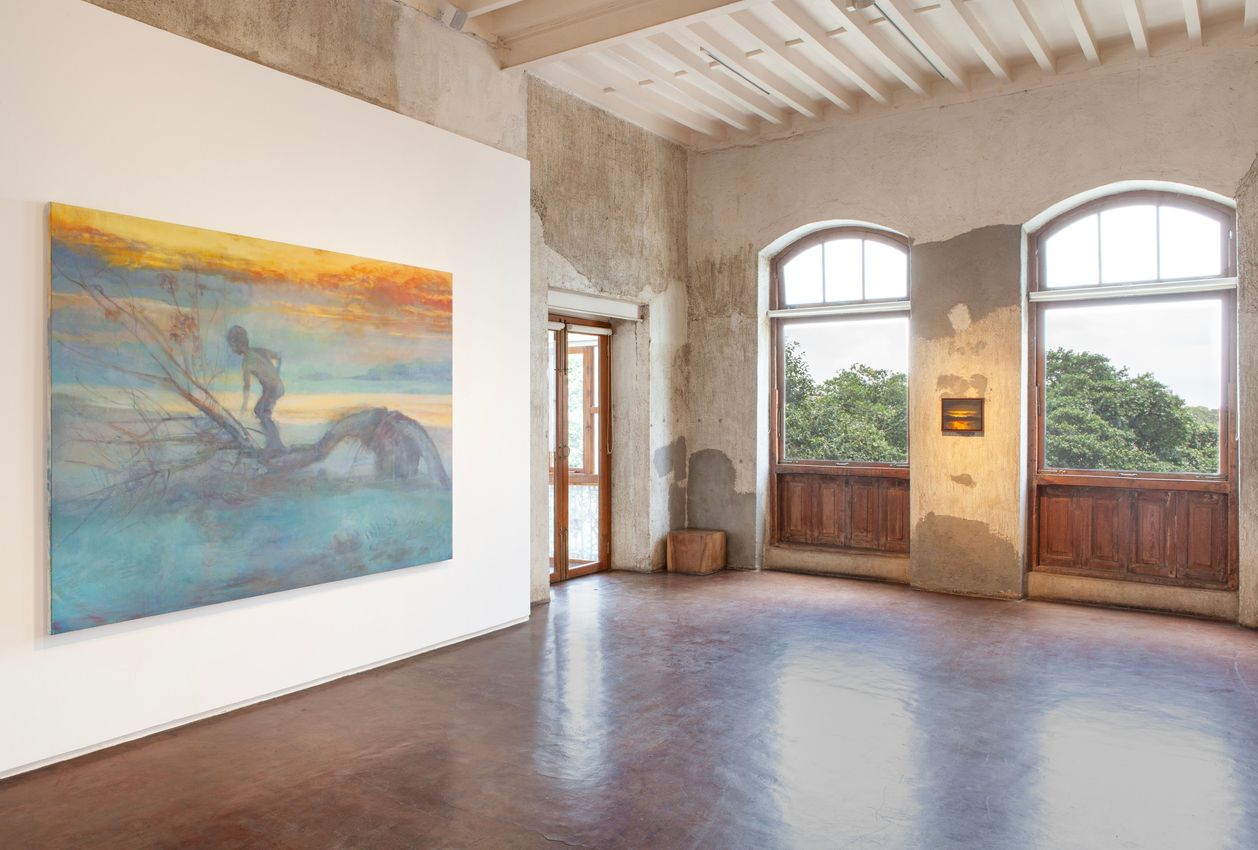
The constant negotiation involved in straddling worlds, one intimate and the other psychic, bubbles to the surface of his canvases. In Need of Roots (2026) points to the saturnine conditions of diaspora, where the feeling of belonging can remain elusive. A figure scrambles over a tree with bowed branches set against a crepuscular sky: the tree is firmly one with its site, while the deracinated figure hugs close to feel some of its grounding. The tree has long been used as a genealogical metaphor for embeddedness, but what of those of us who have been cast off and have been made nomadic? Grewal’s figures pensively ruminate on where to settle, both their body and mind. Unencumbered by company or clothing, salt and sand create a perfect background for this infinite contemplation.

The exhibition includes both paintings and drawings at various scales. Grewal’s postgraduate work at the Royal Drawing School in London, where students study observational drawing, has led to works on paper becoming an essential component of his process and practice. Charcoal on rich woven paper is used to create his characteristic blurred lines and smoky atmosphere, an effect that Grewal is able to later translate to paint. In Black Tide (2026), a figure all but vanishes upon a jagged rocky outcrop with water lapping against the shore. Different modulations of black imbue the scene with a foggy dreamlike setting, harkening back to Freidrich’s lone man on the mountain. Beyond his deftness with creating ambience and mood through color and value, Grewal is a master of shifting scales. This play in scope and size allows his medium to become a camera, panning in and out of scenes in soft focus. In these wide shots, Grewal’s drawings and paintings become lustrous cinematic stills, as though from a film by Derek Jarman (1942-1994) or Rainer Werner Fassbinder (1945-1982). These works evoke the same dramatic reaction as that of sitting in front of a big screen, watching Grewal’s protagonists find their way in nature.

The artist’s solo debut in India is not a homecoming for the figures in Grewal’s work but rather a further stop in their way finding. Restless, they continue on their concomitant journey outward into the land and inward through their minds–traversing the distances they each have inherited. Grewal’s figures, unfixed from any specific geography, speak of everyman who feels untethered, still finding his way. Because it is in this unwillingness to settle that we continue to learn, to discover, and to meld deeper into the worlds in which we are immersed.

Text by: Sayantan Mukhopadhyay, PhD, Associate Curator of Modern & Contemporary Art, Portland Museum of Art. Courtesy Jhaveri Contemporary

Read More

Installation Views

About the Artist

Jake Grewal lives and works in London. His works are in a constant dialogue between people and nature, portrait and landscape. His figures appear in uncanny scenes set in natural settings and are ambiguous within their environment. Grewal shows the male nude and the natural world through a queer gaze.

View Artist Profile

Also Exhibiting at Jhaveri Contemporary

About the Gallery

Jhaveri Contemporary was formed in 2010 by sisters Amrita and Priya with an eye towards representing artists, across generations and nationalities, whose work is informed by South Asian connections and traditions. The gallery’s dedication to original scholarship, engendered through its carefully crafted shows, is one of the many ways it distinguishes itself. Entwined with this philosophy is another guiding principle: showcasing the heterogeneous practices of long-celebrated luminaries as well as emerging talents, often in generously interrogative conversations. With a focus on mining lesser-known art histories, Jhaveri Contemporary facilitates dialogue between artists, curators and historians to add to the wider field of art. Estates served by the gallery include Mrinalini Mukherjee and Anwar Jalal Shemza.

View Gallery Profile
Address
3rd Floor Devidas Mansion
4 Mereweather road
Apollo Bandar Colaba
Mumbai
India
Opening Hours
Tuesday – Saturday
11am – 6:30pm
(1)
Mumbai 3rd Floor Devidas Mansion, 4 Mereweather road
Jhaveri Contemporary
3rd Floor Devidas Mansion, 4 Mereweather road, Apollo Bandar Colaba, Mumbai, India

Opening hours
Tuesday – Saturday
11am – 6:30pm
The art world in focus
