



VALIE EXPORT
1940-2026, AustriaVALIE EXPORT is an Austrian contemporary artist, filmmaker, and pioneer of feminist media art best known for provocative public performances and groundbreaking expanded cinema work. Born Waltraud Lehner in Linz in 1940, Export created her artistic identity as a strategic gesture of self-determination in 1967, establishing herself as a leading figure in European avant-garde practice. Working across performance, film, video, photography, sculpture, and installation, her practice has profoundly shaped feminist art, conceptual art, and media art theory since the 1960s. She lived and worked in Vienna and Linz.
Early Life and Education
VALIE EXPORT was born Waltraud Lehner in Linz, Upper Austria, where she was raised by a single mother. She studied painting, drawing, and design at the National School for Textile Industry in Vienna before relocating to the capital’s vibrant art scene in the 1960s. Export’s decision to adopt the name VALIE EXPORT in 1967 was itself an artistic act—a bold assertion of identity in a Viennese landscape dominated by the Vienna Actionists, including Hermann Nitsch, Günter Brus, Otto Mühl, and Rudolf Schwarzkogler. While influenced by the movement’s transgressive ethos, Export distinguished her practice through its explicit feminist framework, using her body as both subject and medium to confront gender politics and voyeurism in art and society. She remains based primarily in Vienna and Linz.
Artworks and Style
VALIE EXPORT’s practice centres on the body as a site of political and aesthetic intervention, fundamentally challenging how bodies are represented, consumed, and experienced in image culture. Her innovative use of the body as artistic medium predates and runs parallel to international performance art movements, positioning her among the earliest performance artists alongside Joseph Beuys and Allan Kaprow.
Expanded Cinema and Performance (1968–1971)
Export’s most iconic works emerge from her development of ‘expanded cinema’—a radical reimagining of film practice that replaces celluloid with the artist’s body and public space. TAPP und TASTKINO (Tap and Touch Cinema, 1968–1971) was performed across ten European cities including Vienna and Munich. For this work, Export wore a small mock cinema constructed from Styrofoam and later aluminium, strapped directly to her bare chest. She invited passing pedestrians to insert their hands through an opening and feel her breasts, inverting the voyeuristic regime of cinema by substituting tactile encounter for visual pleasure. The work radically reframes the film experience: instead of sitting in darkness before projected images, viewers became active participants in direct physical contact with the artist’s body in public space.
In Aktionshose: Genitalpanik (Action Pants: Genital Panic, 1969), Export entered a pornographic cinema in Munich wearing crotchless trousers and carrying a machine gun. Moving through the theatre rows with wild hair and aggressive posture, she forced male spectators to confront a ‘real woman’ rather than mediated images on screen, directly reversing the sexual objectification that structured both cinema and everyday viewing practices. Through these guerrilla performances, Export weaponised her presence, reclaiming bodily autonomy and agency in spaces designed for male voyeurism.
Photography, Video, and Conceptual Practice (1970s–1980s)
Following her early performance actions, Export transitioned to photography, video, and expanded cinema investigations that maintained her preoccupation with perception, the body, and the ideological construction of gender and vision. Split Reality (1970, 1973 installation version) deconstructs the relationship between sound and image by positioning a vinyl record player and television set within a unified spatial frame; Export listens to the record through headphones whilst the TV’s sound is silenced, fragmenting the unified sensory experience viewers expect.
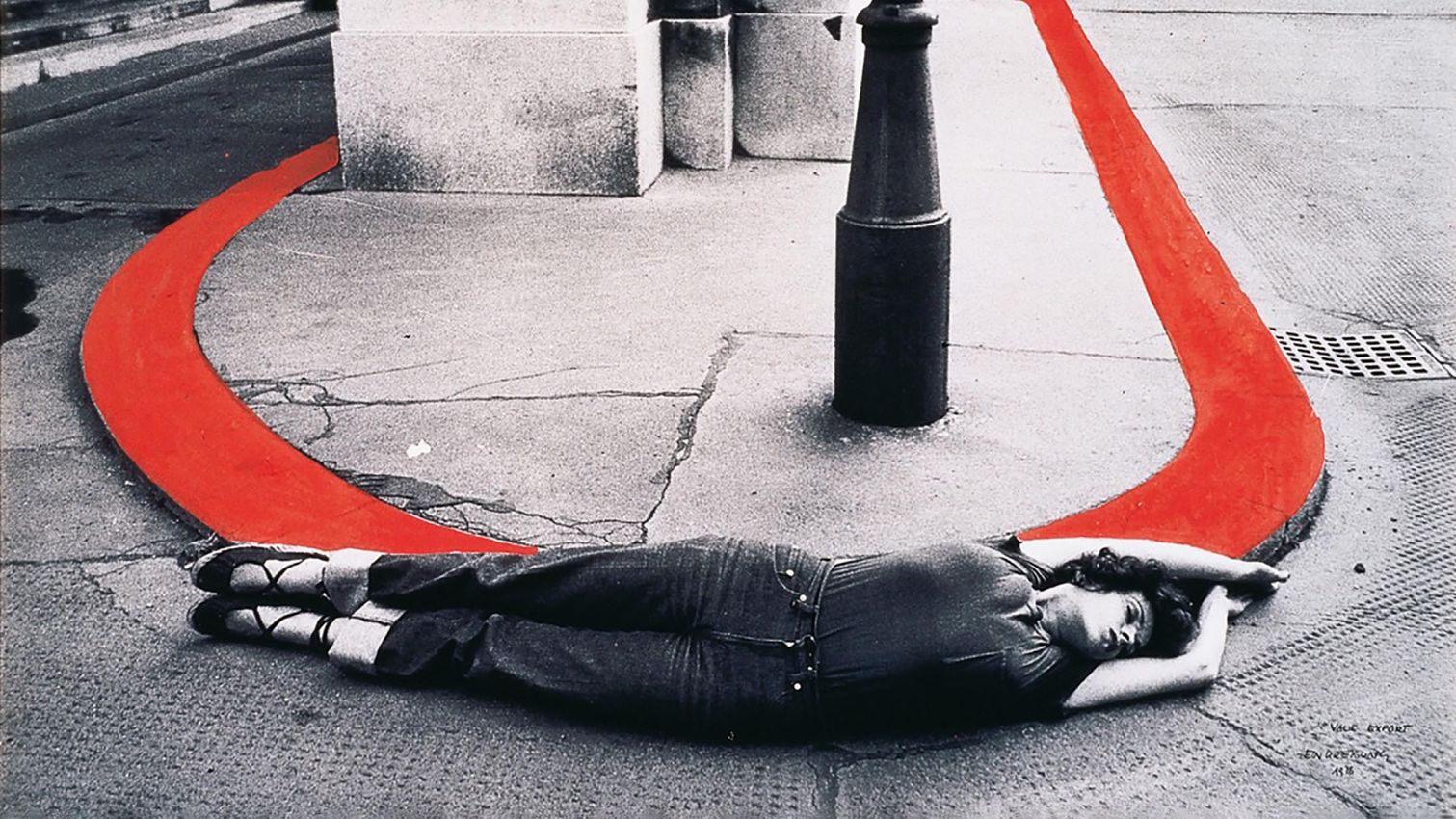
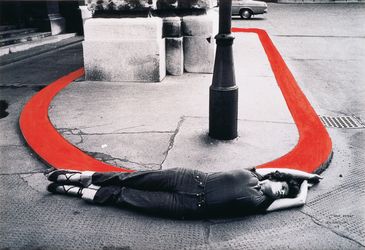
Her extensive series of conceptual photographs from the 1970s interrogate how mass media constructs and naturalises gender identity through technical reproduction and image circulation. Works such as Body Sign Action (1970) and Street Intersection Belgium (1973) employ the camera to document and reimagine spatial relationships, undermining the authority of central perspective and revealing it as an ideologically constructed rather than natural way of seeing.
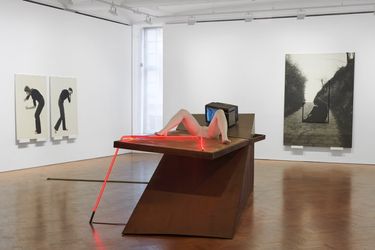
In 1980, Export represented Austria at the Venice Biennale, presenting Geburtenbett (Birth Bed), a sculptural installation of a raised platform supporting a female abdomen rendered in fleshy form, illuminated by red neon light strips emanating from between its splayed legs. The work provocatively literalises the female body as site of reproduction, birth, and contested visibility.
Recent Practice (2000s–present)
Export’s investigations into the relationship between body, performance, and mediated image continue throughout the 2000s and beyond. At the 2007 Venice Biennale, she performed the voice as performance, act and body (2007), projecting live video footage from a miniature camera inserted inside her throat as she read text aloud for twelve minutes. The work extends her decades-long interrogation of cinema and vision, now literally turning the interior of the body—the throat, the site of voice production—into a visual field, collapsing distinctions between interiority and exhibition, voice and image.
Recent exhibitions have consolidated Export’s legacy as a foundational figure in video art, expanded cinema, and feminist art history, with major institutional presentations across Europe and internationally.
Awards and honours of VALIE EXPORT
- 2022: Max Beckmann Prize, City of Frankfurt
- 2020: Golden Nica Visionary Pioneer of Feminist Media Art, Prix Ars Electronica
- 2019: Roswitha Haftmann Prize (€120,000; Europe’s largest single-award art prize)
- 2021: Honorary Fellowship, Royal Photographic Society
- 2010: Grand Gold Decoration for Services to the Republic of Austria
- 2009: Honorary Doctorate, University of Art and Design Linz
- 2005: Austrian Decoration for Science and Art
- 2003: Gold Medal for Services to the City of Vienna
- 2000: Oskar Kokoschka Prize; Alfred Kubin Prize Big Prize Culture of Upper Austria
- 1997: Gabriele Münter Prize
- 1995: Sculpture Award, Generali Foundation
- 1992: Austrian Prize for Video and Media Art
- 1990: City of Vienna Prize for Visual Arts
Exhibitions of VALIE EXPORT
VALIE EXPORT’s work has been exhibited extensively across major international museums and contemporary art institutions, with solo presentations at leading European and international venues including MoMA, the Tate, Centre Pompidou, and the Venice Biennale.
Select solo exhibitions
- MAK Center for Art and Architecture at Schindler House, Los Angeles (2024)
- C/O Berlin Foundation, Berlin (2024)
- Albertina, Vienna (2023)
- Fotomuseum Winterthur, Switzerland (2023)
- Kunsthaus Bregenz, Austria (2023)
- Karma International, Zurich (2024)
- Staatliche Kunsthalle Baden-Baden, Germany (2020–2021)
- Pavillon Populaire, Montpellier, France (2019)
- Lentos Kunstmuseum Linz, Austria (2017)
- Österreichische Galerie Belvedere, Vienna (2010)
- Centre Pompidou, Paris (2007)
- Museo Nacional Centro de Arte Reina Sofía, Madrid (2004)
- Akademie der Künste, Berlin (2003)
Select group exhibitions
- Documenta 6, Kassel, Germany (1977)
- Biennale di Venezia, Venice (1978; 1980 Austrian Pavilion with Maria Lassnig; 2007)
- Stedelijk Museum, Amsterdam (1980)
- Musée d’Art Moderne de la Ville de Paris, Paris (1975)
Website, Instagram, and Further reading
For more information about VALIE EXPORT’s practice and forthcoming exhibitions, visit Thaddaeus Ropac gallery, her primary representation. View exhibitions featuring VALIE EXPORT on Ocula.
About this profile
Ocula‘s editorial team has edited this profile with reference to authoritative sources including museum collections, institutional presentations, and major publications on the artist’s practice.
Valie Export FAQs
Who is VALIE EXPORT?
VALIE EXPORT is an Austrian performance and expanded cinema artist born in 1940 who pioneered radical forms of feminist art through provocative public performances and innovative video and film work since the 1960s. She created her name as an artistic concept in 1967 and remains one of the most significant figures in European avant-garde, feminist, and media art practice.
What type of art does VALIE EXPORT make?
VALIE EXPORT works across performance art, expanded cinema, film, video, photography, sculpture, and installation, consistently using the human body—particularly her own—as a medium to interrogate gender, vision, representation, and the public sphere. Her practice collapses distinctions between cinema and performance, documentation and action, interior and exterior space.
What is VALIE EXPORT’s most famous work?
VALIE EXPORT’s most iconic work is TAPP und TASTKINO (Tap and Touch Cinema, 1968–1971), a performance in which the artist invited members of the public to touch her bare breasts through openings in a small cinema-shaped apparatus worn on her chest, inverting cinematic voyeurism through direct tactile encounter. The work is foundational to performance art and feminist art history.
Where can I see work by VALIE EXPORT?
VALIE EXPORT’s work is held in major international collections including MoMA in New York, the Tate Modern in London, Centre Pompidou in Paris, and the Albertina in Vienna. She has been the subject of recent major solo exhibitions at the C/O Berlin Foundation (2024), Albertina Vienna (2023), and MAK Center Los Angeles (2024). Check Ocula‘s exhibition listings for current presentations.
Why did VALIE EXPORT create her artistic name?
VALIE EXPORT adopted her name as a strategic gesture of self-determination and artistic branding in 1967, deliberately asserting her identity within the male-dominated Vienna Actionist scene. The name functions as both signature and conceptual work, a statement of independence and a rejection of her birth name as her artistic identity. Export has described it as a concept, new identity, and brand.
What does ‘expanded cinema’ mean in VALIE EXPORT’s practice?
In VALIE EXPORT’s conception, expanded cinema is a radical reimagining of film practice that extends beyond the cinema theatre and celluloid apparatus. Instead, she used the human body, photography, video, performance, and public space as cinematic media. Her expanded cinema works replace traditional projection with direct sensory encounter, using the body to activate meaning rather than reproducing images on screen.
How has VALIE EXPORT influenced contemporary feminist art?
VALIE EXPORT is a foundational figure in feminist art, having pioneered the use of the body as a political and aesthetic tool to confront objectification, voyeurism, and gender violence in media and society. Her early performances in the 1960s and 1970s opened pathways for generations of feminist and performance artists, and her theoretical writings on gender, media, and representation remain influential in contemporary art discourse and practice.
Ocula | 2026

Representative Artworks
View story
View story
View story
View story





Explore and Follow Artists Shaping Contemporary Art
A respected voice in contemporary art discourse.
Focusing on ambitious storytelling and insightful art-world commentary. Ocula Magazine publishes in-depth interviews, critical essays and timely analysis on the artists, exhibitions and ideas driving the global art world.
Learn more about Ocula Magazine
Showcasing the best of the art world.
Ocula partners with galleries from around the world to highlight their artists, artworks and exhibitions. Gallery membership is by application and invitation, with each member vetted by an independent panel.
Learn more about Ocula Membership
Specialises in the sale of major artworks.
Led by a team with deep ties to the world’s leading auction houses, galleries and collectors. Ocula’s advisory team offers bespoke services to high-net-worth clients from around the world who are looking to acquire the best of contemporary and modern art.
Learn more about our team and services