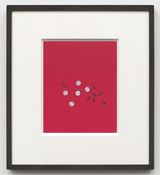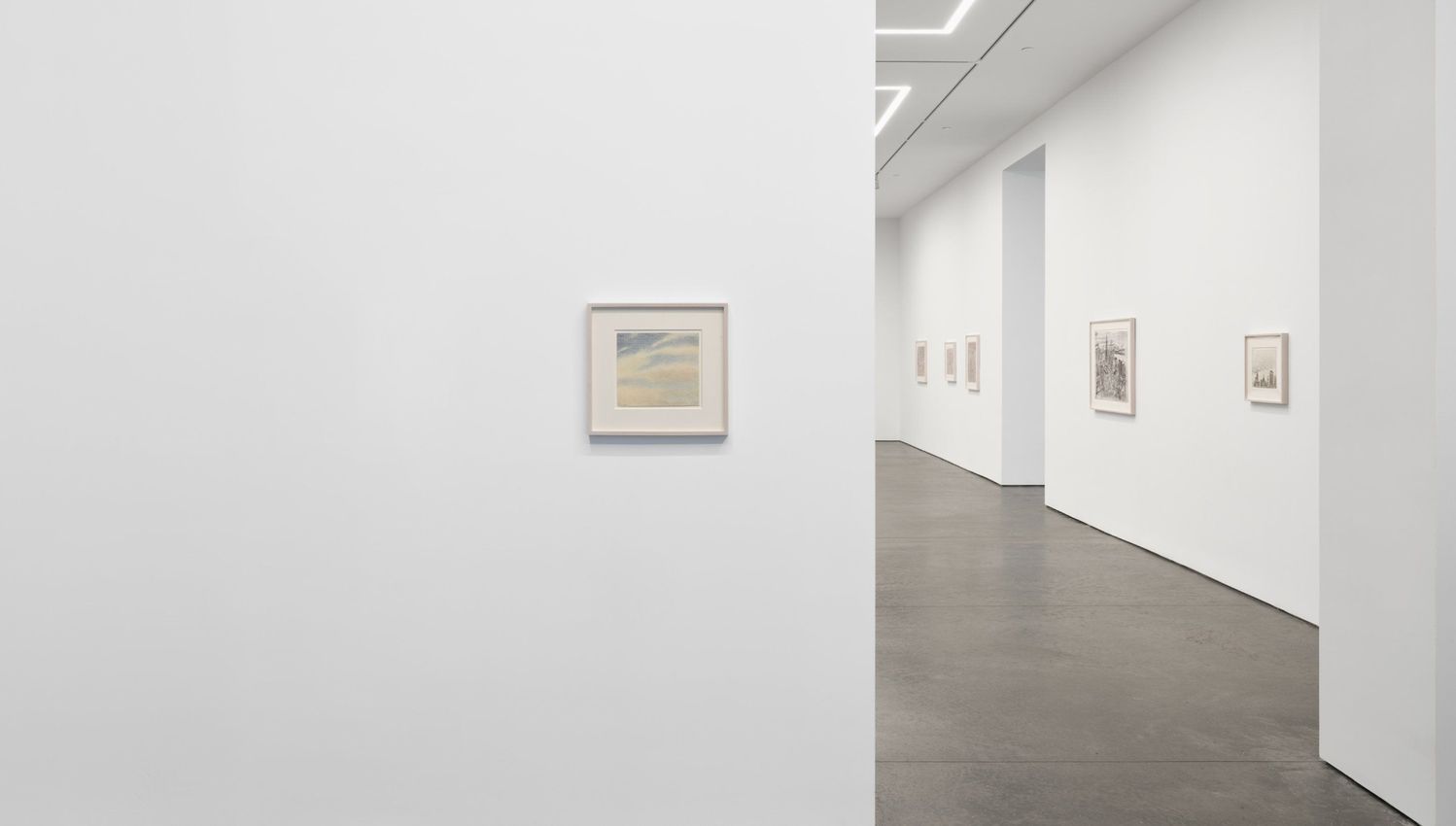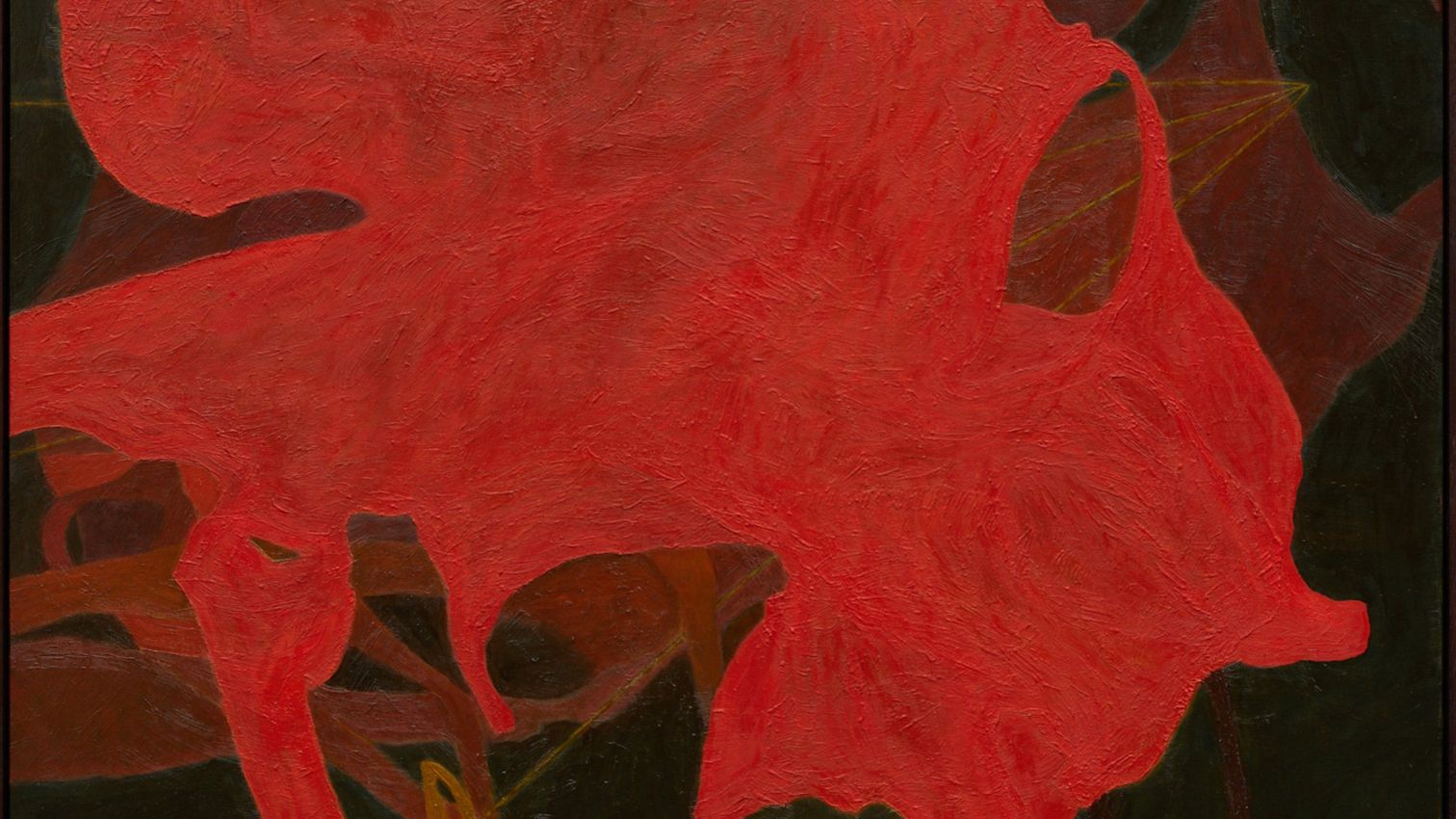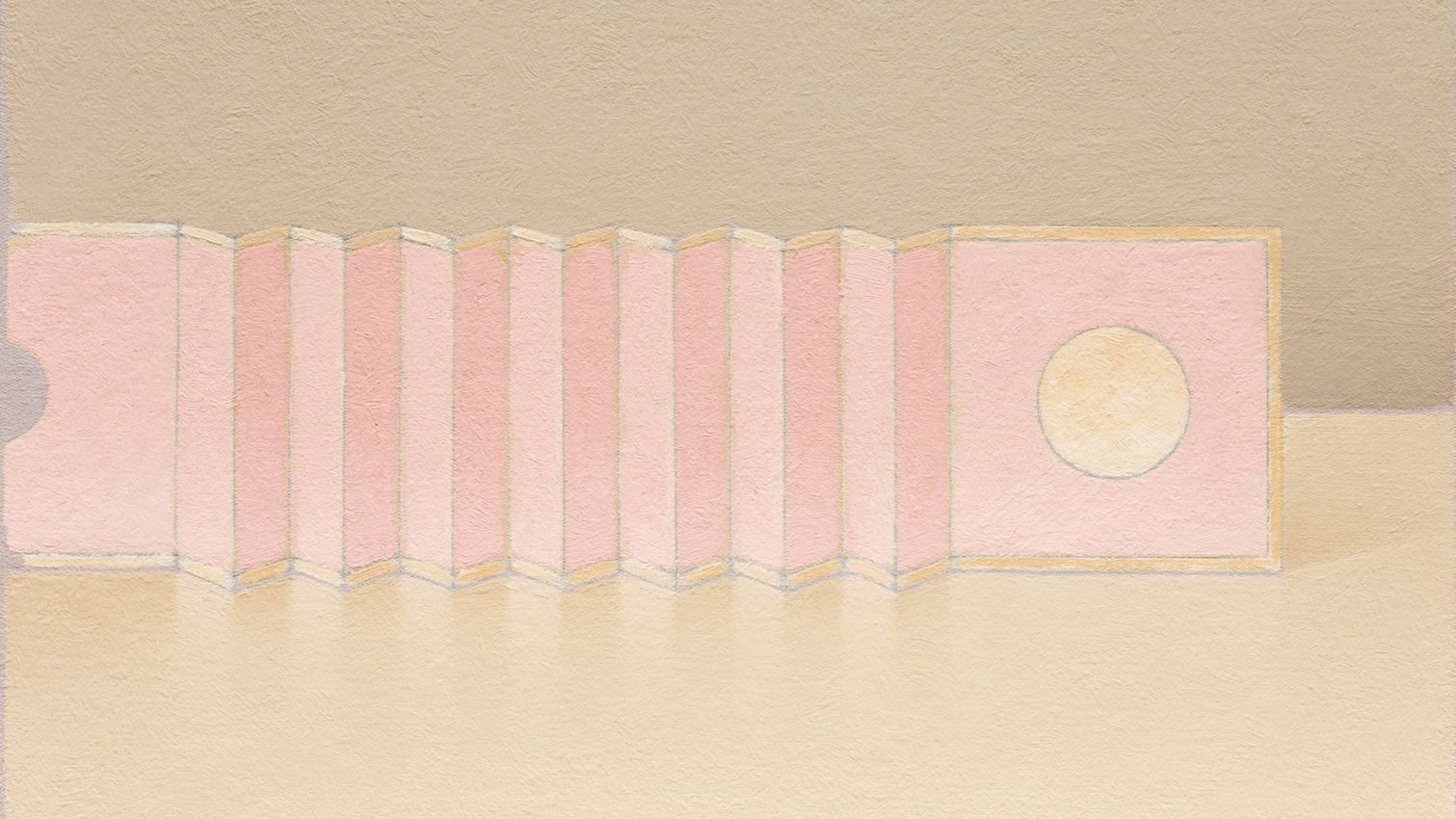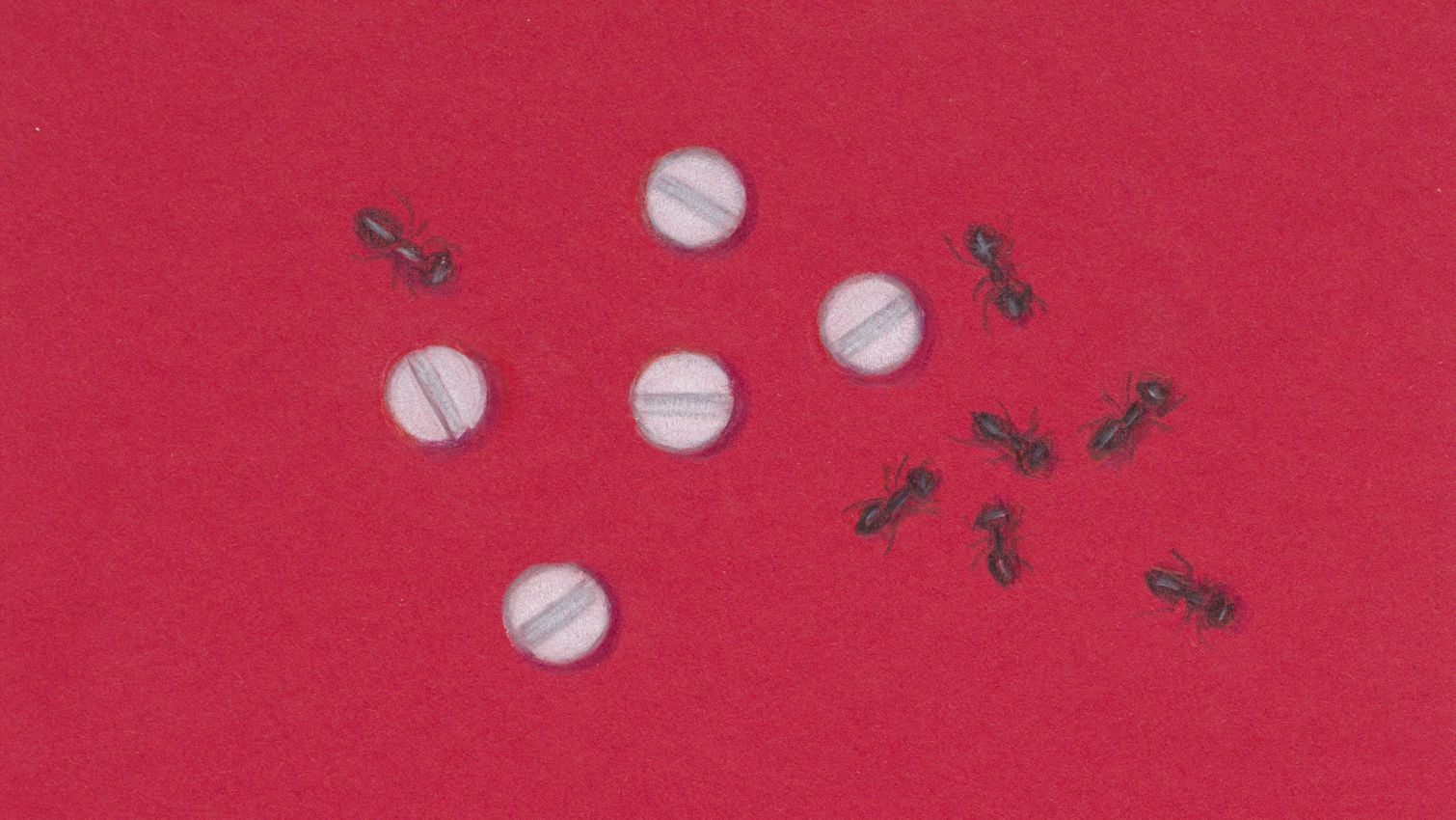
Corresponding to the letters of the Roman alphabet, the twenty-six drawings by Henni Alftan in ABC depict common objects floating against monochromatic grounds. Each composition contains an object or array of items whose English names begin with the titular letter—A (all works 2025) is for aspirin and ants, B is for Band-Aids, buttons, and buckles, and so on. The artist chose only objects small enough, in reality, to fit within the bounds of her approximately ten-by-eight-inch sheets of paper. Working with these constraints, Alftan’s visual alphabet engages questions of illusory and pictorial space, classification and hierarchy, and the relationship between image and language.
Without environments to orient them, the subjects of Alftan’s colored-pencil drawings invite morphological and conceptual connections, both within each frame and across her alphabet. In D, the dots on a die echo those on a pair of dominoes, the tines on the forks in _F _rhyme with the fingers on the glove in G. Categories can be read into various combinations: a Q-tip, inhalers, pills, nail varnish, and false eyelashes all speak to the maintenance of the body; legos and chess pieces to play; envelopes and pens to communication; screws, rulers, and a knitting sample to the labor of creation. Beyond taxonomies of use or alliterative initials, the possibilities for surprising or uncanny resonances between objects animate these works. As in her paintings, where tightly cropped scenes and fragmented bodies withhold access to seamless narratives, it is up to the viewer to find their own meaning in this evocative collection of objects. For Alftan, the world that might extend past the bounds of the frame—the implications an image carries—is always part of the whole picture. A number of the subjects in the _ABC _drawings also appear in her paintings, creating yet another link inside of her often self-referential practice.
Alftan presents her everyday subject matter realistically, at one-to-one scale, a gesture that evokes trompe l’oeil (or fool the eye) painting. Unlike that tradition, however, she isn’t relying on visual “tricks” like forced perspective or manipulated shadows. Just as her paintings depict plausible scenarios in a graphic, minimal style that sets reality at a remove, the flat backgrounds on which her dominoes, Xanax, and jelly beans rest declare that these objects exist not in real space, but in the space of the image. Presented head-on in what might first appear to be an objective, almost-forensic perspective—the artist as crime-scene photographer, capturing evidence—is revealed by Alftan’s soft, hazy pencil strokes to be a subjective exercise in composition. As the Duchampian comb in _C _reminds us, the artist’s intention turns the everyday into art.
While the _ABC _drawings resonate formally and conceptually with picture books used to teach the alphabet, her largely wordless works speak to language’s slipperyness rather than its logic. In N, Alftan puns on “nails,” as in the metal fasteners, and its homonym on our fingertips; the linear profiles of a hair elastic, hairpin, and hook in H suggest the outlines of letters and a question mark. Like hieroglyphs or other cryptic ciphers, these arrangements resemble symbols to be deciphered while confounding straightforward legibility. At times, the geometries of Alftan’s subjects push her compositions close to abstraction, only to be pulled back into representation by the objects that surround them. In P, a yellow, Joseph Albers-esque square is transformed into a Post-it by its association with a paper clip, its office supply companion. The juxtaposition of a sea urchin with a USB stick in U verges on surrealism. Drawing on both the elasticity and coded structures of language, Alftan’s drawings articulate a new poetics of the image.
Henni Alftan (b. 1979, Helsinki, Finland) is a Paris-based painter who creates pictures based on a complex process of observation and deduction. Working in figuration but rejecting a narrative dimension, Alftan’s compositions use the tight framing of close range photography to explore the similarities between painting and image-making. “I paint pictures,” Alftan says, and “painting and picture often imitate each other.” Inviting viewers to consider the history, materiality, and objecthood of painting, Alftan’s vignettes represent a fragmented vision of the real and address pictorial issues such as color, surface, flatness, depth, pattern, texture, and framing devices. Recent exhibitions include Karma, New York (2020); Studiolo, Milan (2019); TM-Galleria, Helsinki (2018); and Z Gallery Arts, Vancouver (2017).


A respected voice in contemporary art discourse.
Focusing on ambitious storytelling and insightful art-world commentary. Ocula Magazine publishes in-depth interviews, critical essays and timely analysis on the artists, exhibitions and ideas driving the global art world.
Learn more about Ocula Magazine
Showcasing the best of the art world.
Ocula partners with galleries from around the world to highlight their artists, artworks and exhibitions. Gallery membership is by application and invitation, with each member vetted by an independent panel.
Learn more about Ocula Membership

Specialises in the sale of major artworks.
Led by a team with deep ties to the world’s leading auction houses, galleries and collectors. Ocula’s advisory team offers bespoke services to high-net-worth clients from around the world who are looking to acquire the best of contemporary and modern art.
Learn more about our team and services