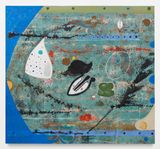
Musical notes, eyes, nodes, arrows, numerals, alien vessels, African masks, and modernist sculpture—these are among the vast range of symbols that recur throughout Ouattara Watts’s paintings. His densely layered compositions reflect his omnivorous approach to the histories of painting and visual expression more broadly: a single canvas by the artist, its surface composed of textiles and other materials, may shift between gestural abstraction, color fields, and figuration. Watts’s attention to materiality dates to 1977, when he arrived in Paris to study art from Abidjan, Côte d’Ivoire and began painting on tarpaulin. By the time he moved to New York City in 1988, he was already incorporating found objects and fabrics into his compositions. Across New Paintings, Watts sets his enigmatic signs among patterned fabric, papier-mâché relief, and paint-spattered floor cloths, holding the graphic and the gestural in tension.
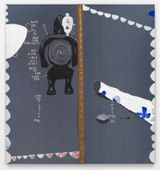
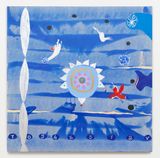
Watts often finds the beginnings of his paintings in the patterns of the textiles he collects from around the world. “It has got to talk to me,” he has said. “Sometimes, when I see a certain textile . . . I can see the painting.” In certain works, Watts integrates fabric into the ground itself. He extended the flat schema of a textile’s patterning into the composition of Untitled (2026), dividing the canvas into stacked registers of black-and-gold floral fabric, painted along one edge with a scalloped border. Elsewhere, he allows the cloth to set the palette and the motifs of the composition. Watts laid a square of Dutch wax fabric across the upper-left quadrant of My Favorite Thing (2026), echoing the swatch’s rosettes in the sky-blue forms he painted over and around it.
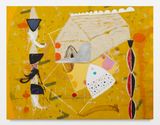
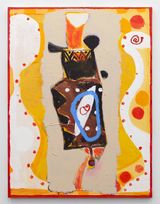
Other works start with materials from the studio itself. Assorted textiles line the walls of his Brooklyn atelier, and drop cloths covering the floor accumulate layers of spilled and splattered paint. Watts repurposed an orange drop cloth, stained with both the residue of earlier paintings and his own footprints, for the ground of Intercessor A to Z (2025–26). Atop it, scattered marks and symbols depict, among other imagery, a house, a tree, and a pattern-like motif abstracting the Egyptian pyramids into a row of triangles. The artist also builds up surfaces from papier-mâché mixed with leaves, as in The Knowledge Transmitter #1 (2025–26), where the composite spans the canvas in two fields of coarse, earthen strokes. Between them he set a swatch of cotton—painted with a red S—alongside his own photograph of a carved-wood African mask, not unlike those he keeps throughout his studio.
Watts’s iconography spans continents and centuries as he draws connections between distant cultures. “In a single body of work,” writes curator Lawrence Rinder, “he may incorporate Senufo and Bambara standing figures, Dogon symbols, cosmological diagrams and numerological charts, Ethiopian Amharic script, a grand piano, antique European lace . . .” In several paintings here, including The Knowledge Transmitter #2 (2025), a stacked pillar recalls both Constantin Brâncuși’s Endless Column, whose repeated forms suggest infinite extension, and the hand-carved wood ladders regarded in Dogon cosmology as links between earthly and ancestral realms. In The Knowledge Transmitter #3 (2026), Watts moved beyond the spiritual and into outer space: two extraterrestrial figures stand at either side of the monumental canvas like sentinels, flanking a spaceship that hovers against a ground of gold damask.
In his studio, Watts works fluidly between canvases, and music plays continuously. The artist revisits elements in each painting as new possibilities emerge in a process that draws on the improvisation of jazz. My Favorite Thing is his tribute to saxophonist John Coltrane, who would have turned one hundred this year. Just as the musician returned to the same tunes over years of performance, reharmonising them through a system known as the “Coltrane matrix,” Watts considers no painting finished. Each work remains open-ended, reflecting both the evolving nature of his practice and the longer history of human civilisation, as he recasts ancient signs, ornate textiles, and other materials in new configurations.


Outtara Watts (b. 1957, Abidjan, Ivory Coast) is an American artist who uses brilliant colors, dynamic patterns, and hypnotic signs and symbols to explore the spiritual ties between people that transcend location or nationality. He constructs fantastic landscapes and mystical scenes to examine these metaphysical relationships. Watts has established a large lexicon of quantitative, geographic, musical, and scientific symbols and forms, both modern and ancient, to communicate his dynamic vision. Taking inspiration from Africa, his Parisian education, and his life in New York, he combines found artifacts, fabric, collage, and traditional painting and drafting methods, creating images that invoke his multicultural identity and give rise to various socio-historical readings. As he has stated: “My vision is not bound to a country or continent...While I use identifiable pictorial elements to be better understood, this project is nevertheless about something much wider. I am painting the Cosmos.” Watts studied at L’École Nationale Supérieure des Beaux-Arts in Paris, France, before relocating to New York in 1989.


A respected voice in contemporary art discourse.
Focusing on ambitious storytelling and insightful art-world commentary. Ocula Magazine publishes in-depth interviews, critical essays and timely analysis on the artists, exhibitions and ideas driving the global art world.
Learn more about Ocula Magazine
Showcasing the best of the art world.
Ocula partners with galleries from around the world to highlight their artists, artworks and exhibitions. Gallery membership is by application and invitation, with each member vetted by an independent panel.
Learn more about Ocula Membership

Specialises in the sale of major artworks.
Led by a team with deep ties to the world’s leading auction houses, galleries and collectors. Ocula’s advisory team offers bespoke services to high-net-worth clients from around the world who are looking to acquire the best of contemporary and modern art.
Learn more about our team and services