Press Release

Dual Dialogue marks Tatehana’s fourth solo exhibition at KOSAKU KANECHIKA. During the artist’s 2017 opening show at the gallery titled, CAMELLIA FIELDS, a sentimental recollection of Tatehana’s hometown, Kamakura, and its natural landscapes were overlaid upon the unique perspective of life and death found in Japan. Drawing from the vanishing point perspective that is often found in Western paintings, conceptual dualities and the notions of such boundaries were illustrated with an overarching perspective during the artist’s 2018 show, Beyond the Vanishing Point.

During Tatehana’s 2019 solo exhibition, WOODCUTS, a foundation of 1960s American minimalism was demonstrated through the artist’s experimentation of the ‘specific objects’ concept. Inspired by the classic motif of Genji-koh incense culture consisting of five straight lines, it was also during this exhibition that a new form was created, dissolving the confines between sculpture and painting.

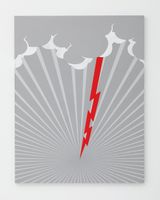
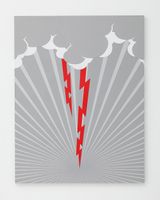
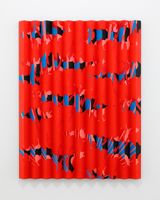
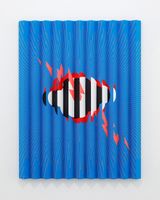
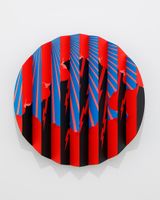
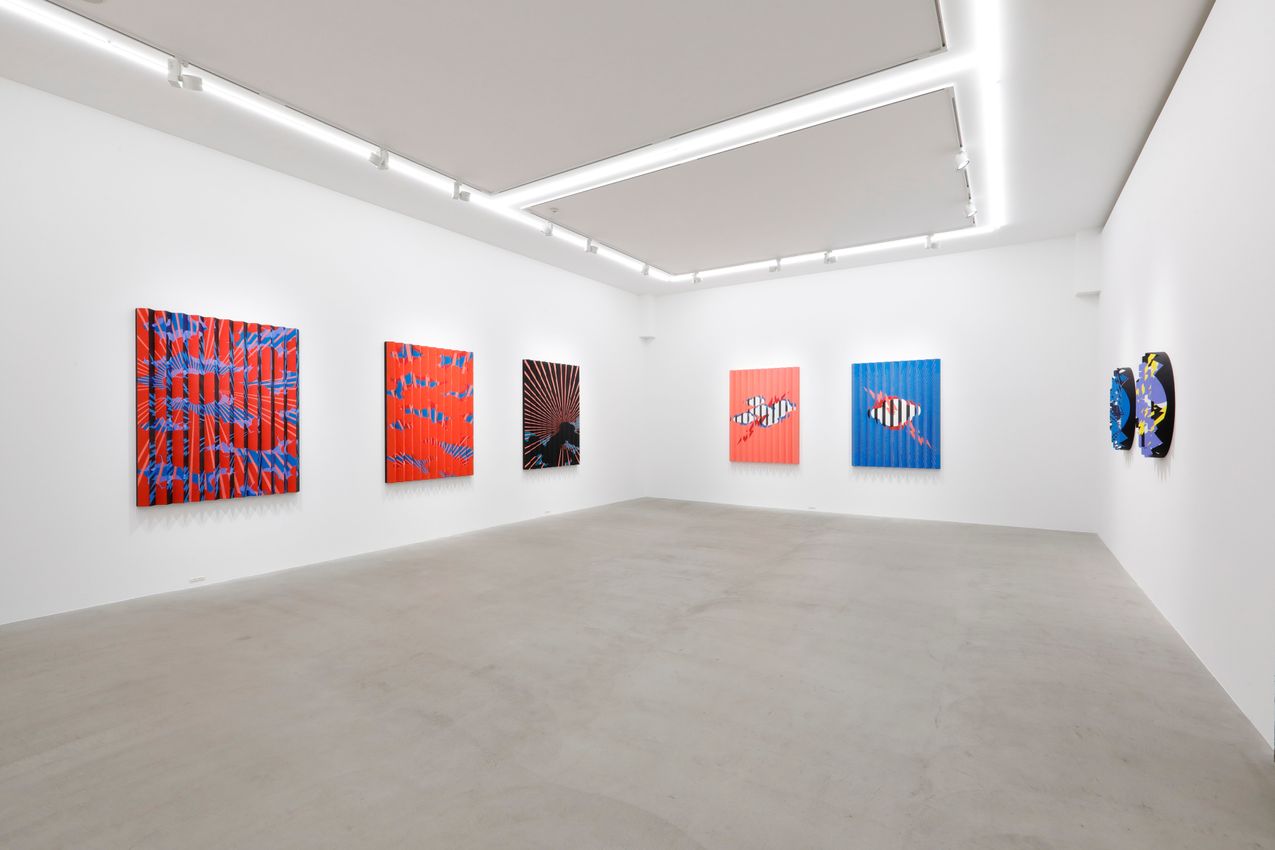
As both the title and theme of this current exhibition, Dual Dialogue, was born out of both opportunity and reflection found during the period of self-quarantine during the COVID-19 pandemic. Working tirelessly to create a new form of expression, it was during this time that a pairing of elements was derived from a dialogue between the artist and his contemplation of historical Japanese culture. Through the artist’s newest series of paintings titled, Duality Painting, a further expansion of the medium is expressed through Tatehana’s mastery.

Regarding his Duality Paintings, Tatehana has stated the following —

Just as the simple act of embracing another person turns two beings into one, by exploring the affinity between different symbolic elements such as ‘life and death’, ‘heaven and earth’, ‘man and woman’, reconstructions of such concepts upon a screen yield a formal expression of syncretism.

Formerly in Japan, there existed a phenomenon known as ‘shinbutsu shūgō’, where the Shinto and Buddhist religions were merged after a history of repeated separation and integration. Since the introduction of Buddhism in the 6th century from the Korean kingdom of Baekje, the joined dogma of belief developed as a single body in Japan, and has long been revered in Shintoism as the ‘three sacred treasures’ of jewel, mirror, and sword. It was also during this time of preliminary fusion that the reproduction of heavenly beings in imagery is said to have begun. Furthermore, from the 8th century, succeeding the Nara period, a formalised and widely-accepted amalgamation of Shinto and Buddhist traditions led to the establishment of sites known as ‘jingu-ji’ and ‘shingan-ji’, where Buddhist temples would be found within a Shinto shrine’s compound. Readily normalised in various aspects of society and culture, this syncretism of religions began to spread swiftly from the capital to its neighboring regions. It would be much later in history that an official decree to separate Shintoism and Buddhism would take place during the Meiji Restoration (1868), effectively banning the ancient practice of fused Shinto and Buddhist traditions. With Shintoism newly instated as the state-ordained religion, this separation in ideology would lead to a nation-wide rejection of Buddhism as a belief. Coinciding with the Meiji Restoration, Japan would decide to open its country following several centuries of isolation. Aiming to modernise by allowing an influx of foreign influences, the conception of modern Japan can also be viewed under the lens of syncretism. One could say that such blended values are unique to Japan in comparison to other countries.

The fusion of seemingly contradicting concepts creates new meanings and interpretations. As stated by Tatehana, such oppositions appear more common and natural than perceived when considering the tides of Japanese history. The approach of shining a new light through juxtaposing contrasting elements to unearth lesser-known characteristics has also been used continuously within art and academic research. It can be said that such considerations have become even more important in the present-day as a shift in values has become essential for survival. In reflecting upon the history of Japan, it is through the unique aesthetics that have been nurtured throughout centuries, and the rich resources of culture and thought, that one is able to find a new perspective yielding the future’s potential.

In light of the ongoing COVID-19 pandemic, such a calamity has served as an opportunity to deepen the artistic process of Tatehana’s creativity. Largely centered around the artist’s new body of two-dimensional works, we cordially invite you to attend Noritaka Tatehana’s solo exhibition, Dual Dialogue, at this time.

Click to view VR viewing room of the exhibition here

Read More
About the Artist

Noritaka Tatehana presents a redesigned worldview by combining elements of traditional Japanese culture with those of the contemporary era. His carefully honed artistry is elegantly expressed through various media, and his creations, which nurture the sensitivities of Japanese history, tradition,and innovation, burst with endless possibilities for the future. Gaining the attention of audiences all over the globe, Tatehana is known for his ‘Heel-less Shoes’ series inspired by takageta – elevated wooden clogs worn by traditional Japanese courtesans. The artistʼs works have been acquired by internationally acclaimed institutions such as the Metropolitan Museum of Art in New York, and the Victoria & Albert Museum in London.

View Artist Profile

Also Exhibiting at KOSAKU KANECHIKA

About the Gallery

Founded in March 2017 by director, Kosaku Kanechika, KOSAKU KANECHIKA is a contemporary art gallery in Tokyo, Japan, that belongs to a new generation of venues re-defining the local contemporary art landscape. The gallery showcases Japanese artists who are renowned domestically and on an international scale, representing Yutaka Aoki, Junko Oki, Takuro Kuwata, Ataru Sato, Chikashi Suzuki, Noritaka Tatehana, and fumiko imano. The gallery also hosts exhibitions featuring overseas artists such as Dan McCarthy and Ruby Neri, introducing artists that engage in novel expressions transcending both medium and genre.

View Gallery Profile
Address
TERRADA Art Complex 5F
1-33-10 Higashi-Shinagawa
Shinagawa-ku
Tokyo
Japan
Opening Hours
Tuesday – Saturday
11am – 6pm
(1)
Tokyo TERRADA Art Complex 5F, 1-33-10 Higashi-Shinagawa
KOSAKU KANECHIKA
TERRADA Art Complex 5F, 1-33-10 Higashi-Shinagawa, Shinagawa-ku, Tokyo, Japan

Opening hours
Tuesday – Saturday
11am – 6pm
The art world in focus