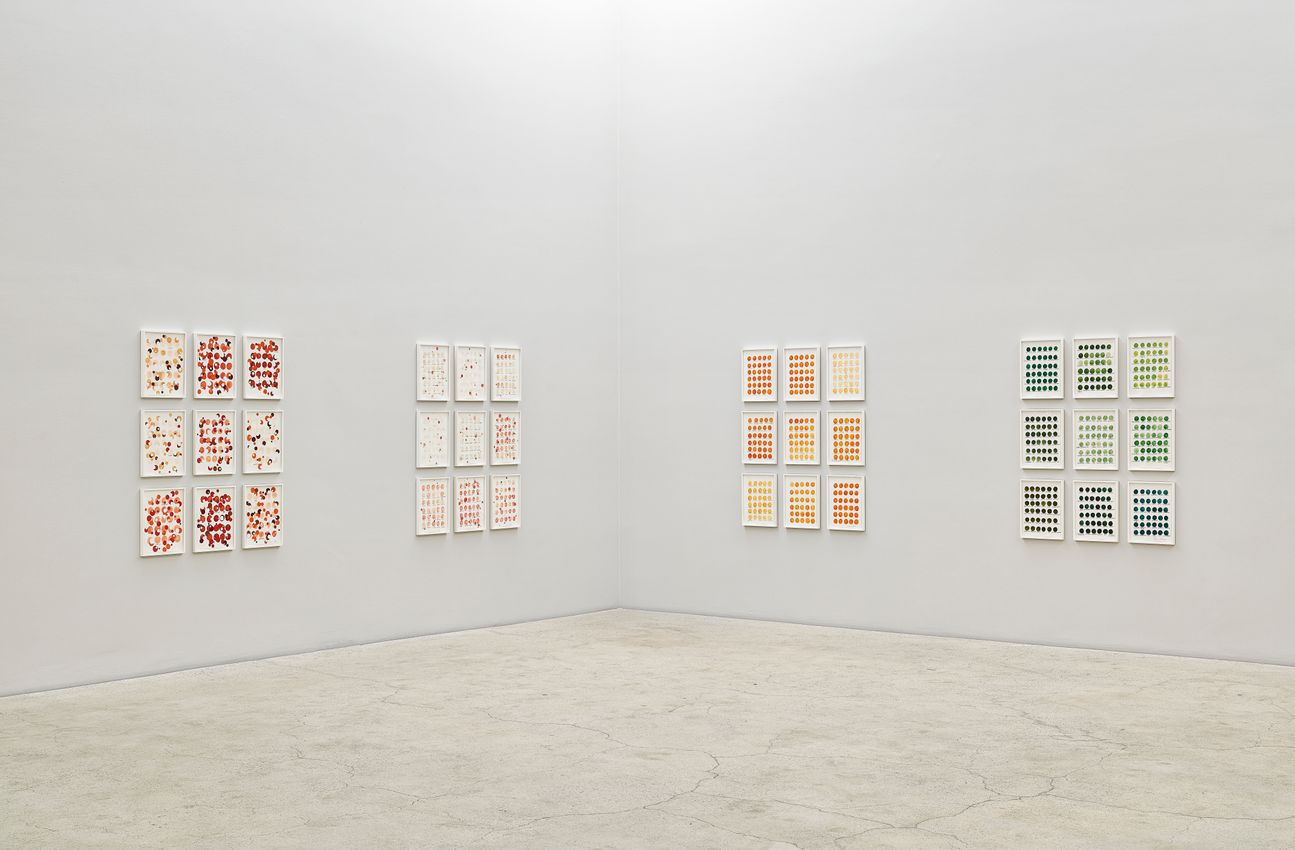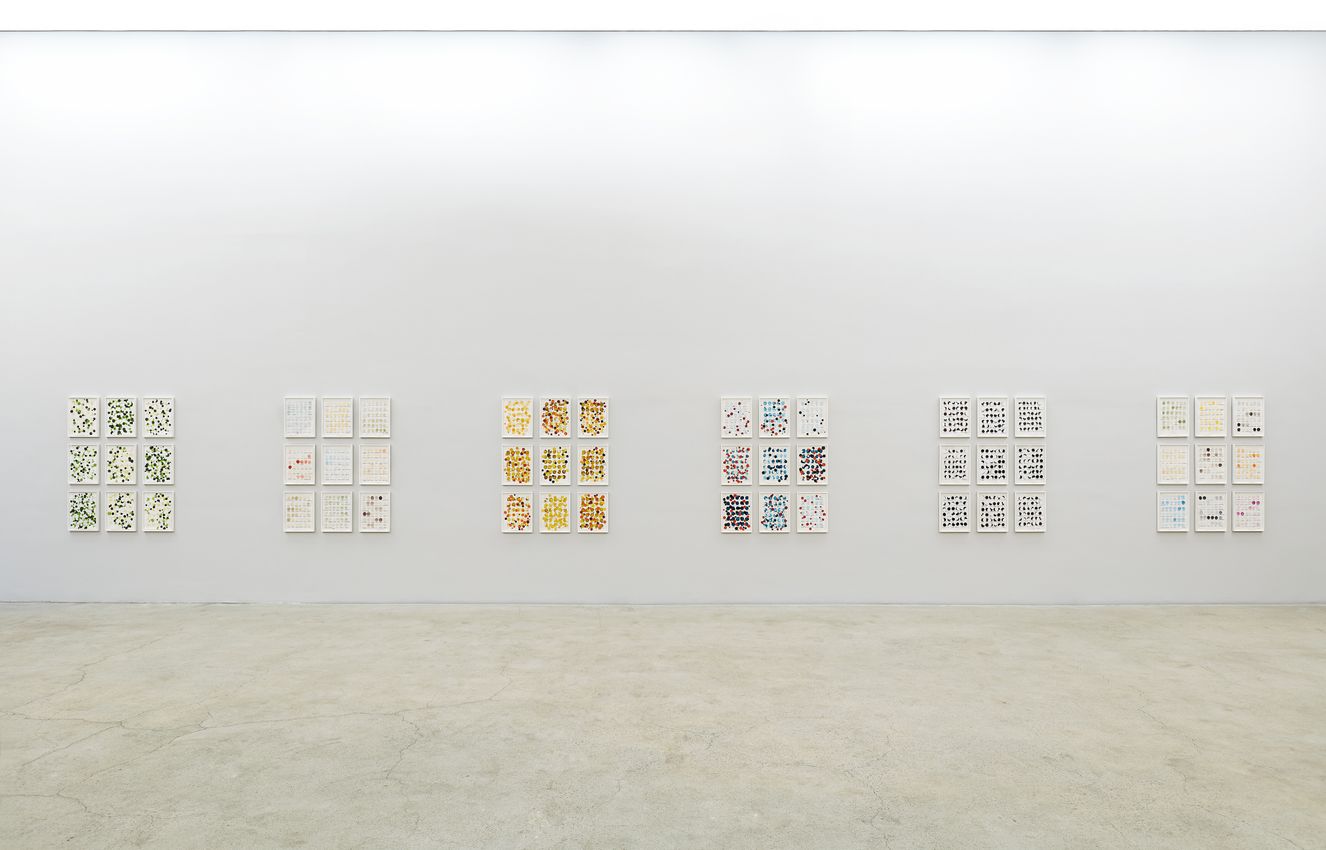
Kukje Gallery is very pleased to announce the exhibition of Roni Horn’s Remembered Words. Installed in K3, this will be the artist’s fourth show at the gallery and will mark the first time over the artist’s career to focus specifically on this series. Created in 2012-2013, Remembered Words consists of discrete sets of drawings, representing a major body of work by the internationally celebrated artist.
For Horn, drawing is a vital part of her practice that she returns to again and again, allowing her to examine themes of language and identity alongside the poetics of juxtaposition, punning, and materiality. This interest in wordplay and the slippery correspondences between meaning and memory inform Remembered Words, which as a full group of works lining the gallery walls, creates an almost infinitely complex and open-ended cultural lexicon.
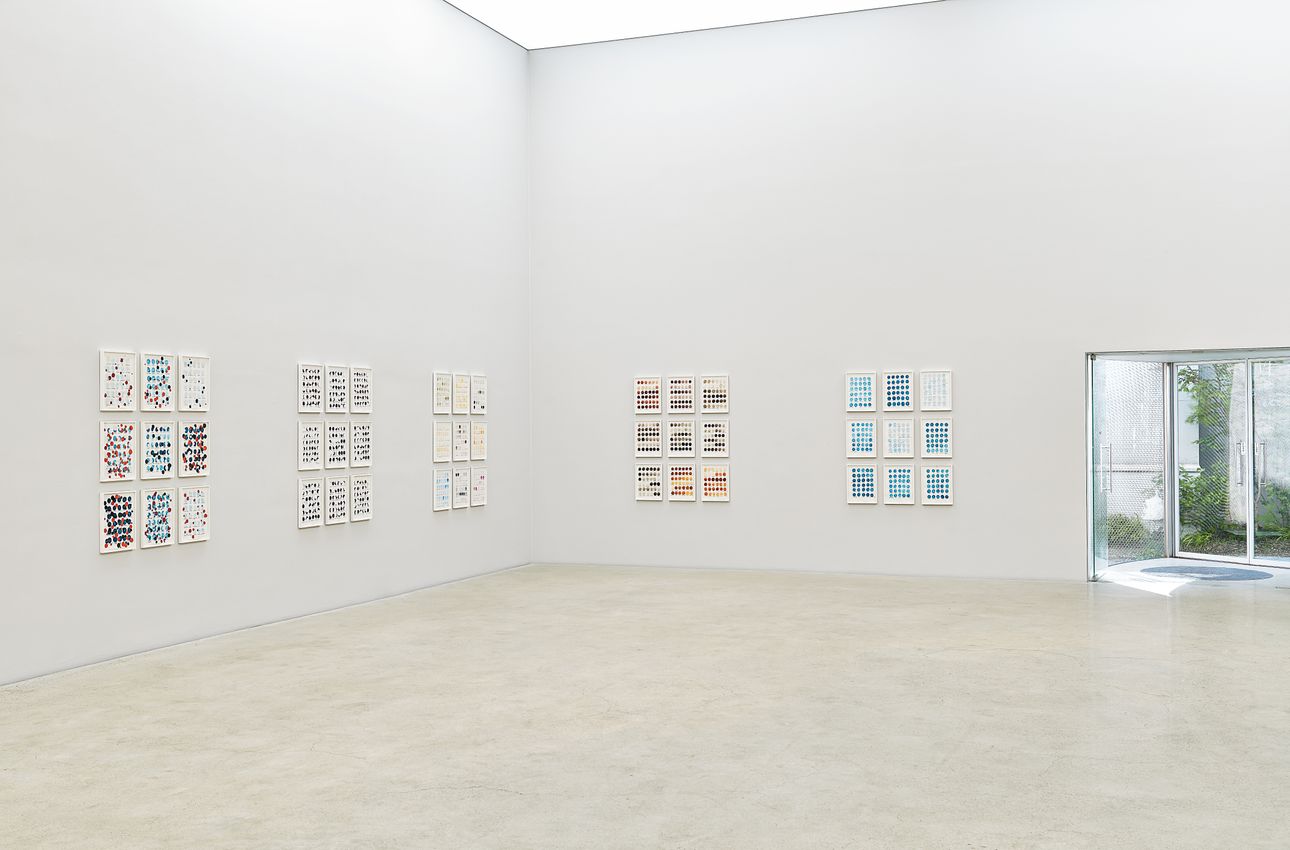
Each of the individual works is a composite of nine parts arranged in a 3x3 grid of framed drawings. Each individual drawing is 15 x 11 inches and contains hand-painted circles in watercolour. These circles are either presented in a grid-like pattern with words written beneath them or appear in disorderly clusters with words jumping in and out in a more rhythmical manner. Resembling something like a scientific taxonomy or a display of forensic clues, these ordered constellations of circles and notations loosely correspond to their title and each other, building in correlations that are at once logical and mind-boggling. So, for example, in Remembered Words—(The Supremes) we get from left to right: rebus, sissy, humpback, bogus, and unface amongst 270 other words jostling for attention. Likewise in Remembered Words—(Ho Ho Ho) we wrestle and cavort with soapy, lavender, walk, malt, pollute, hallucinogen, and so on, with words pinging from frame to frame and across the room. In this way, the artist and audience mutually share their own unique stream of consciousness visually through the title, colours, and words in each set.
In addition to Horn’s uncanny vocabulary, she groups each work loosely within a colour spectrum, allowing the palette to organize another register of meaning. Some of these colourful clusters of spheres look like lunar observations on a cloudy night, others swatches of the jungle or a mysterious rash. There are grids of meticulous colour-coordinated circles, and others are more like blobs or hastily charted directions, bleeding into one another. The spaces between the repeated forms and the way they sometimes touch highlight her highly specific use of colour and choice of water-based medium: siennas and greens, yellows, greys, blacks and blues, and blood red, gradations ranging from a dense opacity to dilute hues.
Evoking the experimental syntax of Gertrude Stein’s poetry and what the British art historian Briony Fer calls ‘micro-poetics of small convergences,’ Horn’s Remembered Words act as triggers. In this way Remembered Words powerfully links to other bodies of work for which Horn is celebrated. In particular, her drawings utilize meticulous cut-and-paste methods to reengineer meaning as exemplified by her series Hack Wits and the beguiling pools of colour the artist captures in her cast glass sculptures. In both, the instability of the subject is foregrounded, evoking the vagaries of weather and the subtle contingencies of each individual thing, what Fer suggests, referring to Remembered Words, is their ‘own version of turbulence.’


Roni Horn was born in 1955 in New York. She has studied at the Rhode Island School of Design (BA) and Yale University (MFA). Since the mid-1970s Roni Horn has produced sculpture, photography, drawings, and books, stretching the definition of each genre. Her works are grounded in a practice of incisive philosophical inquiry and material study that explores nature, identity, and duality. Horn’s broad oeuvre consistently challenges identity politics by dissecting and juxtaposing images and texts with objects, creating deeply resonant dialogues between the different mediums. By focusing on highly mutable subjects, Horn has consistently explored human perception and the visual experience of our changing natural environments. By capturing the continuous flux inherent in water, light, and weather, for example, the artist is able to crystallize her broader interests in the relationships between places and things. By grouping portraiture with objects and drawing, Horn reveals the complex relationship between the viewer, her work, and the dichotomy between the moment of visual perception and the lingering effects of one’s memory.


Established in the heart of Seoul in 1982, Kukje Gallery is a leading Korean gallery dedicated to showcasing works by Korean and international artists and promoting modern and contemporary art. At 54 Samcheong-ro, Jongno-gu, the gallery has 3 key exhibition spaces, respectively named K1, K2, and K3. In 2018, the gallery opened a second location in F1963, a cultural complex housed in a former wire factory in Suyeong-gu, Busan.

A respected voice in contemporary art discourse.
Focusing on ambitious storytelling and insightful art-world commentary. Ocula Magazine publishes in-depth interviews, critical essays and timely analysis on the artists, exhibitions and ideas driving the global art world.
Learn more about Ocula Magazine
Showcasing the best of the art world.
Ocula partners with galleries from around the world to highlight their artists, artworks and exhibitions. Gallery membership is by application and invitation, with each member vetted by an independent panel.
Learn more about Ocula Membership

Specialises in the sale of major artworks.
Led by a team with deep ties to the world’s leading auction houses, galleries and collectors. Ocula’s advisory team offers bespoke services to high-net-worth clients from around the world who are looking to acquire the best of contemporary and modern art.
Learn more about our team and services