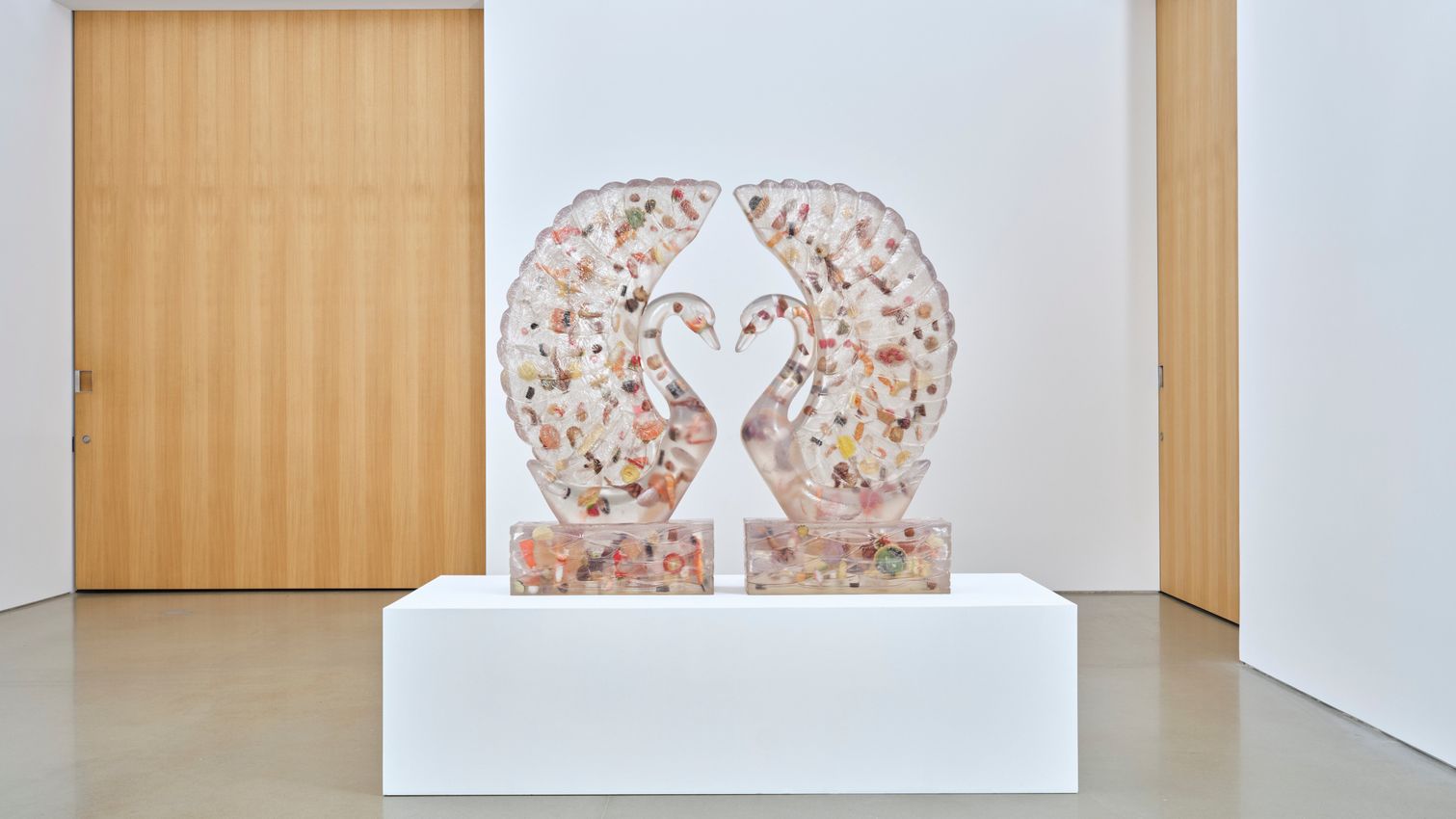
kurimanzutto presents a selection of sculptures, drawings, photographs, and a film in Neurotics Anonymous, Miguel Calderón’s first solo exhibition at kurimanzutto New York. Drawing on the visual language of the twelve-step program Neurotics Anonymous, founded in 1964, Calderón explores themes of desperation, anxiety, and vulnerability. Known for work that incisively and humorously examines human behavior, emotional turbulence, and the social rituals that shape our lives, Calderón brings together a wide-ranging body of work that underscores the breadth of his practice. The exhibition continues his ongoing investigation into the porous boundaries between personal experience and fiction.
A key piece in the show is a marble sculpture in which Calderón reinterprets the visual identity of the “Neurotics Anonymous” program—its flyers, brochures, posters, and graphic motifs—transforming chaotic depictions of inner turmoil into a form that echoes classical allegories of ideals such as Justice, Wisdom, Victory, and Peace. The work also carries personal resonance, as the artist’s mother was involved in a similar support group, grounding the project in intimate experience. Another major work in the exhibition is the ongoing film Cocteleitors, presented here as a fragment of a larger project. In it, Calderón explores the subculture of los cocteleros (‘cocktail hunters’)—a group of characters who crash art openings in Mexico City using fake press passes. For them, these events and their complimentary cocktails have become a means of survival. The cocteleros form a tight-knit group, bonded by shared experience.
Their gatherings offer a space where they are neither judged nor excluded, providing a sense of belonging in contrast to their broader social marginalization. While their lifestyle may appear superficial, it is often rooted in deeper ideological and political positions. By following them through their relentless pursuit of free food and drinks, Calderón constructs a surreal yet biting exploration of access, performance, and the blurred lines that define the contemporary art world. Beyond the film, the exhibition also includes a portrait of one coctelero and a sculptural series that expands this critique, satirizing the coded behaviors and unspoken rules of social life.
Social Climber is a standout sculptural work consisting of five large metal panels that resemble climbing walls. Embedded with faux stones designed to mimic primitive anthropological carvings, the panels address the desire for social ascent and the performative nature of success. From a distance, the structures read as abstract compositions; up close, they reveal faces with distinct phenotypes, subtly evoking systems of hierarchy and classification.
Also included in the exhibition is Revisited Ex-Voto, a deeply personal work drawn from Calderón’s family history. In 1974, his father, a professional race car driver, survived a severe crash. As a gesture of gratitude for what he saw as divine intervention, he created an ex-voto—a traditional votive offering, often in the form of a plaque—using crash site photographs and typed messages of thanks. Decades later, Calderón discovered a photograph by tabloid photographer El Buitre (” The Vulture”), who had often documented his father at races. Taken from a cliff above, the image captured a wreck that transported Calderón back to the moment of near-tragedy. In response, he recreated the scene from memory in Revisited Ex-Voto, a large-scale photograph that blurs the line between fact and fiction, raising questions about spectacle, memory, and the compulsion to document catastrophe.
Another key series, Studies for Monumental Sculptures, features works made from bent speedometer needles that function as speculative models for imagined public monuments. Presented as archaeological artifacts, these pieces evoke both the mythology of speed and Calderón’s personal connection to car racing through his father.
The exhibition also includes a collection of 19 ink drawings developed over time as a form of introspective release. Combining automatic drawing with focused observation, these works map a symbolic universe drawn from Calderón’s subconscious. A bizarre real-life event—a snakebite to the artist’s forehead while he was asleep in his home—recurs throughout the imagery, serving as both a literal memory and a metaphor for transformation.
Additionally, the exhibition features several photographic series, including one exploring a chromatic range within shades of black, and another from 2005 titled SOS, in which the artist attempted to place a phone call from every emergency phone booth along a Colombian highway after becoming stranded when his car broke down.
With Neurotics Anonymous, Calderón offers a sharp, ironic, and deeply personal meditation on identity and the structures that shape our emotional lives. Blending intimacy with satire, and documentary with invention, the exhibition invites viewers to reflect on the strange rituals we create to endure, connect, and survive.
Miguel Calderón explores a broad range of themes, from violence and corruption in Mexico to youth and family dynamics to the supernatural. However, his work is unified by an ever-present sense of theatricality, questioning the fine line between reality and fiction. Frequently cast from the perspective of an outsider, he highlights the macabre complexity of man’s position in the universe deftly weaving together mockery, foolishness, social critique and sincerity of emotion. He creates works from a mashup of vernacular references, employing a variety of media, including video, photography, sculpture and painting. For Calderón, it is important that art be accessible; he came of age as an artist in Mexico during the 1990s, when he was a key figure in the development of a young alternative art scene in Mexico, associated with the non-commercial art space he co-founded called La Panadería.

In November 2022, kurimanzutto opened a 6,500 square foot space at 516 West 20th Street in the Chelsea neighborhood of New York City. kurimanzutto in New York represents an extension of the original gallery in Mexico City: this reaffirms its mission to create new spaces and situations that will transmit the gallery’s spirit, where the artist is central to its existence. With this new project kurimanzutto seeks to establish even stronger connections to artists, institutions, and art professionals who have accompanied them across their evolution. It is a way to maintain and confirm their commitment to the development of the artistic current that lives and breathes in the city. The physical presence of kurimanzutto in New York will both invite and enable this type of happening.

A respected voice in contemporary art discourse.
Focusing on ambitious storytelling and insightful art-world commentary. Ocula Magazine publishes in-depth interviews, critical essays and timely analysis on the artists, exhibitions and ideas driving the global art world.
Learn more about Ocula Magazine
Showcasing the best of the art world.
Ocula partners with galleries from around the world to highlight their artists, artworks and exhibitions. Gallery membership is by application and invitation, with each member vetted by an independent panel.
Learn more about Ocula Membership

Specialises in the sale of major artworks.
Led by a team with deep ties to the world’s leading auction houses, galleries and collectors. Ocula’s advisory team offers bespoke services to high-net-worth clients from around the world who are looking to acquire the best of contemporary and modern art.
Learn more about our team and services