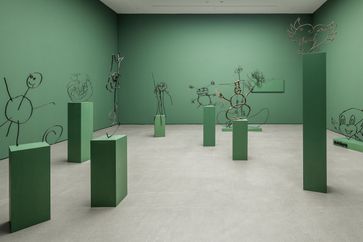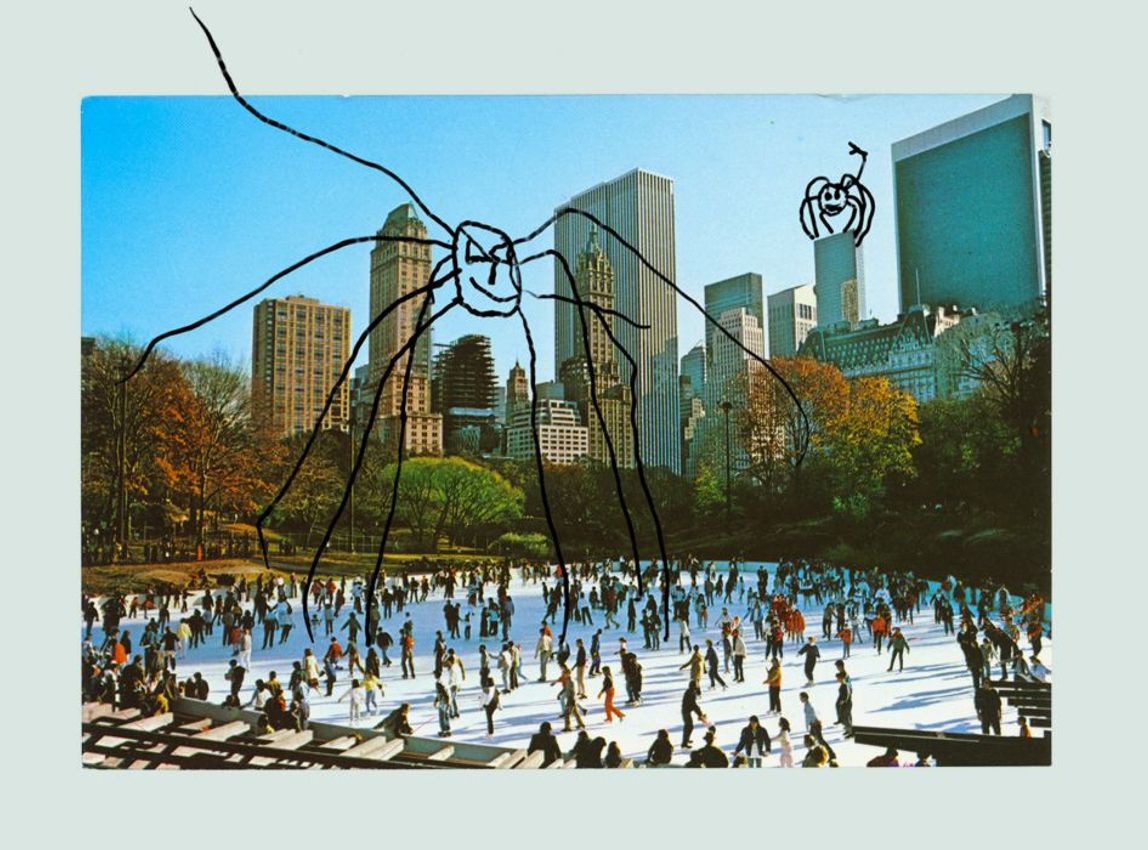
Abetare (Noisy Classroom) is Petrit Halilaj’s first solo exhibition at kurimanzutto New York. Halilaj exhibits disused desks covered in the scratches and doodles of children that he found in Kosovar schools following extensive research through the country to acquire them and then bring them to his Berlin studio. In Berlin he re-elaborated and assembled the old desks into sculptural objects, whose accreted doodles are the inspiration for the artist’s well-known series of bronze and steel sculptures titled Abetare, some of which is currently on display at the Metropolitan Museum of Art as their Roof Garden Commission (on view through October 27, 2024). Alongside and even incorporated into this new body of work are bronze sculptures from Abetare, which transform children’s casual drawings on their desks into three-dimensional forms. Halilaj reimagines kurimanzutto as a classroom where sculptures reflect upon language, youth, and community in the context of Kosovo’s recent history as well as the power of fantasy to overcome, whether it be a banal school lesson or the menace of war, and ultimately vitalize.
This playful exhibition extends Halilaj’s ongoing series Abetare, which borrows its name from the textbook Albanian speakers, including Halilaj, used to learn the alphabet in school. Abetare takes its varied and lively forms from drawings and sketches of schoolchildren carved into their desks; Halilaj turns these daydreams and small acts of rebellion into tridimensional, expansive spatial creations. Noisy Classroom marks a major artistic undertaking for Halilaj. It will be the first time that the desks make their appearance as wall-mounted, sculptural objects. Previously, the desks have been elements integrated into larger installations, but never have they been integrated, combined and modified to become standalone artworks.
“For Noisy Classroom,” Halilaj explains, “I have taken this project back to its roots: the classroom,” and this is reflected in the gallery space itself, which has been transformed into a traditional classroom inspired by the artist’s own memories and experiences. Unlike the standard classroom, Halilaj fills the walls with doodled-on school desks hued in vivid colors. The desks’ inclusion as an element in conversation with the sculptures is new, realized specifically for this iteration of Abetare. From afar, they appear as minimalist paintings, but upon closer inspection, the viewer can see children’s doodles and sketches decorating the wooden surfaces.
Accompanying these desks are Halilaj’s recognizable bronze sculptures from the series Abetare, rendering recurring motifs - hearts, homes, stars, among others– in three dimensions, and in Halilaj’s words, these are presented “in various states of wishfulness and brokenness.” Together, the sculptures and desks create their own spatial logic: they play across the walls, the floors and the ceiling of the gallery, reimagining the classroom as a dreamscape.
To accompany the exhibition, Halilaj has invited Albanian curator Eriola Pira to program a series of three workshops during the run of the exhibition (September 14, September 28, and October 19, each starting at 3:30 pm), activating the classroom as an experiential space for engaging with and embodying the Albanian language. Through aural, oral, and movement-based activities, participants of all ages are invited to recreate and experience a formative learning memory from Halilaj and Pira’s childhoods in Kosovo and Albania. Both living in the diaspora, this collaboration pays respect to the role Albanian intellectuals and artists in the diaspora have played in the establishment, practice, and resilience.
Petrit Halilaj is a highly regarded contemporary artist whose installations, sculptures, drawings, and performances investigate themes of memory, collective history, and cultural identity shaped by displacement and war.

Kurimanzutto was first conceived in the late 1990s in New York by Mónica Manzutto, José Kuri and Gabriel Orozco. They imagined a gallery that could exist nomadically, adapting its form to the spaces needed by specific projects.

A respected voice in contemporary art discourse.
Focusing on ambitious storytelling and insightful art-world commentary. Ocula Magazine publishes in-depth interviews, critical essays and timely analysis on the artists, exhibitions and ideas driving the global art world.
Learn more about Ocula Magazine
Showcasing the best of the art world.
Ocula partners with galleries from around the world to highlight their artists, artworks and exhibitions. Gallery membership is by application and invitation, with each member vetted by an independent panel.
Learn more about Ocula Membership

Specialises in the sale of major artworks.
Led by a team with deep ties to the world’s leading auction houses, galleries and collectors. Ocula’s advisory team offers bespoke services to high-net-worth clients from around the world who are looking to acquire the best of contemporary and modern art.
Learn more about our team and services