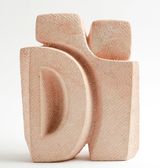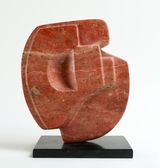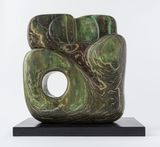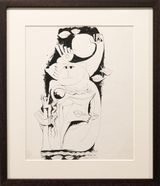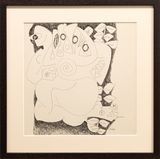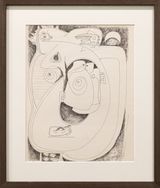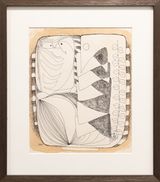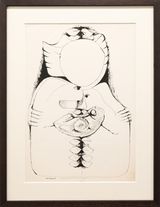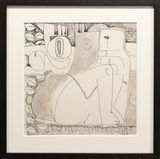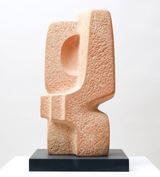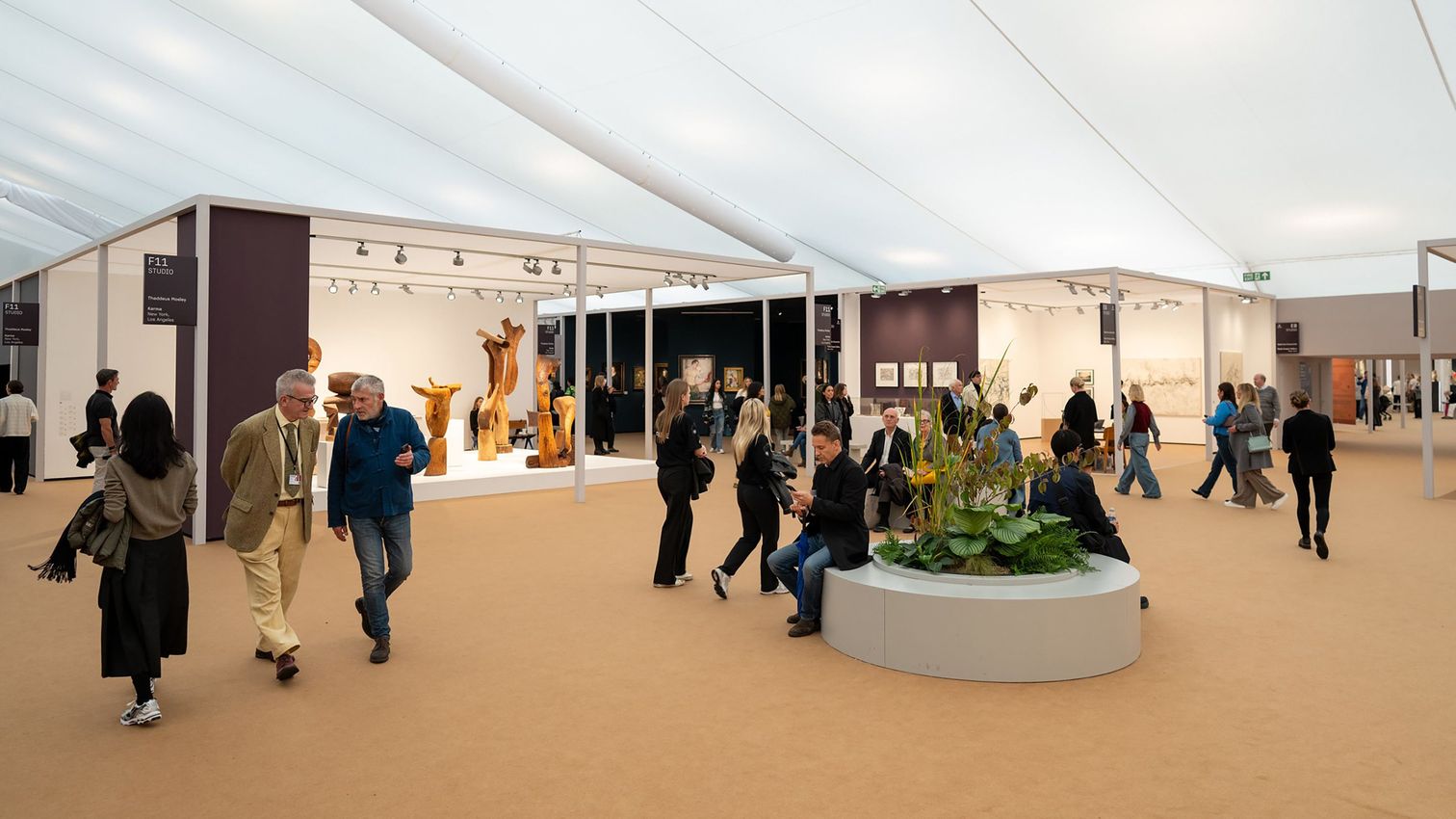
Lawrie Shabibi is pleased to announce its return to Frieze Masters, held in Regent’s Park, London, from 15 to 19 October 2025. Presenting a selection of works by Mona Saudi (1945 – 2022), one of the leading sculptors of her generation in the Arab world. The presentation brings together six stone sculptures and eleven works on paper produced between 1973 and 1978, offering a cross-section of her five-decade practice.
Born in Amman in 1945, Saudi moved to Beirut in 1962 before leaving briefly for Paris shortly afterwards, to study sculpture at L’École Nationale Supérieure des Beaux-Arts. She then returned back to Beirut in 1969 and has since been a prominent figure in the Lebanese art scene until her death in 2022. From the outset, she chose to work primarily in stone—a deliberate choice for its timelessness, density, and inherent variation in colour and pattern. She worked with marble from Carrara, pink limestone from Irbid, and black diorite from Syria. For Saudi, sculpture was not a mode of representation but a dialogue with the material; she believed the form of each piece was already latent within the stone.
Her practice is informed by a synthesis of ancient Middle Eastern sculpture—Egyptian, Sumerian, and pre-Islamic—with modernist abstraction. She was particularly drawn to the notion of latent movement in Egyptian and archaic Greek sculpture, and deeply influenced by Constantin Brancusi’s reduction of form to essential elements. Her sculptures merge symbolic simplicity with spatial complexity, reflecting her exploration of the Arabic concept of Takween—translated as both ‘creation’ and ‘formation.’
The stone sculptures on view are emblematic of her engagement with universal themes such as fertility, growth, and love. Her formal language—rounded volumes, continuous curves, and totemic verticals—combines a visual economy with metaphorical depth. The works maintain an equilibrium between monumentality and intimacy, whether installed in public spaces, such as outside the Institut du Monde Arabe in Paris, or held in institutional collections such as the British Museum.
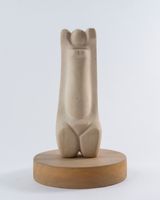
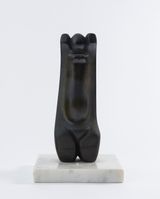
Among the works on view is Fertility (1971), an early sculpture that marks Saudi’s transition from drawing to stone as her primary medium. Created shortly after her return to the Middle East from Paris, the work reflects her engagement with sculptural abstraction and her exploration of womanhood, creation, and continuity.
Notably, there are two distinct versions of Fertility, both dated 1971. The first is carved in limestone and represents Saudi’s initial expression of the theme, merging modernist aesthetics with regional materials. The second is a unique bronze cast—unusual within her practice for its close adherence to the original stone form, rather than a reinterpretation.
Both versions of Fertility were shown in Beyond Form: Lines of Abstraction, 1950–1970 at Turner Contemporary, UK, in 2024, underscoring the enduring significance of Saudi’s sculptural language within broader narratives of modernist abstraction.
Also on view is Mother/Earth (1981), in which Saudi fuses the archetype of the maternal body with the generative force of the earth. The sculpture’s softly rounded forms convey notions of shelter and fertility, offering a symbolic reflection on creation as both a cultural and spiritual force. Saudi always counted this piece among her personal favourites, highlighting its importance within her body of work. Variations on Stone (2001) continues this exploration through a modular composition of carved forms, where subtle shifts in proportion and curvature echo natural rhythms. In Woman/River (2003), fluid contours suggest the movement of water and the continuity of life, merging feminine and elemental imagery in a meditation on transformation and renewal.
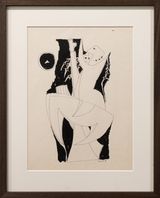
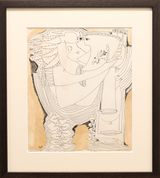
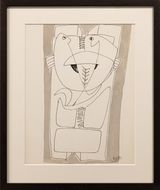
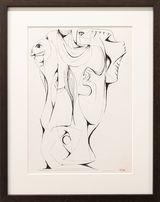
Alongside the sculptures, the presentation includes eleven rarely seen works on paper produced between 1973 and 1978. These drawings remained private during the artist’s lifetime and were first exhibited publicly in 2023. Executed during the early years of the Lebanese Civil War (1975–1990), they reflect Saudi’s precise technique and emotional register. Through delicate lines and restrained compositions, she explored themes of love, resistance, and interior life. These drawings function as a visual diary, documenting personal and historical memory, and provide important context for the conceptual underpinnings of her sculptural work.
The recurring motif of embracing figures conveys a quiet yearning for closeness—whether to another person or to the land—and imbues the works with a sense of intimacy and longing. As Saudi once reflected, ‘All my work springs from [my] poetic memory,’ underscoring the emotional and lyrical foundation of her visual language. Several of the works on paper possess a rhythmic and fluid quality, with ink lines that curve and extend across the pages, giving the compositions a sense of motion and vitality.
Together, the selection highlights the continuity of Saudi’s vision across mediums, underscoring her position as a key figure in the development of modern sculpture in the Arab world. She remains one of the few artists of her generation to work exclusively in stone, a material she regarded as both elemental and enduring.
ABOUT THE ARTIST
Mona Saudi was born in Amman, Jordan in 1945. She studied sculpture at the École nationale supérieure des Beaux-Arts in Paris, France.
Saudi sculpted mainly in stone - one of the few artists of her generation to do so. Her forms are full of vitality, beauty and a clear sense of equilibrium, frequently returning to ideas of fertility and growth. Always starting with basic shapes, the square, circle, cylinder, rectangle, she goes on to give them movement, a life of their own—either repeating their forms, varying their depths or heights or cutting them across one another to create new, graceful compositions.
Solo exhibitions include Icons, Abu Dhabi Art, with Lawrie Shabibi, 2018; Humanized Abstraction, Saleh Barakat Gallery, Beirut, 2017; Poetry in Stone, Lawrie Shabibi, 2015; Saint John Perse Foundation, Aix-en-Provenance, 2011; Poetic Inspirations, The Mosaic Rooms, AM Qattan Foundation, London, 2010; and Retrospective, Darat Al-Funun, Amman, 1995.
Select group exhibitions include: Beyond Form: Lines of Abstraction, 1950 - 1970, Turner Contemporary, curated by Flavia Frigeri, Margate, UK, 2023; On This Land, works from the collection of the Barjeel Art Foundation, Concrete, Alserkal Avenue, Dubai, UAE, 2023; In the Heart of Another Country: The Diasporic Imagination Rises, curated by Dr Kholeif, Sharjah, Art Foundation, Sharjah, UAE, 2023; Beirut and the Golden Sixties: A Manifesto of Fragility at the 16th Lyon Biennale, macLYON, Lyon, France, 2022; Feminine Power: the divine to the demonic, The British Museum, London, UK, 2022; Beirut and the Golden Sixties: A Manifesto of Fragility, Gropius Bau, Berlin, Germany, 2022; Abu Dhabi Art with Lawrie Shabibi, Abu Dhabi, UAE, 2018; Abu Dhabi Art with Lawrie Shabibi, Abu Dhabi, UAE, 2016; Le Corps Découvert, Institut du Monde Arabe, Paris, France, 2012; Salon d’Automne, Sursok Museum, Beirut, 2011-1993; International Cairo Biennale, Cairo, 2003; Voyage en Jordanie, Hotel de Ville, Paris, France, 1997; Forces of Change, National Museum of Women in the Arts, Washington D.C, 1994; Arab Contemporary Artists, Institut du Monde Arabe, Paris, 1987; Arab Artists, Kunst Hus, Oslo, 1981; Palestinian Art, Oriental Museum, Moscow, 1979; International Art Exhibition for Palestine, Beirut, 1979; Colamarini and his Students, Musee Rodin, Paris, 1978 and Salon de Mai, Musee d’Art Moderne, Paris 1973-1972.
In 2018, Poetry & Form, a survey of her works curated by Hoor Al Qassimi, was presented at the Sharjah Art Museum in collaboration with Sharjah Art Foundation. Her works are in the collections of the Guggenheim, Abu Dhabi; Sharjah Art Foundation; British Museum, London; Barjeel Art Foundation, Sharjah; Institut du Monde Arabe, Paris; the National Gallery of Fine Arts, Amman; the Khaled Shoman Foundation, Amman; National Museum for Women in the Arts, Washington D.C; Dar Al Athar Al Islamiyya, Kuwait; the Museum of Modern Art, Kuwait; Moussem culturel international d’Assilah, Asilah; Arab Bank Headquarters, Amman; Jabal Amman, Public Square, Amman; University of Science & Technology, Irbid; Al Wafa Bank, Casablanca; International Sculpture Park, Lebanon; Al Hariri Art Collection, Beirut; and the Ministry of Culture, Cairo.
A monumental sculpture by Mona Saudi stands outside the Institut du Monde Arabe in Paris, the only work permitted to grace the surrounding precinct by its architect Jean Nouvel.
Mona Saudi passed away in February 2022 in Beirut, Lebanon.
Mona Saudi was born in Amman, Jordan in 1945. She studied sculpture at the École nationale supérieure des Beaux-Arts in Paris, France.
A respected voice in contemporary art discourse.
Focusing on ambitious storytelling and insightful art-world commentary. Ocula Magazine publishes in-depth interviews, critical essays and timely analysis on the artists, exhibitions and ideas driving the global art world.
Learn more about Ocula Magazine
Showcasing the best of the art world.
Ocula partners with galleries from around the world to highlight their artists, artworks and exhibitions. Gallery membership is by application and invitation, with each member vetted by an independent panel.
Learn more about Ocula Membership

Specialises in the sale of major artworks.
Led by a team with deep ties to the world’s leading auction houses, galleries and collectors. Ocula’s advisory team offers bespoke services to high-net-worth clients from around the world who are looking to acquire the best of contemporary and modern art.
Learn more about our team and services