Press Release

Victoria Miro is delighted to present High Seas; Closed Skies, the gallery’s first exhibition by Shahzia Sikander since announcing representation of the New York-based artist.

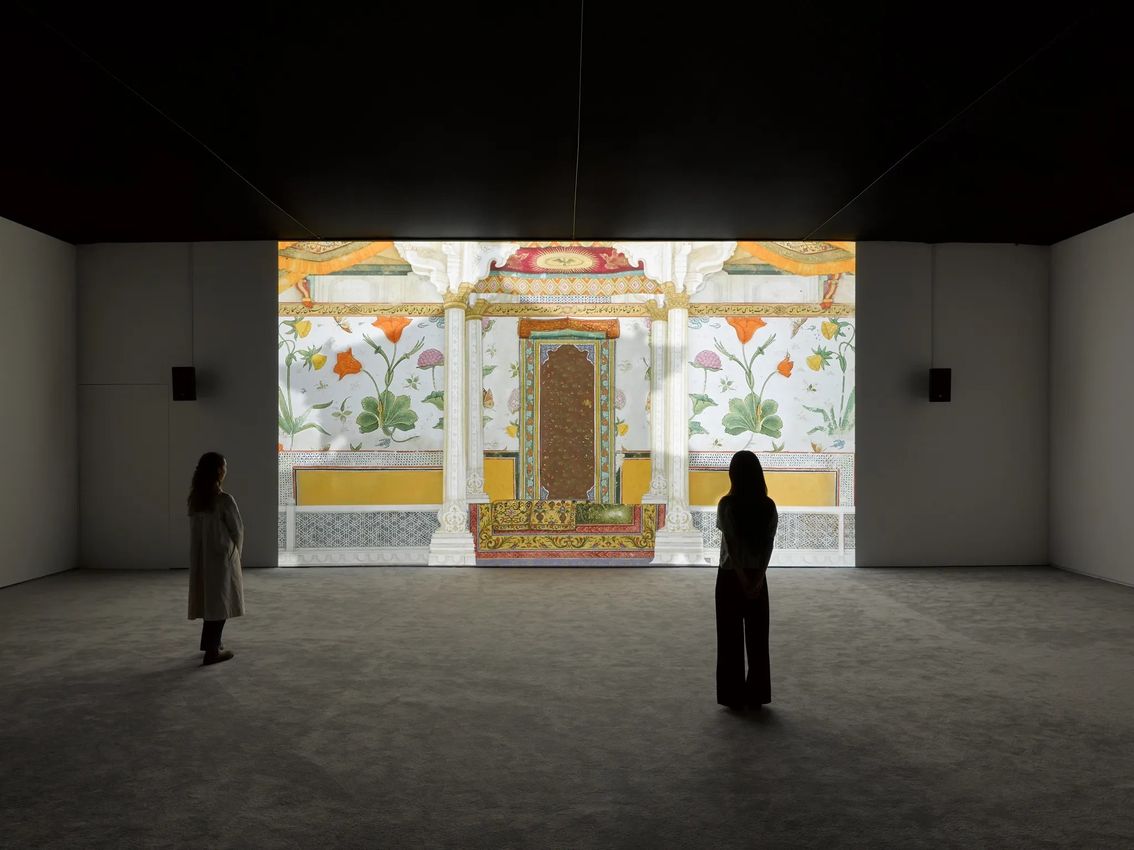
A focal point of the exhibition is the artist’s acclaimed new animation, 3 to 12 Nautical Miles, a radiant cinematic tableau that navigates the enduring currents of power and trade that have shaped the global landscape from the nineteenth century to the contemporary era.

Animated from hand-painted images, 3 to 12 Nautical Miles traces the entangled histories linking the British East India Company, Mughal India and Qing China through objects and symbols that signal how authority was constructed, distributed and contested. The work interrogates Britain’s opium cultivation in India, its coercive trade with China and the First Opium War, exposing the mechanisms of imperial extraction and the deep power asymmetries between Britain and China at the time. Its title refers to the incremental expansion of territorial waters: the legal zone between three and twelve nautical miles from any coastline where sovereignty can be asserted, contested and enforced.

Co-commissioned by M+ and Art Basel and presented by UBS, 3 to 12 Nautical Miles received its debut this spring in Hong Kong (where it is on view until 21 June), transforming the exterior of M+ into an immersive screen within the cityscape, and in doing so aligning subject with setting, past with present.

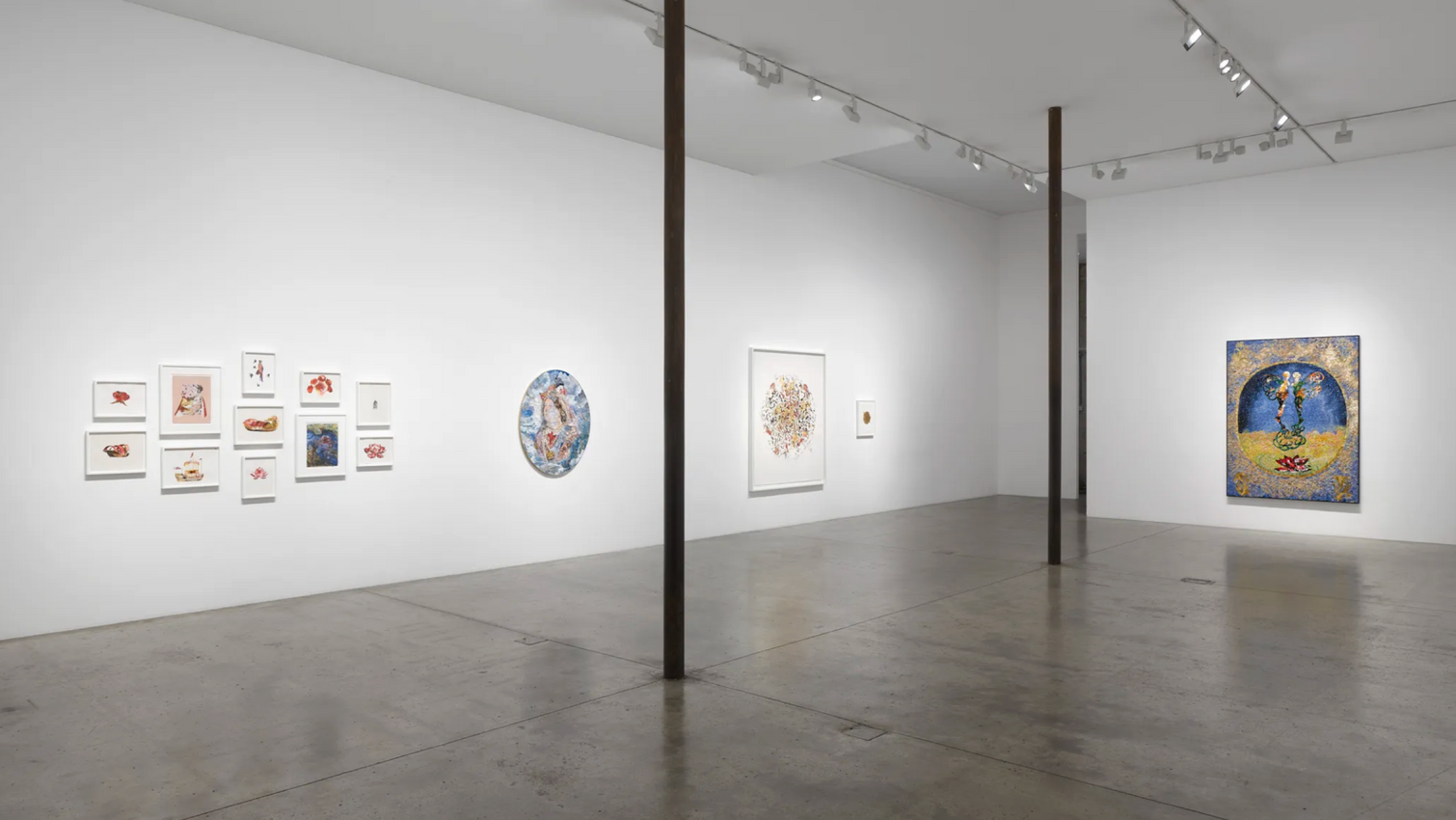
The work now comes to London, the city in which the East India Company was chartered, where decisions that turned Bengal into an opium production system were ratified, and through which Hong Kong was seized as a colonial outpost. Here, it will be heard for the first time with its score, by Pulitzer Prize-winning composer Du Yun. The exhibition also features new mosaics and works on paper.

Commentary about the works in the exhibition is written by Haani Jetha.

Sikander’s thinking happens simultaneously in multiple materials, and each one thinks differently, holding what the others cannot alone and together constituting a single inquiry conducted across different registers of time, permanence, and light. At its centre is the animation: a cinematic tableau of ink and gouache drawings set in motion, the hand still foundational even as the work passes through digital form.

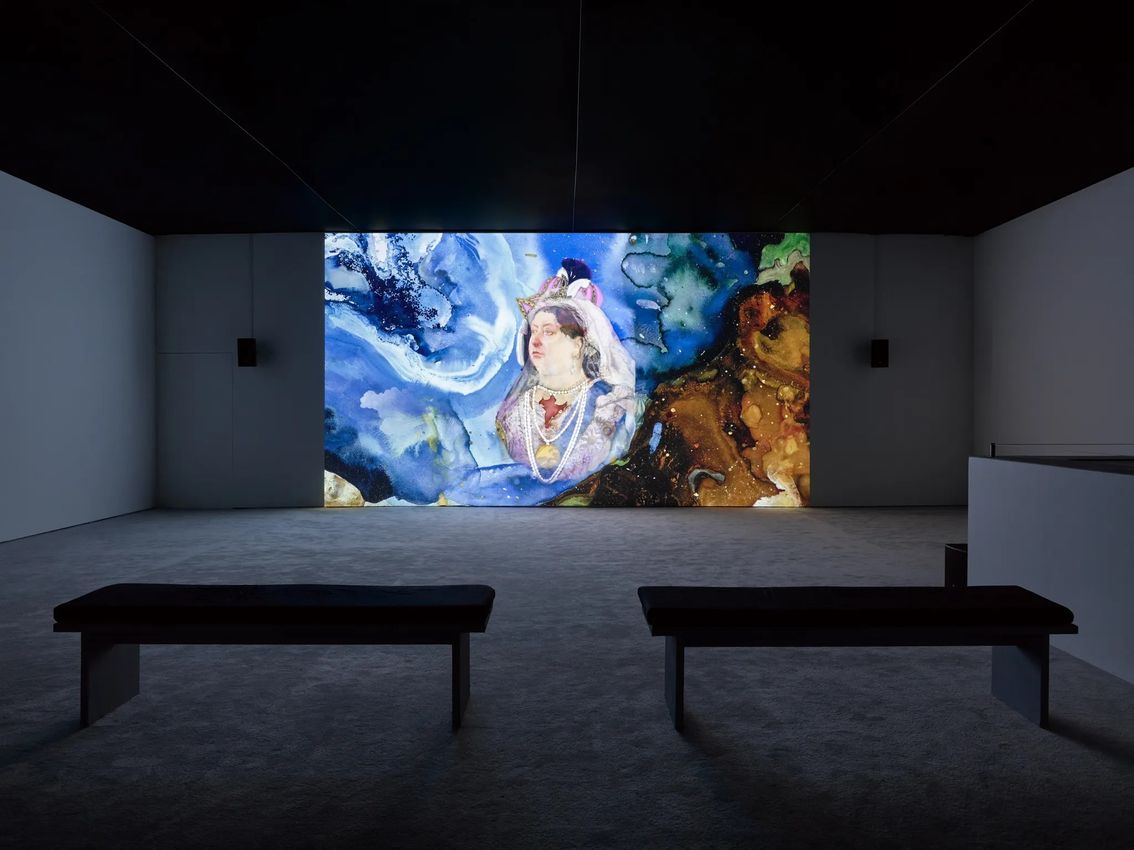
That inquiry circles one recognition: that power is not fixed but infrastructural. The animation makes this viscerally visible. Thrones dissolve. Akbar II morphs into the Daoguang Emperor of Qing China. Ships burn, but crucially, it is the archetypal British vessel that goes up in flames, the HMS Nemesis, the HMS Wellesley. Nineteenth-century British records almost always depicted Chinese junks alight; to show the imperial vessel as combustible is to perform what the archive refused to record. Then the sampan: the small, locally crewed Chinese boat that sustained everyday trade, fishing and transport, and with it the informal labour and survival economies that endure beneath the ledgers of empire. Scaleless and adaptive, slipping between regimes, borders, and epochs, the sampan enters the animation as a modest particle, then proliferates until it is beyond counting. This is the arithmetic of extraction. Its vastness accrues act by precarious act.

Queen Victoria appears wearing a map of India and Hong Kong as a necklace, territory made portable, the violence of possession rendered as refinement. And the poppy swells and scatters across the portraits of the powerful – Chinese generals, the assembled East India Company men, Victoria herself. Not as historical footnote but as temporal loop unspooling into the Opium Wars, beauty and devastation collapsed into one recurring form that will not stop blooming.

And yet the animation does not end in destruction. It ends, as it begins, with the shamsa, the symbol of illumination and the passage of light in the Indo-Persian manuscript tradition within which Sikander trained and has spent over three decades opening outward. At the heart of that final sunburst appear two female faces, a suggestion of collective feminine presence, an antidote to the extractive logic the work has traced. The sunburst does not redeem history. It insists on holding it, in light.

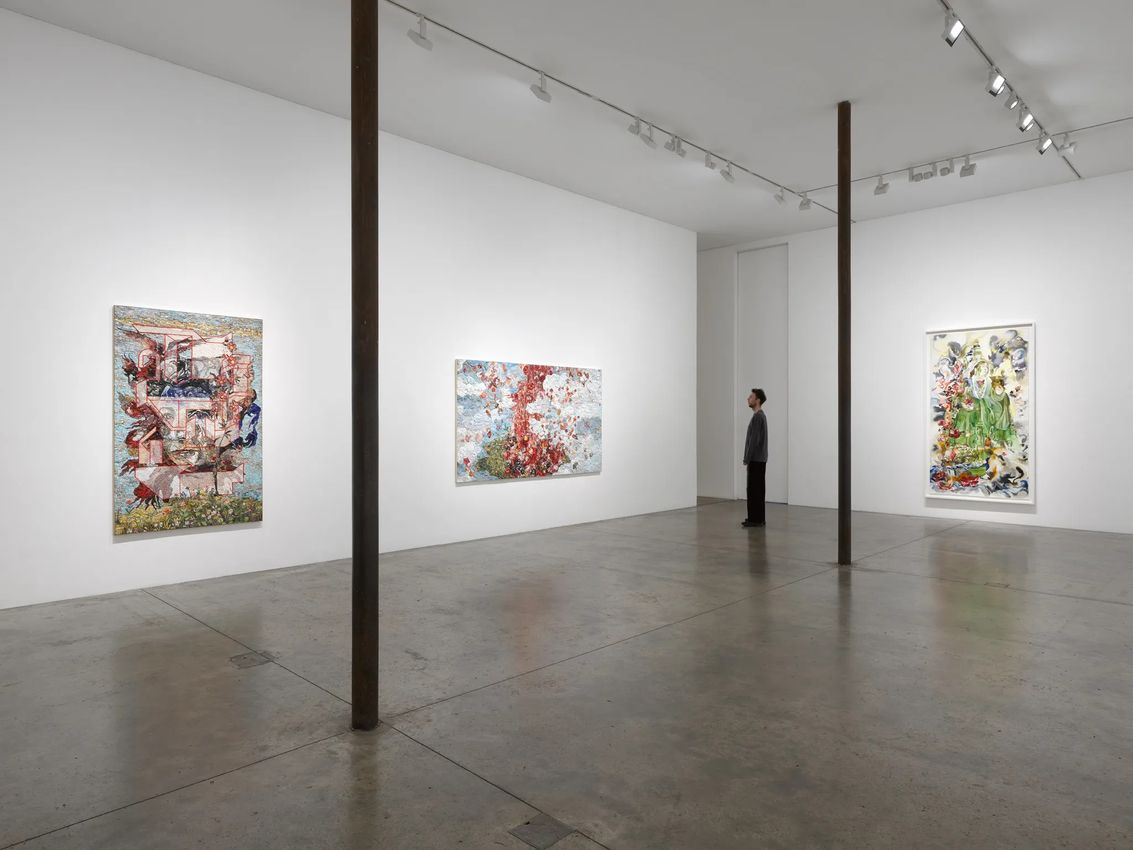
A single moment of the animation is seized and vitrified in Parting Skies. A red tree bleeds down the centre over the rise of a hill, its rivulets arrested in the moment of falling, as poppies bloom, dissolve and are flung upward into a cloud-occluded sky. That Sikander arrived at mosaic through animation is itself telling. ‘The dynamism of the pixel emerged in my mind as a parallel to the unit of a mosaic,’ she has said; both build from discrete fragments that resolve into an image through accumulation. The opium poppy obeys as so: singular then countless, making visible how vast systems, ruinous or beautiful, are assembled from innumerable small acts. Beauty and catastrophe stay inseparable here, as they are in empire’s account of itself. The poppy is the flower and the war at once.

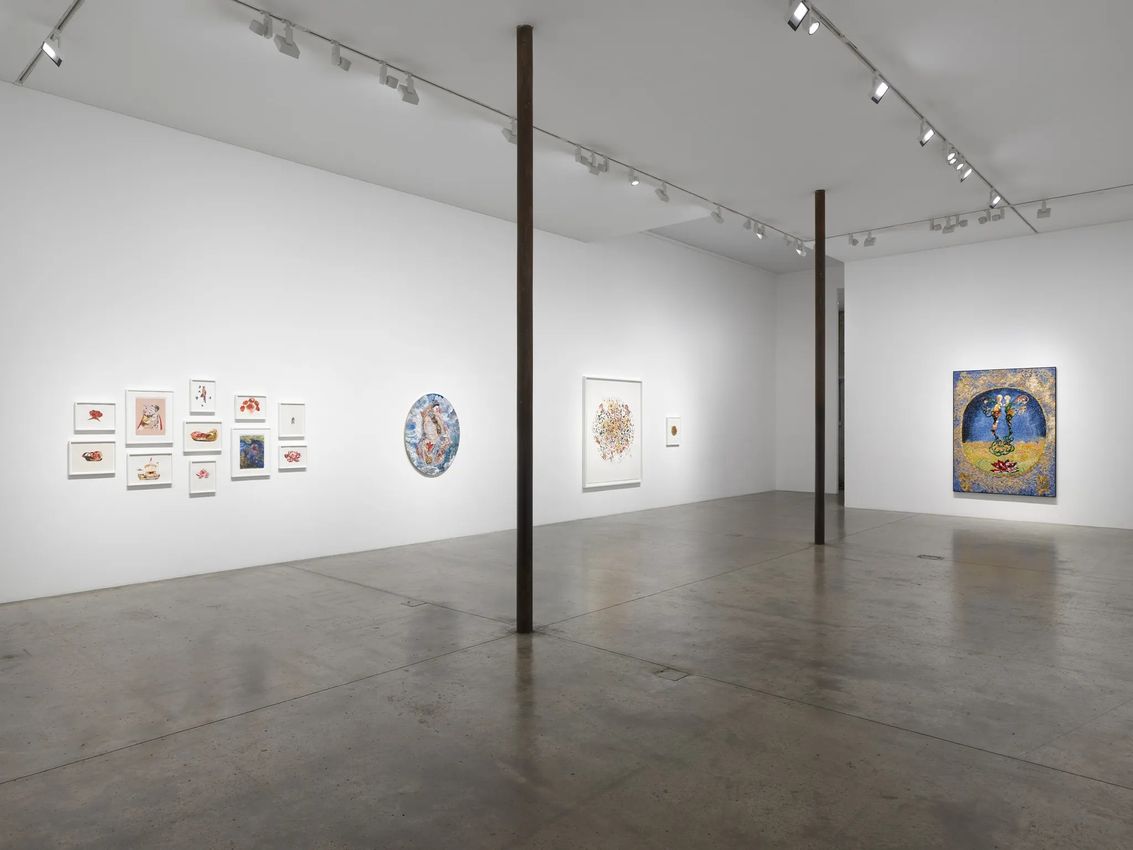
Queen Victoria sits sealed in mosaic within an oval frame, the shape Victorian Britain reserved for the cherished likeness. The cameo, the locket, the parlour miniature: the oval was the form of dynastic continuity and private devotion, the body made portable, kept close, possessed. It was also the shape worn against the skin. To frame her this way names what the animation exposes. Empire absorbed into the sovereign’s body, territory worn as adornment, possession passing for refinement.

Look at what she wears. Ropes of pearl, a gold pendant burnished with territories hanging at her throat. The crown of the Mughal court rises behind her head, annexed into her own regalia; conquest has become costume. She is composed entirely of fragments, yet the oval holds them in a seamless calm.

This is precisely what colonial power claimed for itself, to gather what it had broken and call the result order. Mosaic is conscripted to feign a wholeness it is built to refuse. Victoria is the one figure permitted to forget she is in pieces.

A mosaic portrait of poet and feminist thinker Adrienne Rich, operates as counterimage to Queen Victoria. Where Victoria absorbed territory as ornament, Rich spent fifty years exposing that mechanism in language, the way imperial and patriarchal power aestheticise their own violence, making possession look like refinement and extraction like order. Across her face run red lines drawn from the geometry of Safavid architecture, a scaffolding that fractures the likeness even as it holds it, cutting the portrait into facets like a map mid-break, like territory coming apart rather than territory worn.

That Rich also, in a lesser-known dimension of her practice, translated Mirza Ghalib’s Urdu ghazals into English, places her in unexpected proximity to the literary and visual traditions from which Sikander’s art extends. The ghazal is built from autonomous couplets, each one whole unto itself, holding multiplicity without forcing resolution, the poem cohering through accumulation rather than argument.

It is the hidden architecture of everything in these gallery rooms. The animation’s dispersing particles, the mosaic’s assembled tesserae, the single drawn mark that generates them all, every one proceeds fragment by deliberate fragment. Rich grasped this grammar in language. Sikander builds it here in glass and marble.

Victoria returns at an apparitional scale in gouache, looming in the green of verdigris, the hue of her own oxidation, of every imperial monument. Her gown falls not in cloth but coils downward into a latticework of valves, spools, and fittings of an active oil well. The throne becomes the rig. Gilded cartographies, worn again, but softened here to a bauble adrift in bleeding pigment. In her raised hand she carries a severed head: the Company Man, the East India Company’s combustible avatar. The trophy is inverted as she holds the very instrument of her power, the broker who built her empire. Beneath her, at the waterline, a British vessel burns among blue waves, and poppies open their saturated reds. It is the flower that financed the century and the war that named it.

Empire did not end but changed state, the territorial sway of the nineteenth century flowing forward into the siphoning, petro-economy that succeeded it. The same logic in new infrastructure. Sovereignty over land and sea becomes sovereignty over what lies beneath them. The contest the animation stages over who controls passage at sea is not history but the present tense: the Strait of Hormuz, a few nautical miles of water through which a fifth of the world’s oil moves sits closed today, the same law of territorial seas that gives the exhibition its title still decides who may pass and at what cost.

A sphere of light hangs suspended in gouache and gold leaf, kin to the shamsa, the sunburst from which a Mughal manuscript would unfold, the same form that bookends the animation by opening and closing its cycle. Particles, silhouettes, debris refuse to settle into a single thing – flames, a swarm of birds, static, oil on water, human migration seen from altitude. The iconographic language stays open-ended and is polysemic, accumulative rather than fixed. It is the mosaics’ principle carried into paper.

Through this churning field tumble the scattered Company Men, potbellied, clad in red tailcoats and buckled shoes, every sartorial detail precise while the face stays indiscernible, the stereotype emptied of the individual. Flakes of gold leaf and gouache gather into circular drifts around them, the gilding of the sacred page turned to the gleam of accumulated wealth, beauty and extraction once again indivisible.

Amid rupture, The Hour Glass turns toward repair. Two figures, mirrored in profile, heads restored, their limbs unspooling into coils of orange and green like flame. (Where it matters most) they are joined at the roots that grow from their legs and braid together. Against empire’s relations – geographies forced together by conquest, across oceanic distance – this kinship is freely chosen, cross-border and cross-bodied, an image raised pointedly in a moment loud with talk of border crises and who may belong.

They hover within a great gold-rimmed oval. Elsewhere, that oval sealed the imperial likeness into possession; here it recovers its oldest sense, the circle of continuity, the cycle that closes only to begin again. At the threshold of the oval is a single red lotus, an emblem of emergence that recurs throughout Sikander’s vocabulary, set at the very base as the ground from which ascent begins.

Courtesy Victoria Miro.

Read More

Installation Views

About the Artist

Shahzia Sikander is a Pakistani American artist best known for transforming the meticulous techniques of Indo-Persian manuscript painting into complex visual narratives that probe intertwined histories of empire, migration, gender, and power. Signature works including the early painting The Scroll (1989–90), the hand-painted animation SpiNN (2003), and the recent moving-image commission 3 to 12 Nautical Miles (2026), shown on the façade of M+ during Art Basel in Hong Kong, demonstrate how she moves fluidly between intimate works on paper, animation, sculpture, installation, and monumental site-specific public projections.

View Artist Profile

Also Exhibiting at Victoria Miro

About the Gallery
Since Victoria Miro founded her eponymous gallery in Cork Street, Mayfair, in 1985, the gallery has grown to represent over 40 artists and estates. With a reputation for presenting ground-breaking artists from around the world, Victoria Miro has exhibition spaces in London and a further gallery space in Venice.

View Gallery Profile
Address
16 Wharf Road
London
United Kingdom
Opening Hours
Tuesday – Saturday
10am – 6pm
(1)
London 16 Wharf Road
Victoria Miro
16 Wharf Road, London, United Kingdom
+44 207 336 8109
http://www.victoria-miro.com

Opening hours
Tuesday – Saturday
10am – 6pm
The art world in focus