




WAEL SHAWKY
b. 1971, EgyptWael Shawky is a leading contemporary artist whose inventive films, performances, and installations have redefined how history is told through art. Internationally acclaimed for his epic Cabaret Crusades trilogy and his representation of Egypt at the 2024 Venice Biennale, Shawky’s practice transforms complex narratives of religion, identity, and myth into visually striking, thought-provoking artworks.
Early Years
Born in Alexandria in 1971, Wael Shawky spent much of his childhood in Mecca, Saudi Arabia—a formative experience that exposed him to profound cultural and religious contrasts, later reflected in his art. He returned to Egypt at age 13. Shawky holds a BFA from Alexandria University and an MFA from the University of Pennsylvania, Philadelphia. He currently lives and works between Alexandria and Philadelphia, drawing on his transnational background to inform his multifaceted practice.
Wael Shawky Artworks
Wael Shawky’s art is distinguished by its rigorous research and innovative use of diverse media, including film, video, drawing, installation, and performance. His works reimagine historical events and mythologies, often blending fact and fiction to probe the construction of collective memory.
Cabaret Crusades Trilogy (2010—2015)
Shawky’s seminal Cabaret Crusades trilogy uses marionettes to retell the medieval Crusades from an Arab perspective. The films—The Horror Show Files (2010), The Path to Cairo (2012), and The Secrets of Karbala (2015)—employ Arabic dialogue and intricate puppetry, including glass marionettes crafted in Murano, to create a sense of distance from the events and challenge Eurocentric narratives.
Al Araba Al Madfuna Trilogy (2012—2016)
In Al Araba Al Madfuna, Shawky casts local children to perform ancient Egyptian myths and parables, their voices dubbed by adults. This poetic inversion explores the interplay between innocence and experience, myth and reality, and the transmission of cultural memory.
Early Works and Other Projects
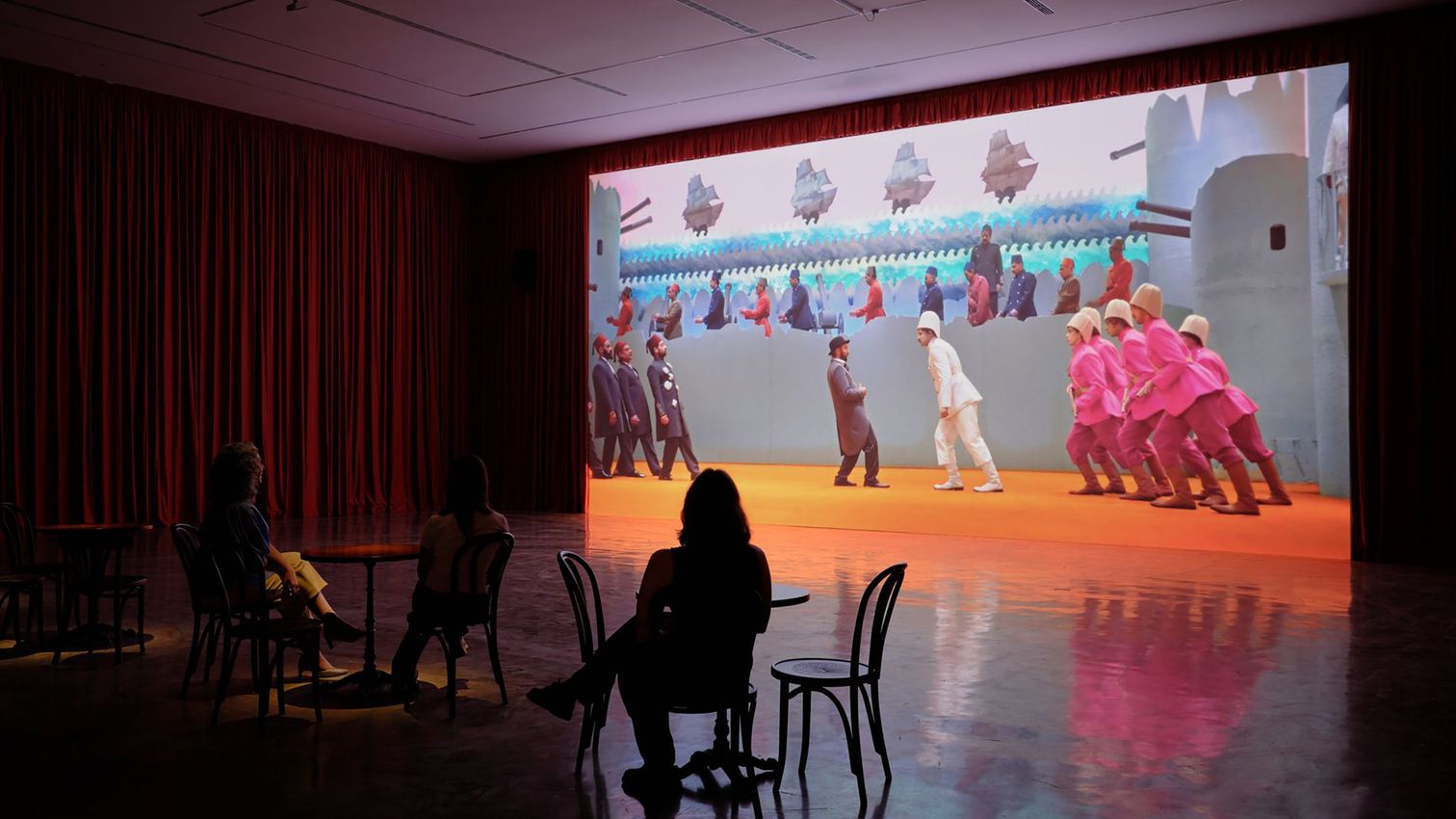
Shawky’s early video works, such as The Cave (Amsterdam) (2005) and the Telematch series (2007—2009), address themes of East-West dichotomies, religious conflict, and social transformation through playful yet incisive visual language. His more recent projects include Drama 1882 (2024), a filmed musical reflecting on Egypt’s nationalist Urabi revolution, presented at the Egypt Pavilion of the 2024 Venice Biennale.
Select Public Commissions
- In the Sound of Muzdalifah (2023), Islamic Arts Biennale, Jeddah
- Drama 1882, Egypt Pavilion, 60th Venice Biennale (2024)
Select Awards and Accolades
- Mario Merz Prize, Fondazione Merz, Turin (2015)
- Sharjah Biennial Prize (2013)
- Abraaj Group Art Prize, Dubai (2012)
- Schering Stiftung Art Award, Berlin (2011)
- Grand Prize, Alexandria Biennial (2009)
Exhibitions
Wael Shawky has been the subject of both solo exhibitions and group exhibitions at important institutions. Below is a selection of important exhibitions.
Solo Exhibitions
- Drama 1882, Egypt Pavilion, 60th Venice Biennale, Venice, Italy (2024)
- Daegu Art Museum, Daegu, South Korea (2024)
- M Leuven, Belgium (2022)
- Modern Art Museum of Fort Worth, Texas, USA (2021)
- Castello di Rivoli and Fondazione Merz, Turin, Italy (2016)
- MoMA PS1, New York, USA (2015)
- Serpentine Galleries, London, UK (2013—14)
- KW Contemporary Art Institute, Berlin, Germany (2012)
Group Exhibitions
- Sharjah Biennial (2025, 2019, 2013)
- Istanbul Biennial (2015, 2005)
- Documenta 13, Kassel, Germany (2012)
- Gwangju Biennale, South Korea (2012)
- Venice Biennale, Italy (2003)
Wael Shawky FAQs
Where can I see Wael Shawky’s work?
Wael Shawky’s artworks are held in major public collections, including Tate Modern, London; Museum of Modern Art, New York; Darat Al Funun, Amman; and Sharjah Art Foundation. His recent exhibitions have been staged at venues such as the Modern Art Museum of Fort Worth, M Leuven, Daegu Art Museum, and the Egypt Pavilion at the 2024 Venice Biennale.
What are the main themes in Wael Shawky’s art?
Wael Shawky’s art explores the construction of history, national and religious identity, and the interplay between myth and reality. His works often reframe historical narratives from non-Western perspectives and examine the effects of migration, social change, and globalization.
What is Wael Shawky’s most famous artwork?
Wael Shawky is best known for his Cabaret Crusades trilogy, which uses marionettes to retell the Crusades from an Arab viewpoint, and the Al Araba Al Madfuna trilogy, which features children performing ancient myths.
Has Wael Shawky won any major awards?
Yes, Wael Shawky has received numerous accolades, including the Mario Merz Prize (2015), the Sharjah Biennial Prize (2013), the Abraaj Group Art Prize (2012), and the Schering Stiftung Art Award (2011).
What is MASS Alexandria?
MASS Alexandria is an independent art school and educational space founded by Wael Shawky in 2010 in Alexandria, Egypt. It supports emerging artists through interdisciplinary research and critical education.
Are there any random and interesting facts about Wael Shawky?
Wael Shawky’s childhood in Mecca coincided with the dramatic social and religious changes of late 1970s Saudi Arabia, an experience that deeply influenced his interest in the intersection of tradition and modernity. He has organised heavy metal concerts in rural Egypt and staged performances with Bedouin children, highlighting his unconventional approach to storytelling.
How do you pronounce Wael Shawky’s name?
Wael Shawky is pronounced ‘WAH-el SHAW-kee’ in English, with the Arabic pronunciation being WAA-il SHAW-kee’.
Ocula | 2025












Explore and Follow Artists Shaping Contemporary Art
A respected voice in contemporary art discourse.
Focusing on ambitious storytelling and insightful art-world commentary. Ocula Magazine publishes in-depth interviews, critical essays and timely analysis on the artists, exhibitions and ideas driving the global art world.
Learn more about Ocula Magazine
Showcasing the best of the art world.
Ocula partners with galleries from around the world to highlight their artists, artworks and exhibitions. Gallery membership is by application and invitation, with each member vetted by an independent panel.
Learn more about Ocula Membership
Specialises in the sale of major artworks.
Led by a team with deep ties to the world’s leading auction houses, galleries and collectors. Ocula’s advisory team offers bespoke services to high-net-worth clients from around the world who are looking to acquire the best of contemporary and modern art.
Learn more about our team and services