Press Release

Lisson Gallery presents an exhibition of new and recent works by Julian Opie, united by the theme of the walking figure. Encompassing sculptures, animations and paintings, these extend the artistic vocabulary that he has developed over four decades – “a language of forms, of images, of people.”

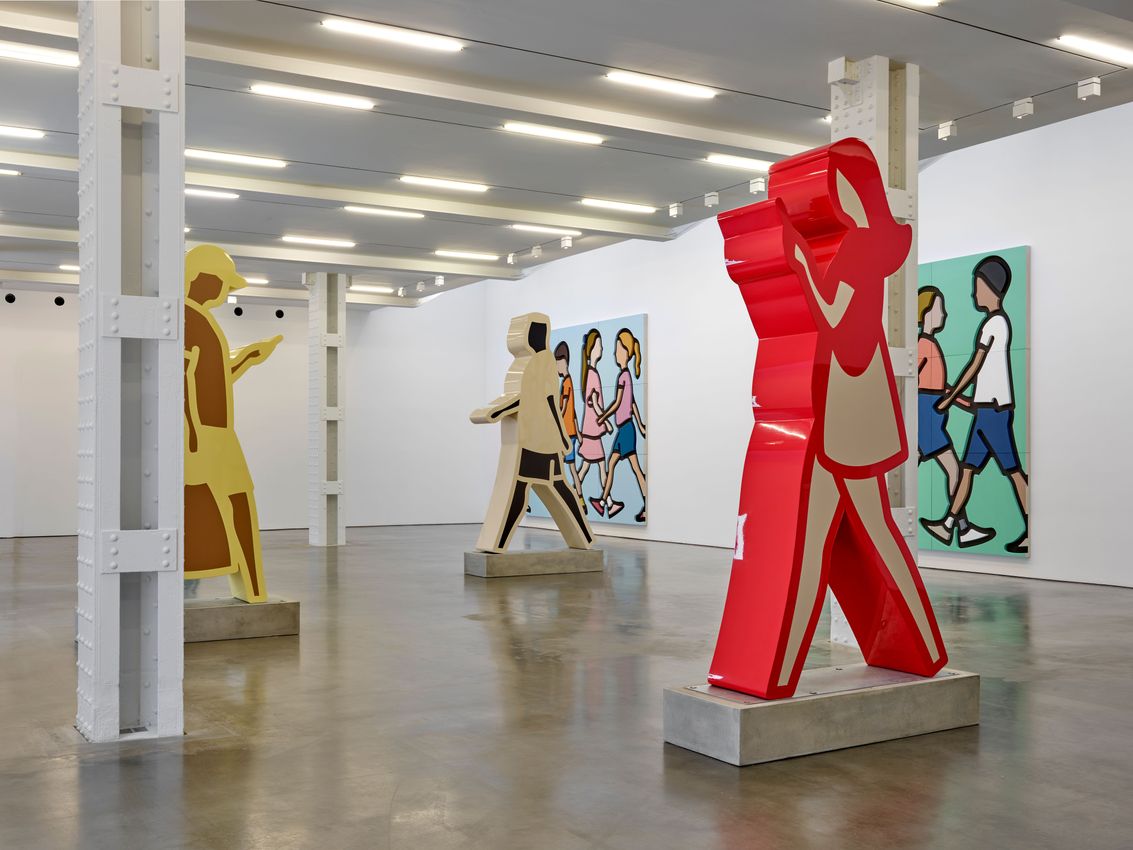
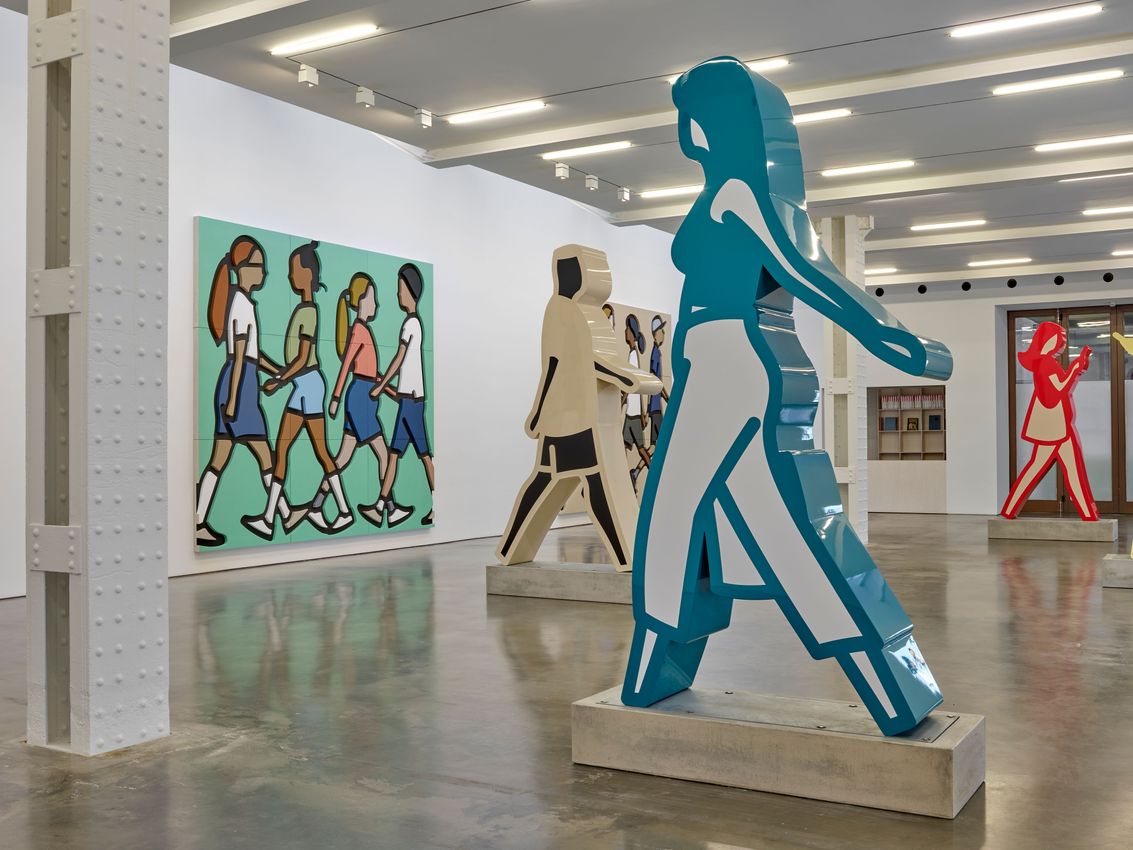
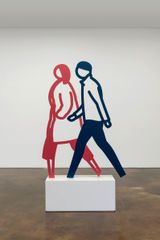
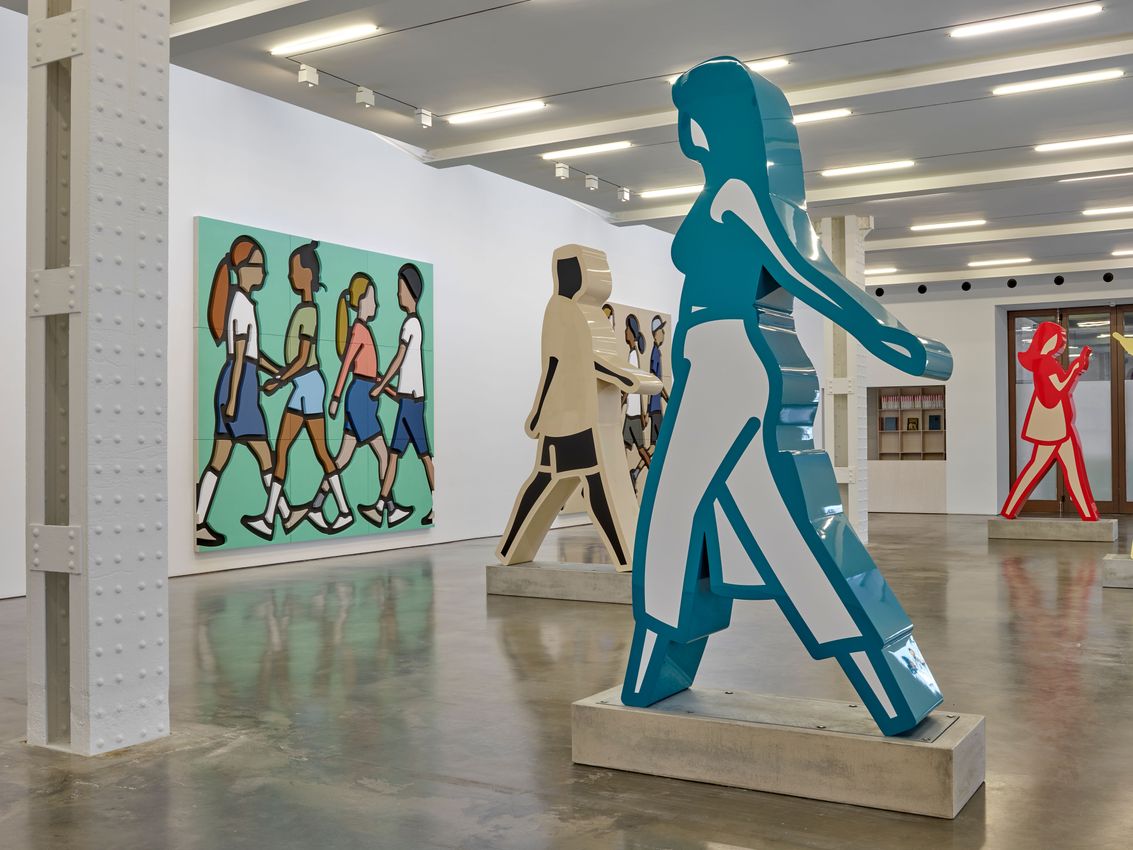
Four sculptures, installed at staggered intervals on concrete plinths, derive from Opie’s _Busan Walkers_series of 2023. Rendered in high-gloss auto paint on aluminium, each depicts a figure in motion – a passerby originally photographed on the Busan seafront and subsequently translated into a drawing, which in turn served as templates for a series of twenty statues. A simplified profile view of a body has been enlarged – given volumetric depth – and yet the image remains studiedly two-dimensional.

Red phone. (2023) and Yellow phone. (2023) portray people walking while holding their mobile devices. At once inhabiting the physical world and the virtual space, the figures express a quality – pervasive in Opie’s art – of demonstrative gesture and self-containment. Sleek externality belies a sense of the sealed interior. The man in Black shorts. (2023) swings his arms as he walks; the young woman of Turquoise hair. (2023) adopts a more extravagant posture, flinging out one arm behind her to merge with her hair.

In this way, Opie invests minor details, a transient stance or a piece of clothing, with emblematic force. In their dual flatness and heft, the Busan Walkers invoke a long history of free-standing and architectural sculpture, for instance classical Greek carvings that were originally designed to be viewed frontally, as adornments on buildings, and later reinterpreted as objects in the round; or the monumental bronze statuary of historical figures familiar in cities around the world, their stone plinths rendered here in the more urban language of cast concrete. Opie restates that tension between image and objecthood, conveying visual information through the barest essentials.

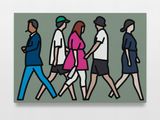
He has eliminated practically all individualising details from his figures. And yet, contrary to the standardised signage that constituted an early inspiration, a sense of ‘real life’ persists. It is discernible in three new animations on LED screens, also deriving from a larger group, in which he depicts lines of schoolchildren in continuous motion. The imagery shares the declarative linearity and flatness of his work in general – the children’s faces and clothes are neutral, differentiated by basic facts of hairstyle, height, or clothing (the anomaly of a baseball cap, the shape of a dress).

These works mark a new development in that Opie hasn’t previously included children in his images of walking crowds, and while the animations are schematic – types who might almost have sprung from an instruction manual – they are also made individual. No two figures are alike. The cyclical movement, too, varies within each animation. As Opie has noted: “Each child walks at a slightly different speed, so the relationships between them change over time like four independent pendulums.”

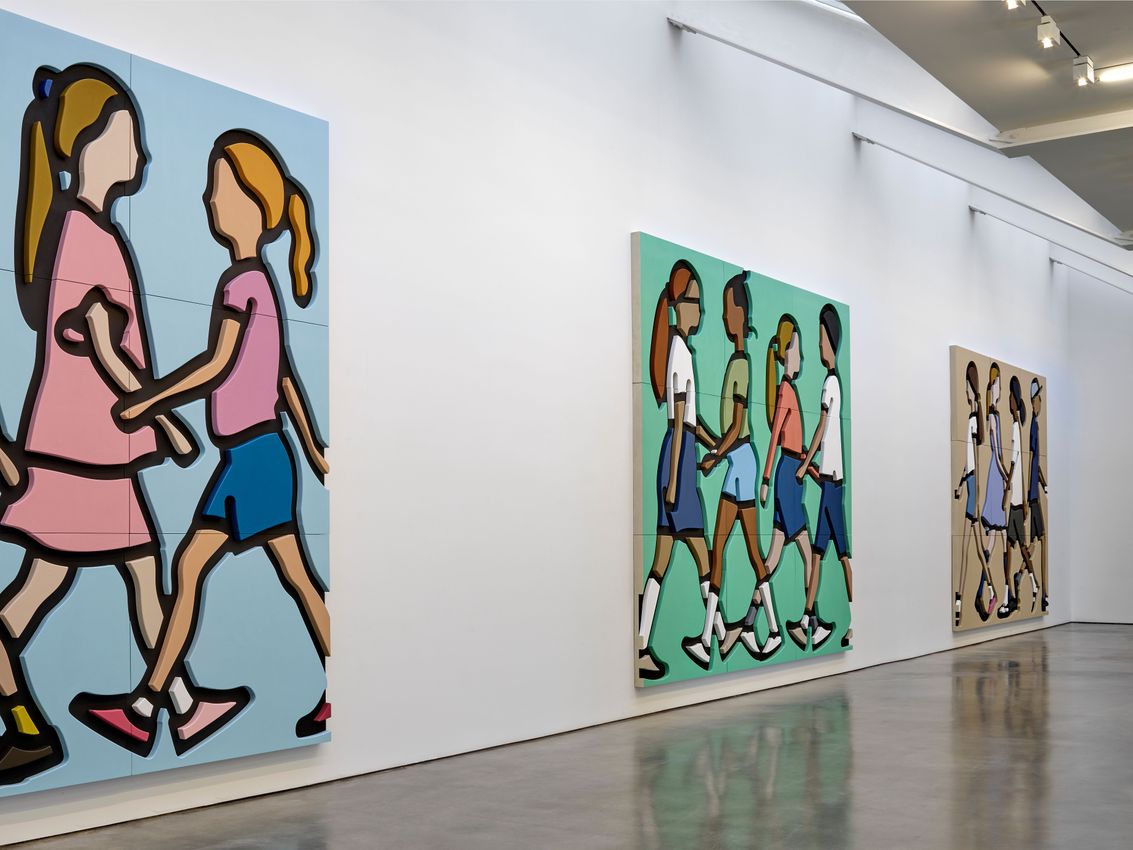
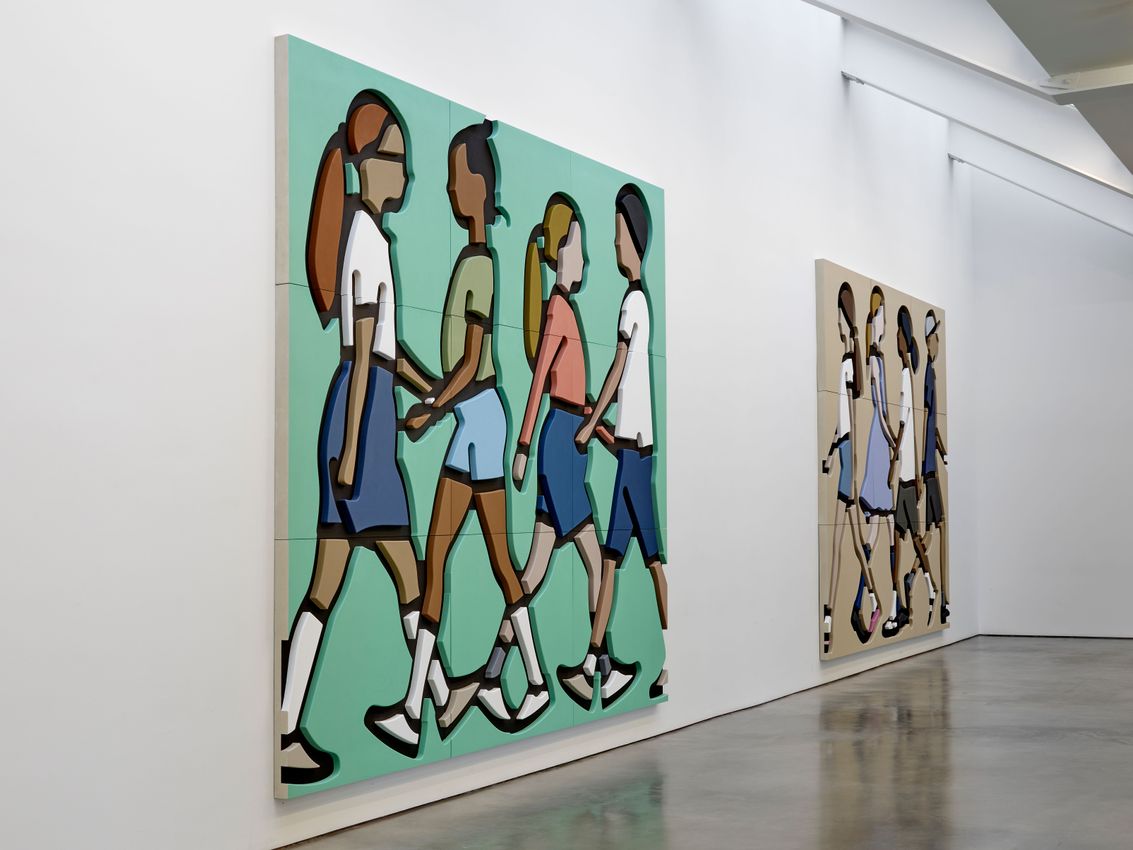
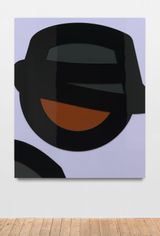
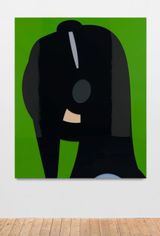
In contrast to the monodirectional movement of the LED works, three paintings of children walking, made on gridded resin supports, show backward and forward positions. The image is hand painted and deeply engraved into the material, whose stone-like quality and monumental scale evokes imposing decorative friezes on the walls of ancient temples. The rhythm of the animations devolves into something more syncopated, suggestive of two-way motion. Each painting and animation depicts a particular year group: the artist began by making videos of classes in a school. Seen as a totality, the endlessly strolling children amass into a portrait of growing up.

Read More

Installation Views

About the Artist

Julian Opie’s work is instantly recognisable in public commissions around the world. One of the most significant artists of his generation, his distinctive formal language is the result of digital alteration, presenting images as black outlines and simplified areas of colour; it speaks of Minimal and Pop art, of billboard signs, classical portraiture and sculpture and Japanese woodblock prints. “Things in my experience don’t look photographic”, he observed in 2001. “When I recall the things I did in a day, for example, it’s not as a series of photographs, high resolution pictures. It’s a series of images which resemble symbols and signs. It’s like another language.” Opie ‘paints’ using a variety of media and technologies, from inkjet on canvas and painted aluminium to vinyl on walls and sculptures of everyday features: scaled-down buildings, life-size cars, signposts. His programme of purification has been applied to reproductions of paintings, telephone directories, books and to portraits, where faces or bodies are abbreviated to astonishing likenesses. Landscapes are emptied out of unmemorable detail to become the essence of themselves; the subtle, repetitive movements in Opie’s wall-mounted computer films of Japanese landscapes have a hypnotic quality.

View Artist Profile

Also Exhibiting at Lisson Gallery

About the Gallery

Established in 1967 in London, Lisson Gallery is one of the most well-known galleries operating globally. Boasting an influential and continuing legacy, including playing a pivotal role in the careers of many pioneers of historically important art movements, the gallery works with some of the most significant contemporary artists today.

View Gallery Profile
Address
504 West 24th Street
New York
United States
Opening Hours
Tuesday – Saturday
10am – 6pm
(1)
New York 504 West 24th Street
Lisson Gallery
504 West 24th Street, New York, United States

Opening hours
Tuesday – Saturday
10am – 6pm
The art world in focus