



“The uncertainty of our time brings many questions, but also possibilities. The female figures initiate new life, holding it in their arms and in their body as a part of themselves.”
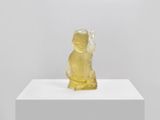
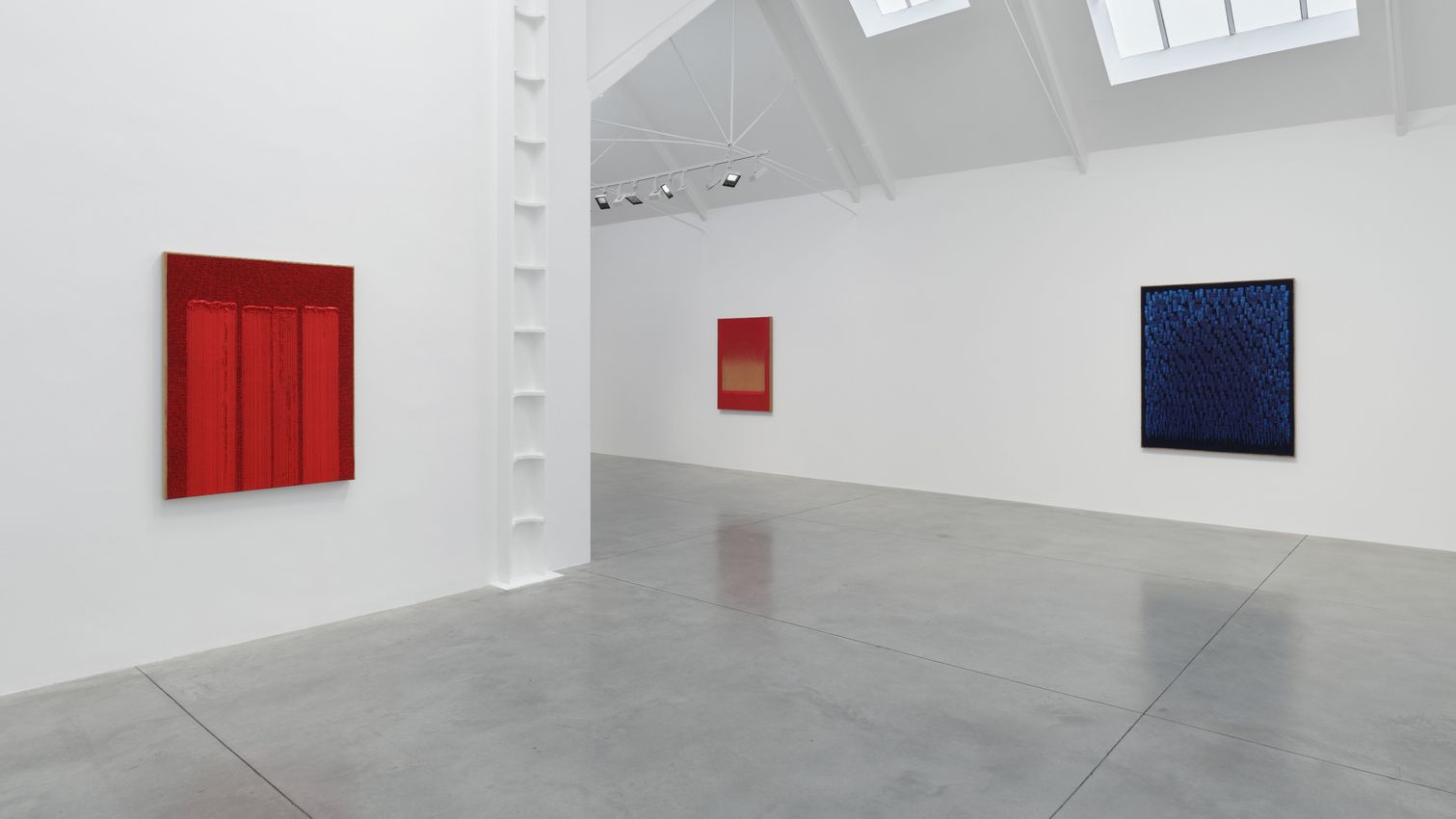
Lisson is pleased to host Leiko Ikemura‘s first exhibition with the gallery, featuring many of the themes present in her work over the past 30 years, including a wide range of media from paintings in tempera to bronze figures and glass forms. The installation revolves around a central, three-and-a-half metre rabbit/woman figure, known as Usagi Janus (2024). This hand-sculpted and hand-patinated, protective spirit – part-bunny, part-bodhisattva of compassion – provides respite from the outside world in her conical-shaped bodily enclosure, the tiny punctures in her mothering skirt creating an internal universe of projected stars. The giant’s two faces – one staring forward, the other looking backwards – refer to the many alter egos and avatars that appear throughout Ikemura’s oeuvre, some of which can be seen in the smaller bronze pieces and crystal heads. The Janus-faced figure represents less of an either/or dialectic than a it does state of in-betweenness, one she seeks to explore through her anthropomorphic creatures and objects, or else in the spaces that dwell neither in light nor dark, neither in good nor evil, but rather in a twilit dusk and a zone of uncertainty.
The Usagi is a recurring motif that Ikemura recalls from a childhood game to locate the shadowy features of a rabbit on the surface of the moon, but first appeared as a character in her practice following the Tōhoku earthquake and associated Fukushima nuclear accident of 2011. Witnessing reports from afar of devastation for both the Japanese population and its natural habitats, including subsequent birth defects in animals, the artist envisaged this mythical Usagi acting both as a messenger for the kami (gods) and as a container for universal suffering, resilience and renewal. A precursor can be seen in a smaller-scale bronze from 1990, titled Hasen-Frau or Hare-Woman, revealing how Ikemura’s creatures have endured and survived many decades, while the German title points to the decision, relatively early on in her career, to settle and make work in Europe.
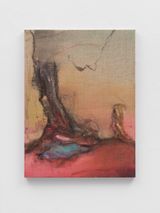
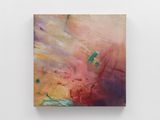
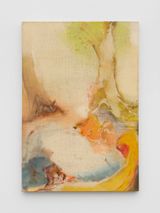
Framing the shrine-like form of Usagi Janus is a trio of fantastical landscapes depicting a bucolic, forest scene, which might also depict the very origins of life on our planet. Among the mountainsides and wooded pastures are reclining figures or hidden faces, either fused indelibly with the land or haunting its borders through skeletal or skull-like apparitions. In one of Ikemura’s poems, entitled Transfiguration, she writes: “I’ve seen it / everything changes / people turn into rocks / into mountains / into oceans.” A figure in repose is also captured vividly in Sleeping Figure in Red (1997/2012), in which a young female is face down, with head in hands, perhaps in distress or, as the title suggests, at rest.
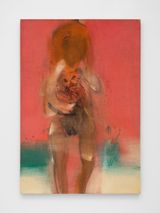
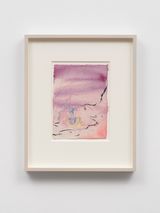
Ikemura’s recurring cast of young girls can be found variously recumbent, strident, floating, crying, laughing. Here a duo of Brave Girls (2022), one in pink with a cat, one in orange with a wedding veil, flank a third, Pièta in Cherry Red (2024), also cradling a cat or baby, with a pair of hypnotizing eyes blazing back at the viewer. At once powerful and confrontational, but also vulnerable and naive, Ikemura again finds a subtler path between these extremes for her fearsome adolescents, the pigments soaking through and infusing the raw jute canvas with their glowing, glowering presence. Whether as psychological portraits of moods or alternate, hybrid beings, these singular objects by Ikemura amount to an impressive act of world building and longevity.
Leiko Ikemura is a Japanese Swiss contemporary artist known for poetic paintings, sculptures, drawings, and glass works that merge human, animal, and landscape forms into hybrid, transitional figures. Her artworks explore themes of cross-cultural identity, ecology, femininity, and the fragile relationship between humans, nature, and cosmic space, often through spectral girl-like bodies and rabbit–human beings.


A respected voice in contemporary art discourse.
Focusing on ambitious storytelling and insightful art-world commentary. Ocula Magazine publishes in-depth interviews, critical essays and timely analysis on the artists, exhibitions and ideas driving the global art world.
Learn more about Ocula Magazine
Showcasing the best of the art world.
Ocula partners with galleries from around the world to highlight their artists, artworks and exhibitions. Gallery membership is by application and invitation, with each member vetted by an independent panel.
Learn more about Ocula Membership

Specialises in the sale of major artworks.
Led by a team with deep ties to the world’s leading auction houses, galleries and collectors. Ocula’s advisory team offers bespoke services to high-net-worth clients from around the world who are looking to acquire the best of contemporary and modern art.
Learn more about our team and services