Marian Goodman Gallery is pleased to present COLLECTIVE INTELLIGENCE, Agnieszka Kurant’s first solo exhibition with the gallery, on view from 11 July – 22 August 2025. The show features a selection of recent works from series she’s continually expanded over the past decade.
Kurant’s multidisciplinary practice explores collective and nonhuman intelligences, the future of labor and creativity, and the exploitations with digital capitalism. Her work centres on the emergence and evolution of forms shaped by collective agency, be they termite mounds, minerals, signs, tools, or social movements. In collaboration with scientists, she sets up complex systems, networks, and environments where multiple agents—molecules, bacteria, animals, AI algorithms, or human crowds—interact to generate hybrid, unstable forms undergoing constant metamorphosis, like living organisms. Oscillating between biological and digital, natural and artificial, life and nonlife, her works explore the evolution of living systems, culture and technology, transformations of the human, automation, and cybernetics.
Kurant’s research-based works draw on processes of networked value creation in the digital economy and investigate collective authorship and the global system of labour exploitation embedded in artificial intelligence. The hybrid forms she produces often counter algorithmic predictions with uncomputable, unpredictable processes. Her assemblages and amalgamations, grown, evolved, crystallised, or shaped on a molecular level, emerge from the mutations of matter in the Anthropocene and reflect shifts in collective subjectivity influenced by technology. These speculative experiments propose ideas for how human and nonhuman life might evolve.
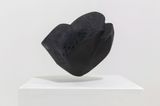
Featured in the exhibition are two sculptures from the series Post-Fordite (2022, 2025), a body of work made in part from a quasi-geological formation known as Fordite or “Detroit agate,” which consists of thousands of layers of car paint that have accumulated and fossilised over decades on automotive production lines. Sourced by former workers from now defunct factories, Fordite is cut, polished, and sold on the market as a gemstone, with value increasing as this resource is being exhausted. Kurant assembles fragments of this industrial byproduct into new hybrid rock formations that, on the one hand, encapsulate a century of human labor and shifting consumer tastes and, on the other, speculate about the footprints that might be left behind by our world of post-Fordist, digital capitalism, in which society functions as a distributed factory of data production and exploitation.
Conversions (2019-ongoing) is a series of perpetually morphing liquid-crystal paintings that deploy a custom artificial-intelligence algorithm and evolve in response to data mined from millions of social media users involved in global protest movements expressing their emotions about current world events. This data animates a computer-controlled heat-based system that causes quasi-alchemical transformations of the liquid crystal particles. That process produces shifting forms on the painting’s surface, resembling biosemiotic phenomena—signs produced by various kinds of intelligence to make meaning from and interact with their environment. Conversions employ a material that reflects transformation itself—i.e., liquid crystals that fluctuate between states of matter and are used in LCD screens. Kurant conceives of painting not as abstract or representational but rather as what Harun Farocki called “operational images,” which here represent the networked relations and real-time crowd dynamics essential to the political economy of digital capitalism. This collective thermal footprint emulates a complex living organism, transforming invisible labor, the energy of crowds, and social change into physical mutations of matter.
Present and future merge in Semiotic Life, in which a 75-year-old Juniper Bonsai tree becomes entangled with its algorithmically predicted, optimised future form. Speculation on the species’ evolution over millennia alters the living tree’s growth, dramatising the tension between natural and artificial evolution, and questioning whether AI can predict complex phenomena like life itself.
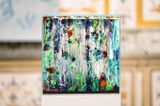
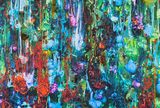
In Chemical Garden (2021–ongoing), Kurant combines liquid glass with salts of metals used in computer components to grow inorganic crystal formations resembling plants. These works consider the ways organic and inorganic substances are continuously reorganised into various unstable forms, and highlight how, paradoxically, inorganic chemicals, whose extraction causes destruction of ecosystems, were once crucial to the origin of life on earth. Nonorganic Life(2025) extends this exploration. Vivid metal-salt crystals are grown on anodised-aluminium surfaces printed with macro photographs of past Chemical Garden works. These paintings, blending micro and macro scales, blur distinctions between the technological, mineral, and biological.
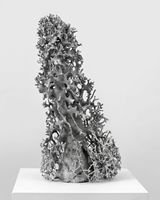
The exhibition also includes two new works from Kurant’s A.A.I. (Systems Negative) series (2016–present). These zinc casts of the interiors of termite mounds in Namibia were developed in collaboration with entomologists and follow on the earlier colourful mounds Kurant built with the labor of entirely unaware worker societies of millions of termites. The title references “artificial artificial intelligence,” a term coined by Jeff Bezos to describe labor crowdsourced from millions of online workers who, in a simulation of an AI algorithm, perform tasks that computers are currently unable to do. Kurant applies this concept to interspecies outsourcing, reflecting on labor exploitations in late capitalism’s extractivist economy.
Evolutions (2014) draws from the Princeton mathematician Nils Aall Barricelli and his 1950s experiments with artificial life using an ENIAC, the first general purpose computer. Punch cards modelling these algorithmic organisms evolving in a digital universe form the basis for Kurant’s lenticular prints.
A comprehensive monograph, Agnieszka Kurant: Collective Intelligence, will be published in October 2025 by Sternberg Press. Edited by Stefanie Hessler, Jenny Jaskey, and Kurant, it includes texts by Carolyn Christov-Bakargiev, Rosi Braidotti, Franco “Bifo” Berardi, Nicolas Bourriaud, Kate Crawford, Caroline A. Jones, Nora Khan, Jussi Parikka, Matteo Pasquinelli, and Elvia Wilk, among others. Kurant’s work is currently featured in The World Through AI at Jeu de Paume, Paris, and was featured in Basel Parcours in June. This fall, she will participate in Data Dreams: Contemporary Art in the Age of AI, in Sydney, from November 2025 to April 2026.
Recent solo exhibitions include MUDAM, Luxembourg (2024); Kunsthal Gent (2023); Kunstverein Hannover (2023); Castello di Rivoli, Turin (2022); and Sculpture Center, New York (2013). She has realised commissions for the façade of the Guggenheim Museum (2015) and for MIT List Visual Arts Center, Cambridge (2021–22). Kurant’s work has also been shown at Gwangju Biennale (2024); Sydney Biennale (2024); Centre Pompidou and Pinault Collection – Bourse de Commerce, Paris (2024); Gropius Bau, Berlin (2024); Louisiana Museum, Denmark (2023); Munch Museum, Oslo (2023); Dhaka Art Summit (2023); MoMA and SFMOMA (2021); Nottingham Contemporary (2021); Kunsthalle Wien and Whitechapel Gallery, London (2020); Istanbul Biennial and Triennale Milano (2019); Guggenheim Bilbao (2017); The Kitchen (2016); Palais de Tokyo, Paris (2014); Witte de With, Rotterdam (2011); and Performa Biennial, New York (2009).
Kurant was the recipient of the 2020 LACMA A+T Award and the 2019 Frontier Art Prize.
Agnieszka Kurant is a Polish conceptual artist whose acclaimed contemporary art practice investigates the invisible forces shaping society, from collective intelligence and artificial life to the hidden economies of data and labour.


For over forty years, Marian Goodman Gallery has played an important role in helping to establish a vital dialogue among artists and institutions working internationally. Marian Goodman Gallery was founded in New York City in late 1977. In 1995 the Gallery expanded to include an exhibition space in Paris – with an additional exhibition space and bookshop added in 2016 - and in 2014 an exhibition space in London. The London space transitioned to Marian Goodman Projects in 2021, a new initiative to present exhibitions and artist projects in London and other select cities around the world.

A respected voice in contemporary art discourse.
Focusing on ambitious storytelling and insightful art-world commentary. Ocula Magazine publishes in-depth interviews, critical essays and timely analysis on the artists, exhibitions and ideas driving the global art world.
Learn more about Ocula Magazine
Showcasing the best of the art world.
Ocula partners with galleries from around the world to highlight their artists, artworks and exhibitions. Gallery membership is by application and invitation, with each member vetted by an independent panel.
Learn more about Ocula Membership

Specialises in the sale of major artworks.
Led by a team with deep ties to the world’s leading auction houses, galleries and collectors. Ocula’s advisory team offers bespoke services to high-net-worth clients from around the world who are looking to acquire the best of contemporary and modern art.
Learn more about our team and services