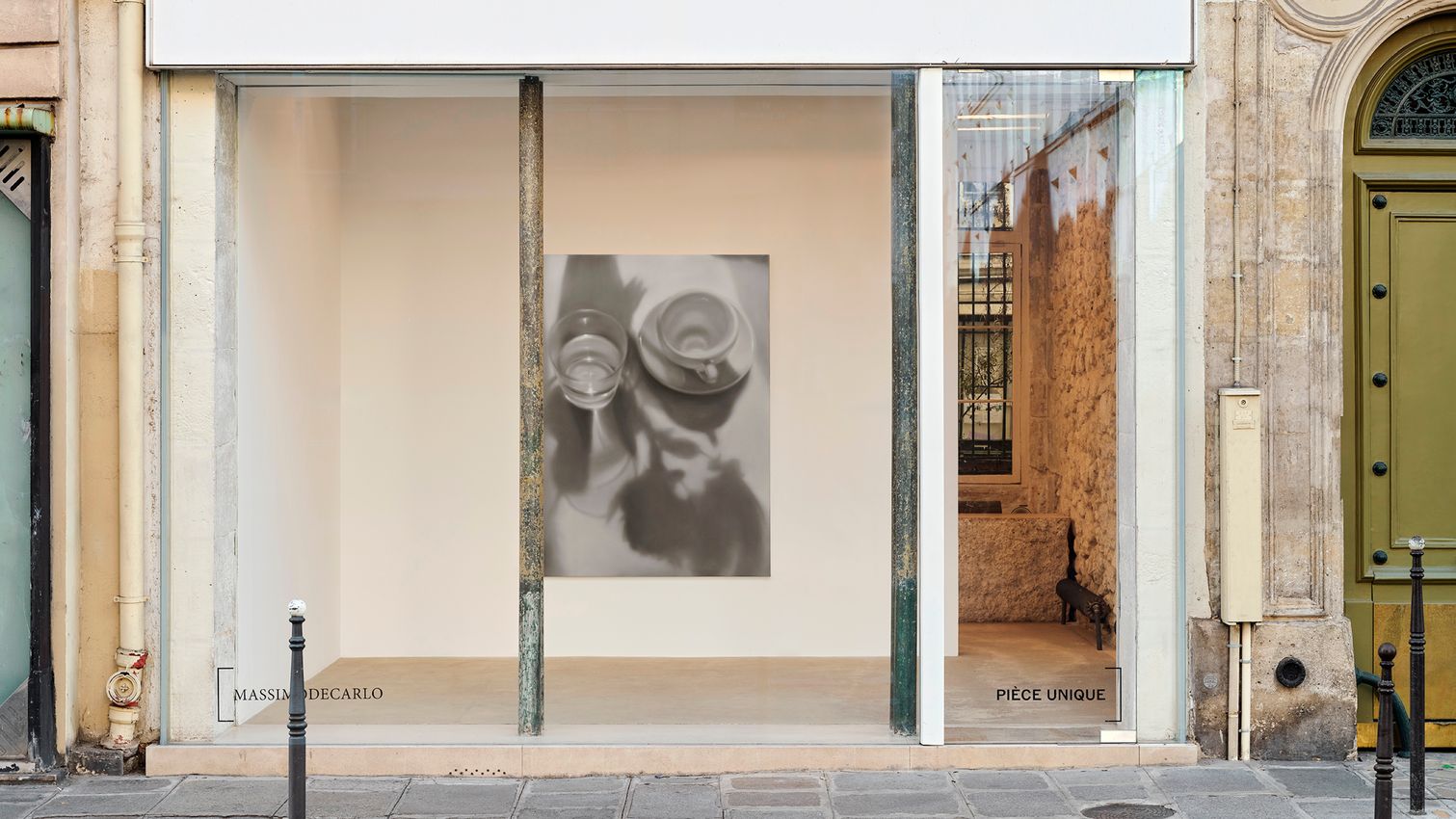
MASSIMODECARLO Pièce Unique is pleased to present Daily Blur, Alexis Ralaivao’s first exhibition with the gallery – two new paintings about presence and absence and about what an image can keep of what is no longer there.
Everything Ralaivao paints comes from his own life, and often by accident – a photograph taken for some other reason entirely, with no thought of painting. He is drawn, again and again, to what sits at the edge of visibility: a transparency, a reflection, a shadow, something half-remembered. The two paintings gathered here hold that instinct in two keys – one cool and grey, one warm with colour.
The larger announces its own paradox in its title: J’ai acheté des fleurs pour les peindre, je n’ai peint que leurs ombres – I bought flowers to paint them, I painted only their shadows. A glass of water and an emptied espresso cup rest on a white cloth, and beneath them spreads a soft, dark bloom of shade in which petals, a stem, and a leaning stalk slowly declare themselves. The flowers had sat on the artist’s table one morning and cast this shadow across it, and it was the shade, not the bloom, that he chose to keep. “You can guess that there are flowers,” he says, “but you don’t see them.”
Ralaivao is self-taught. Based in Rennes (France), he came to painting through intensive, independent study of its history. From the Dutch Golden Age he takes the patient, near-obsessive attention of Johannes Vermeer and Gerard ter Borch, and their tenderness toward cloth, glass, metal and skin. From twentieth-century Italy, the cropped and magnified everyday of Domenico Gnoli and, above all, the hushed still-life devotion of Giorgio Morandi. “Maybe it was better not to know anything,” he says of teaching himself – less a rejection of this lineage than a licence to enter it on his own terms, answerable to no one but his own eye.
Beside this grey world hangs its opposite: a smaller canvas, warm-skinned, a string of red beads at a bare throat. It belongs to another current in his painting – the colour, the closeness – and to an ordinary evening: his partner trying on a necklace. Cropped close, the face lifted out of frame, it holds the warmth of the moment it was taken. One canvas is absence; the other, presence. Together they form the two halves of how he sees: the empty table and the beloved neck.
And then there is a third element that remains unseen. On the back of every canvas, Ralaivao writes by hand – fast, unplanned, “whatever is on my mind” the day he finally lets the work go. Where the front is built in slow, deliberate layers, the back is spilled in a single breath. He began because signing and dating felt “too cold, just to sign and send them away”; he wanted “something more, and something secret”, a few lines meant only for whoever comes to live with the painting. A diary, sealed to the wall.
What unites the two works, in the end, is an impulse to keep. A shadow saved where a flower stood; an ordinary evening held in a string of red beads; a few words hidden on the reverse of a canvas. Each is an act of preservation, holding something fast before it slips away – not the thing itself, but what it leaves behind: a trace, a warmth, a mark. These are the smallest, most fleeting things, and for Ralaivao the ones most worth holding on to.
Courtesy MASSIMODECARLO.


MASSIMODECARLO Pièce Unique opened in a historical building at 57 Rue de Turenne on February 2021. It has been renovated by acclaimed Japanese architect Kengo Kuma in collaboration with PiM.studio Architects. MASSIMODECARLO Pièce Unique offers a flexible, dynamic, and upbeat program of single-work exhibitions, visible day and night through its glass window. The gallery is born from the purchase of the “Pièce Unique” brand, an adventurous space by iconic gallerist Lucio Amelio that he opened in Paris in 1989 designed with Cy Twombly. MASSIMODECARLO Pièce Unique will respect and recast into the 21st Century the legacy of this historical project, renewing its original idea, infusing a new perspective, and offering an alternative exhibition model for the contemporary art system.
A respected voice in contemporary art discourse.
Focusing on ambitious storytelling and insightful art-world commentary. Ocula Magazine publishes in-depth interviews, critical essays and timely analysis on the artists, exhibitions and ideas driving the global art world.
Learn more about Ocula Magazine
Showcasing the best of the art world.
Ocula partners with galleries from around the world to highlight their artists, artworks and exhibitions. Gallery membership is by application and invitation, with each member vetted by an independent panel.
Learn more about Ocula Membership

Specialises in the sale of major artworks.
Led by a team with deep ties to the world’s leading auction houses, galleries and collectors. Ocula’s advisory team offers bespoke services to high-net-worth clients from around the world who are looking to acquire the best of contemporary and modern art.
Learn more about our team and services