



MASSIMODECARLO Pièce Unique is pleased to present Rat-A-Hum-Tat-Tat-Rat-A-Hum-Tat-Tat, the first solo exhibition by Xiao Guo Hui with the gallery.
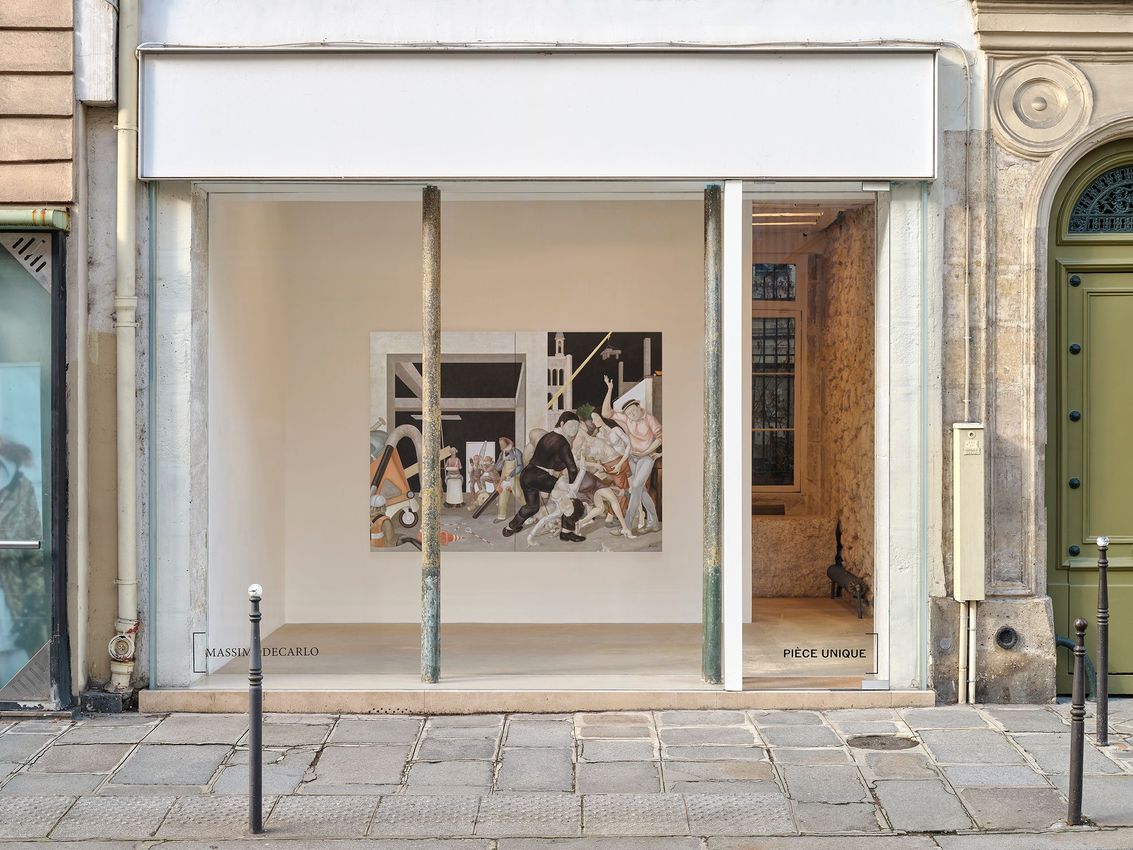
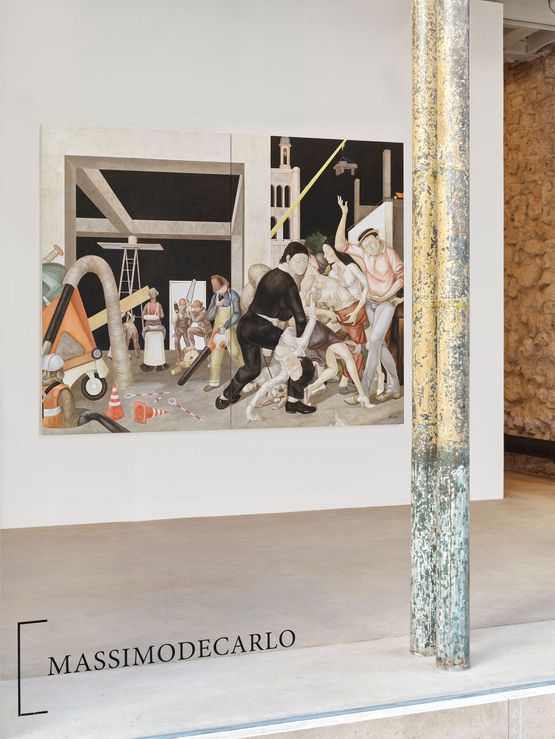
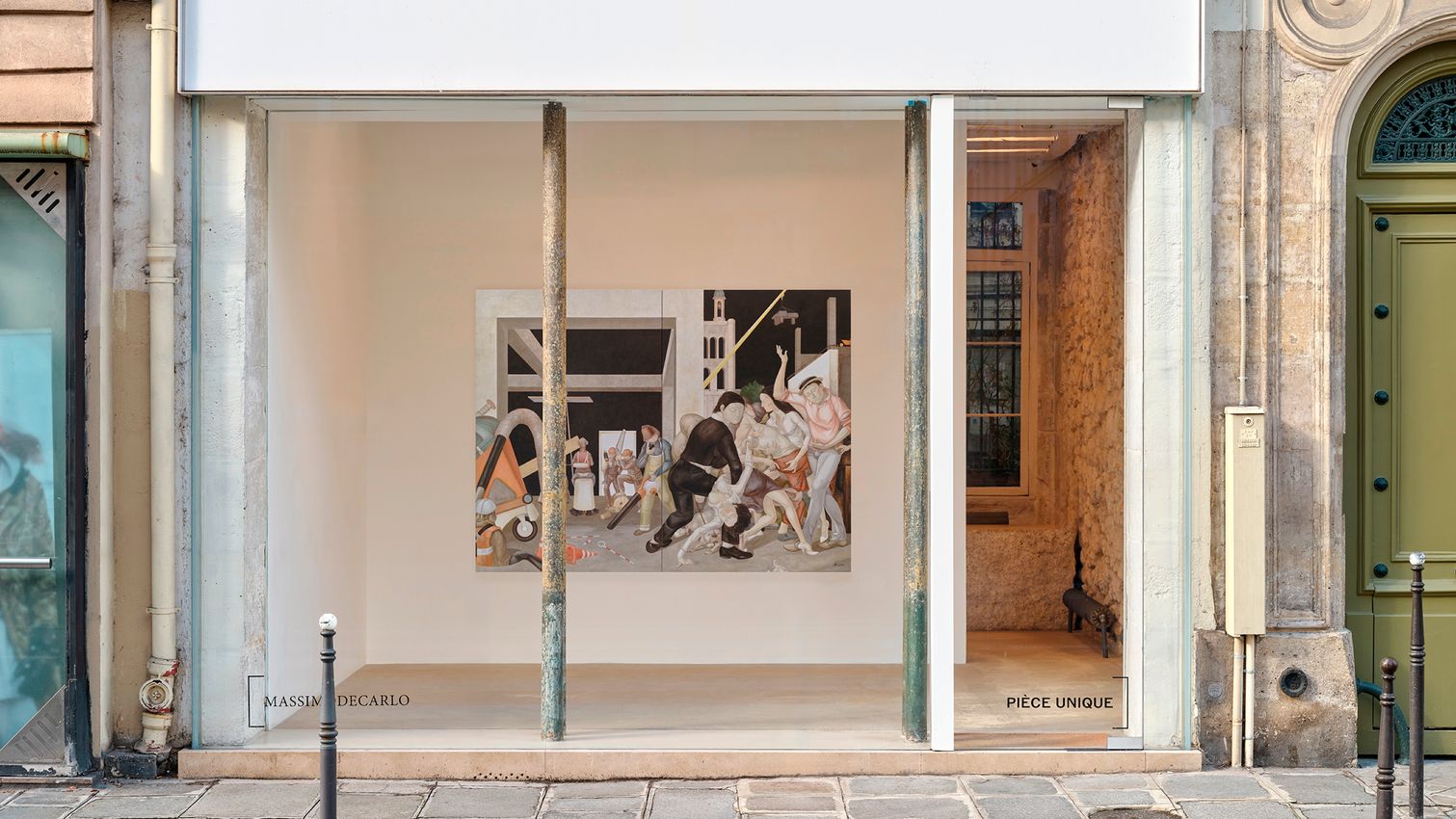
The title imitates a sound: the beat of the music one dances to. For the window of Pièce Unique, Xiao has made a single large painting – a diptych over two metres wide – on the one subject a space facing a busy street cannot keep out: noise.
For eight years he and his wife lived in the Marais, met each morning by “the piercing beep of the street-cleaning trucks, the roar of the leaf blowers, the relentless rumble of construction machinery.” Xiao sets himself in a long line of the noise-afflicted: he thinks of Schopenhauer, “driven nearly to madness” by a sewing machine in his building, and wonders how the philosopher would cope today. What he calls, half in earnest, “an almost pathological fear of noise” has sharpened something in him – he notices that the loudest machines are also the approved ones, the sounds a city makes to keep itself, in his words, “cleaner or more beautiful.” Their noise is permitted.If that is the sound of order, the other side of the diptych holds a different kind of sound. On the right, a crowd has gathered to dance – a few professionals, most amateurs, all of them, he says, “totally absorbed in their world.” They make noise too, but theirs is chosen and shared. Place Colette, the square across from the Louvre, gave the first impulse for this image, but Xiao has rebuilt it from memory and invention into a place that exists only in the painting. Placing the dancers beside the machines, he lets the viewer decide “which group of people is making the noise,” and declines to answer himself: “I prefer to let the meanings suspend, and let the viewer define them.” The refusal is deliberate: to name the noise on the viewer’s behalf would be to add one more instruction to a world already crowded with them.A century ago the Futurists faced the same modern condition and drew the opposite conclusion, taking the roar and speed of the city as the music of the future. Xiao reverses them. He is not exhilarated by the machine; he is uneasy about what its noise pushes out of the frame – the state of absorption, of people wholly given over to something they have made themselves.
Trained in oil painting, Xiao abandoned it for older techniques, combining egg tempera and fresco. He learned the craft from Cennino Cennini’s_Il Libro dell’Arte_, the old handbook of the Tuscan workshop, reaching back past five centuries of oil to the matte, hand-worked skin of early Renaissance painting. A polished, precise finish, he says, is “suffocating” – so he refuses, in paint, the same smooth cleanliness the city imposes on its streets.The clothes are the invention of his wife, Chen Wen Qing, a designer and painter herself: for every figure she designs and sews a costume, and the two adjust it together – colour, cut, character. As in a Botticelli or a Piero della Francesca, where a sitter’s clothes announce who they are before the face does, dress is what makes each figure a particular person.
Everything in the work converges on the form Xiao wanted from the start: a stage. The window of Pièce Unique opens directly onto the street, and from the pavement, through the glass, the painting reads like a scene under stage light – a play performed on a wall. Behind the glass is the slow, hand-built world of the picture. In front of it is the street itself, the traffic and the machines and the passers-by. The two meet at the glass, and – like the dancers it holds – the painting keeps playing its own music and declines to join the noise, leaving whoever stops on the pavement to decide, once more, which side of the window the real noise is on.


Xiao Guo Hui (b. 1969, China) is a Canadian artist based in Fontainebleau, France. Through figurative painting, he explores the enduring patterns of human behavior and the tensions that emerge between belief, conviction, and conflict. Rather than depicting contemporary events, his works investigate how individuals and societies construct systems of meaning, draw boundaries between competing visions of the world, and negotiate opposing claims to truth. In doing so, they invite reflection on the contradictions and uncertainties that continue to shape contemporary life.


MASSIMODECARLO Pièce Unique opened in a historical building at 57 Rue de Turenne on February 2021. It has been renovated by acclaimed Japanese architect Kengo Kuma in collaboration with PiM.studio Architects. MASSIMODECARLO Pièce Unique offers a flexible, dynamic, and upbeat program of single-work exhibitions, visible day and night through its glass window. The gallery is born from the purchase of the “Pièce Unique” brand, an adventurous space by iconic gallerist Lucio Amelio that he opened in Paris in 1989 designed with Cy Twombly. MASSIMODECARLO Pièce Unique will respect and recast into the 21st Century the legacy of this historical project, renewing its original idea, infusing a new perspective, and offering an alternative exhibition model for the contemporary art system.
A respected voice in contemporary art discourse.
Focusing on ambitious storytelling and insightful art-world commentary. Ocula Magazine publishes in-depth interviews, critical essays and timely analysis on the artists, exhibitions and ideas driving the global art world.
Learn more about Ocula Magazine
Showcasing the best of the art world.
Ocula partners with galleries from around the world to highlight their artists, artworks and exhibitions. Gallery membership is by application and invitation, with each member vetted by an independent panel.
Learn more about Ocula Membership

Specialises in the sale of major artworks.
Led by a team with deep ties to the world’s leading auction houses, galleries and collectors. Ocula’s advisory team offers bespoke services to high-net-worth clients from around the world who are looking to acquire the best of contemporary and modern art.
Learn more about our team and services