




WIFREDO LAM
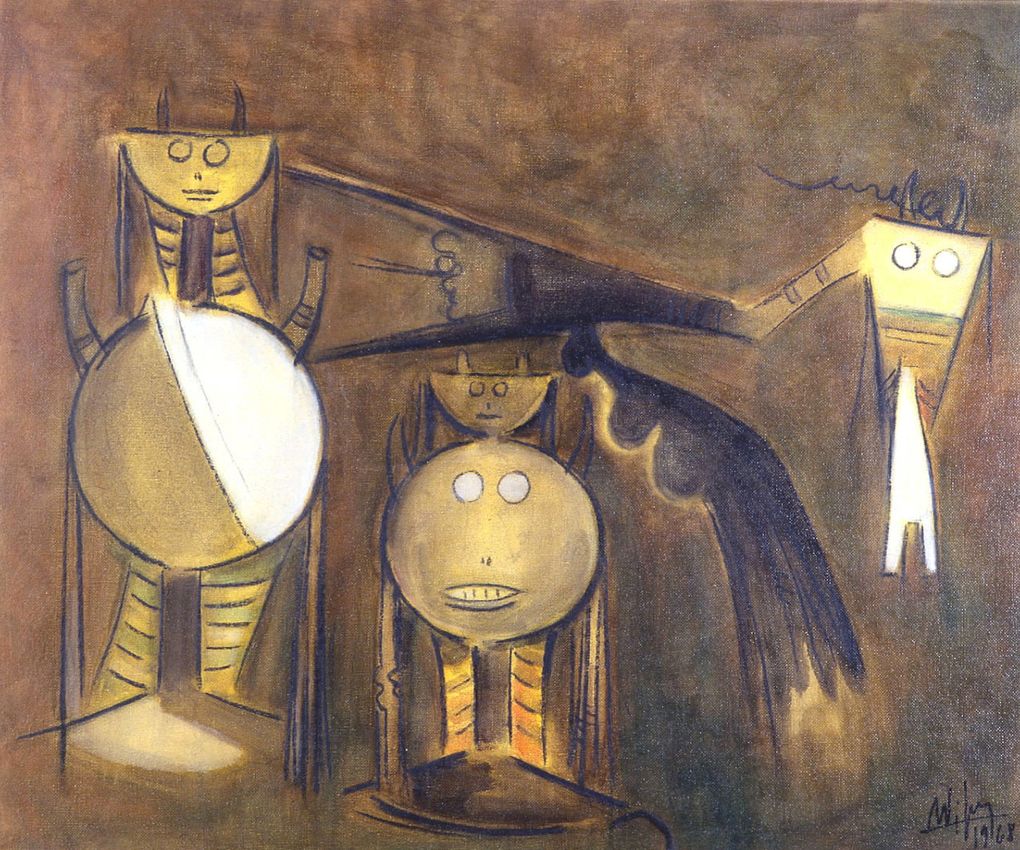
1902-1982, CubaWifredo Lam masterfully combined different cultural iconography with the formal breakthroughs of European modernism to forge a singular artistic language. His influential practice—celebrated worldwide in major institutions including Tate Modern (London), Centre Pompidou (Paris), and Asia Society (Hong Kong)—is distinguished by its evocative symbolism and seamless fusion of diverse histories, traditions and cultures.
Throughout his oeuvre, spanning painting, printmaking, ceramics, and sculpture, Lam’s work embodies the rich, vibrant syncretism of Afro-Caribbean culture, frequently portraying figures that dissolve boundaries between the corporeal and the spiritual and between modernity and ancestral heritage. His pioneering visual vocabulary not only challenged Eurocentric paradigms but also paved the way for global non-Western perspectives to enrich and transform the avant-garde.
In 2025, the Museum of Modern Art in New York opened Wifredo Lam: When I Don’t Sleep, I Dream, a major retrospective that underscored Lam’s enduring significance for both 20th-century modern art and contemporary artistic practice. Covering six decades of his production, the show brought together more than 130 works from the 1920s through the 1970s, including paintings, monumental works on paper, collaborative drawings, artist’s books, prints, ceramics, and extensive archival material, with important loans from the Estate of Wifredo Lam in Paris. The exhibition traced how Lam—a Cuban-born artist who spent much of his life between Spain, France, and Italy—came to exemplify the transnational artist of the 20th century.
Early Days
Wifredo Lam was born in Sagua La Grande, Cuba, to a Chinese immigrant father and a mother of African and Spanish descent, grounding him in a complex multicultural heritage from the outset. His family practised Catholicism while maintaining African spiritual traditions.
In 1916, Lam moved with his siblings to Havana, where he briefly studied law but soon shifted focus, studying at the Escuela Profesional de Pintura y Escultura, Academia de San Alejandro until 1923. His participation in exhibitions at the Salón de Bellas Artes was pivotal in solidifying his commitment to painting. At age 21, he was awarded a scholarship to study in Spain—a move that would set the stage for his future engagement with European modernism and shape the trajectory of his influential artistic career.
Wifredo Lam in Spain
In Madrid, Lam continued his fine art studies under Fernando Álvarez de Sotomayor y Zaragoza, the curator of the Museo del Prado and teacher of Salvador Dali. His years in Spain brought him into contact with Spanish Old Masters and exposed him to the upheavals of the Spanish Civil War. He regularly visited the Archeological Museum, and encountered the works of Diego Velázquez, Hieronymus Bosch and Francisco de Goya at the Prado Museum, where he also spent a great deal of time. Inspired by Goya’s studies of political corruption, Lam went on to use his own work as a way of condemning the horrors of the Spanish War, which he fought in. The violence of the struggle inspired his painting La Guerra Civil (The Spanish Civil War) in 1937.
In 1931, his first wife, Eva (Sébastiana Piriz) and their son Wilfredo Victor died of tuberculosis. The terrible suffering he endured led to numerous paintings of mother and child.
Paris, Picasso and Breton
In 1938, after escaping war-torn Spain for Paris, Wifredo Lam entered the heart of the European avant-garde, forging ties with influential artists such as Picasso, Braque, Matisse, and Miró. Meeting his future wife, Helena Holzer, during this period marked a personal milestone. Lam’s exposure to figures like André Breton and his involvement with the Surrealists at Villa Air Bel deeply shaped his artistic direction. Here, he produced a pivotal series of ink drawings that introduced his now-iconic hybrid figures—a visual language blending Surrealism with Afro-Cuban symbolism]] that he would develop more fully during his transformative years in Cuba from 1941 to 1947.
Artistic Practice
Wifredo Lam’s art is defined by an inventive fusion of human, animal, and plant forms—elements deeply rooted in his Afro-Cuban heritage and expanded through his exposure to European modernism. Following his return to Cuba in 1941, compelled by the Nazi occupation of France, Lam reconnected with the spiritual and cultural fabric of the Caribbean. This marked a crucial turning point: he began experimenting with form and technique, using both fluid washes and thick impasto, and often left parts of the canvas bare to heighten tension. His palette shifted to more muted, earthy tones, reflecting the psychological and political atmosphere of his homeland.
In 1942, he created over 100 works, including La Jungla, a landmark painting exhibited at Galerie Pierre Matisse in New York. The piece—with its densely layered hybrid figures amid sugarcane—powerfully evokes Caribbean slavery, spiritual resilience, and cultural resistance. Lam’s commitment to hybridity extended across mediums, appearing in his ceramics, sculpture, and printmaking, and reinforcing his exploration of Afro-Cuban identity and modernism.
Later Works, Recognition and Legacy
From the late 1940s, Wifredo Lam’s art evolved to emphasise spiritual and mystical themes, blending Oceanic and African influences into his work. His international reputation grew as his paintings were exhibited widely across the United States, Europe, the Caribbean, and the Soviet Union, accompanied by critical coverage in major art magazines. In 1946, Lam and his wife Helena traveled to Haiti, where attendance at voodoo ceremonies alongside figures like André Breton profoundly influenced his art. A trip to New York connected him with Marcel Duchamp and new artistic circles including Arshile Gorky and John Cage. By the late 1940s, Lam divided his time among Europe, Havana, and New York, engaging with artists such as Noguchi, Motherwell, Pollock, and members of CoBrA.
After separating from Helena, Lam settled in Paris in 1955, producing large-scale works that gradually shifted towards abstraction before returning to figuration in the 1960s with complex, elongated figures. He married Swedish artist Lou Laurin in 1960, a period marked by important accolades including the Grand Prix at the Havana Salon and the 1964 Guggenheim International Award. Lam increasingly aligned with European postwar avant-garde currents, collaborating with the CoBrA movement and Italian avant-garde artists, and frequenting Albissola Marina, Italy, which became a hub for artistic innovation.
The 1960s saw Lam deepen his printmaking collaborations with celebrated poets and writers, partnering with master printer Giorgio Upiglio for prolific graphic work. From 1964 onward, he maintained studios in Paris and Albissola Mare, surrounded by an intellectual circle and honored by major international exhibitions. Lam died in 1982 in Paris, leaving a legacy that reshaped modern art through his integration of non-Western cosmologies and Afro-Caribbean syncretism, and his key role in Afro-Cuban and Surrealist modernism.
In summer 2026, Lam’s legacy was further contextualised within broader conversations on Black internationalism and global modernism with the announcement of his inclusion in Project a Black Planet: The Art and Culture of Panafrica at the Barbican in London, a major international exhibition that examined the impact of Pan-Africanism on artistic and cultural production, situating artists like Lam within a wider constellation of creators who have drawn on African and diasporic thought to reimagine the terms of modern and contemporary art. The same year, Galerie Gmurzynska also announced an exhibition dedicated to Pablo Picasso and Wifredo Lam.
Wifredo Lam FAQs
What is unique about Wifredo Lam’s style?
Wifredo Lam is recognised for combining Afro-Cuban religious imagery with Cubist and Surrealist painting, creating a distinctively hybrid visual language.
What style of art did Wifredo Lam make?
Wifredo Lam’s work is often associated with Surrealism and Cubism, but he developed a highly personal style that blends European modernism with Afro‑Cuban religious imagery and Caribbean visual traditions. Many historians describe his work as a form of Afro‑Cuban or transcultural modernism rather than fitting neatly into a single European movement.
What is Wifredo Lam best known for?
Wifredo Lam is best known for his hybrid, mask‑like figures that merge human, animal, and plant forms to explore Afro‑Cuban spirituality and colonial history within a modernist language. His painting La Jungla (The Jungle) (1946) is his most celebrated work and a key reference point in discussions of Caribbean and global modern art.
What is the meaning behind Wifredo Lam’s ‘The Jungle’ (1946)?
The Jungle by Wifredo Lam is widely interpreted as a response to the legacy of slavery, the exploitation of Caribbean sugar economies, and the resilience of Afro‑Cuban spiritual practices. The dense, overlapping figures and sugarcane forms evoke both physical confinement and spiritual presence, suggesting a landscape haunted by history yet charged with ritual power.
What key themes appear in Wifredo Lam’s early work?
Wifredo Lam’s early work is marked by profound personal loss and his experience of the Spanish Civil War. In 1931, the deaths of both his first wife and infant son from tuberculosis cast a deep shadow over his life—an episode that, as he later confessed, left him ‘deprived...of all enthusiasm for life.’ The grief from this period surfaces in the somber tone and psychological intensity of several of his early paintings. By 1936, Lam was directly involved in the Spanish Civil War, joining the Republicans in their fight. The chaos and collective struggle of wartime quickly entered his visual language; his paintings of this era often feature tense, interlocking groups of figures, capturing both the volatility and solidarity of the time. The interplay between private sorrow and the turbulence of world events became foundational to Lam’s evolving artistic vision.
Where is Wifredo Lam’s work exhibited?
Wifredo Lam’s art is in the collections of major museums worldwide, including Tate Modern, Centre Pompidou, Museo Reina Sofía, and MoMA. In 2026, MoMA will present Wifredo Lam: When I Don’t Sleep, I Dream, the most extensive retrospective devoted to the artist in the United States.
How did Wifredo Lam influence modern art?
Wifredo Lam influenced modern art by opening new pathways for artists outside the West, pioneering ways to integrate non-European perspectives with avant-garde art movements.
What is the connection between Picasso and Wifredo Lam?
Wifredo Lam and Pablo Picasso developed a close professional and personal relationship after Lam arrived in Paris in the late 1930s. Picasso recognised Lam’s talent early on, supported him within the European avant‑garde, and helped introduce him to key artistic networks, including Surrealist circles. While Lam absorbed aspects of Cubism and modernist experimentation that Picasso had helped pioneer, he transformed these influences through his own Afro‑Cuban heritage, spiritual interests, and experience of colonial history. Their connection is therefore often described as a dialogue: Picasso championed Lam within the European scene, and Lam expanded modernism’s visual language beyond a strictly European frame.
What are some of Wifredo Lam’s key artworks?
- La Jungla (The Jungle), 1946: is filled with enigmatic hybrid figures—part human, part animal, part vegetation—crowded together amid thick sugarcane stalks and palm leaves. Mask-like faces, elongated limbs, and exaggerated body parts evoke Afro-Cuban spiritual imagery and Surrealist morphologies. Painted upon his return to Cuba from Europe, it is a powerful anti-colonial statement about identity.
- La Présence éternelle (The Eternal Presence), 1944: This large canvas depicts three majestic figures, their forms fusing human and animal elements, surrounded by frond-like patterns. Dedicated to Cuban composer Alejandro García Caturla, this painting is a celebration of Afro-Caribbean spirituality and a testament to Lam’s commitment to blending European modernism with his own heritage.
- Femme à tête de cheval (Horse-headed Woman), 1950: The mysterious, surreal figure—a woman with a horse’s head—occupies a strong, totemic presence on the canvas. Lam’s technique merges sensual, mask-like ambiguity with Afro Cuban religious references, drawing inspiration from his partner Helena Holzer and highlighting his deep exploration of spiritual transformation through hybrid imagery.
Ocula | 2026









Explore and Follow Artists Shaping Contemporary Art
A respected voice in contemporary art discourse.
Focusing on ambitious storytelling and insightful art-world commentary. Ocula Magazine publishes in-depth interviews, critical essays and timely analysis on the artists, exhibitions and ideas driving the global art world.
Learn more about Ocula Magazine
Showcasing the best of the art world.
Ocula partners with galleries from around the world to highlight their artists, artworks and exhibitions. Gallery membership is by application and invitation, with each member vetted by an independent panel.
Learn more about Ocula Membership
Specialises in the sale of major artworks.
Led by a team with deep ties to the world’s leading auction houses, galleries and collectors. Ocula’s advisory team offers bespoke services to high-net-worth clients from around the world who are looking to acquire the best of contemporary and modern art.
Learn more about our team and services