The Pink Cloud of Paris
Patricia Leite’s gaze is contagious. When she asks her friends to send her photographs that might inspire her to paint, it’s not so much about adopting their point of view as it is about sharing with them her way of seeing the world. Ever since I began living and thinking with her work, I often find that a certain sky at dawn, a certain branch silhouetted against the sky, or a certain abandoned lounge chair on a terrace reminds me of her, even though I’m not one of those who send her their images.
In the early 1980s, she took part in a movement marking a return to painting that was sweeping through Brazil and the rest of the world at the time. Her painting from that period reflects influences ranging from Klee to Volpi. Abstract, organic, and gestural, it is associated with the concept of “sensitive geometry”, a term often used at the time to characterise Constructivist production in Latin America.
This was followed by about fifteen years during which Leite disappeared from the art scene to focus on forging a language that would be truly her own. She set up her studio in her home, with large windows overlooking mountains and the city of Belo Horizonte. A few paintings bear witness to the gradual transition from abstraction to the image, but even more so to the emergence of a meeting point between world, painting, and painter.
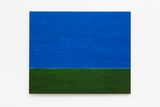
The painting that symbolises this arrival at the turning point in her work dates from 2003 and is titled Barnett Newman. On an untreated wooden panel, Leite applies numerous layers of diluted oil paint until she achieves a deep colour that seems to glow from within. The lower third of the painting is a pale yellow, separated from the azure-blue upper section by a gradient of darker blues. The lines separating each element are slightly irregular. Newman’s spiritual and inner verticality has become a horizon line; his esoteric surfaces, a sun-scorched beach; his gesturality, the irregularities that bring the natural world to life.
Patricia Leite has devoured Barnett Newman and all the others from whom she learned and then unlearned. She has forged her own space in painting, successfully making formal questions coincide with an existential perspective.
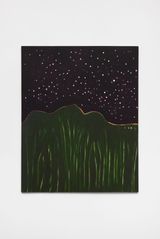
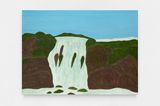
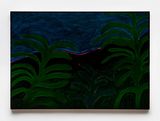
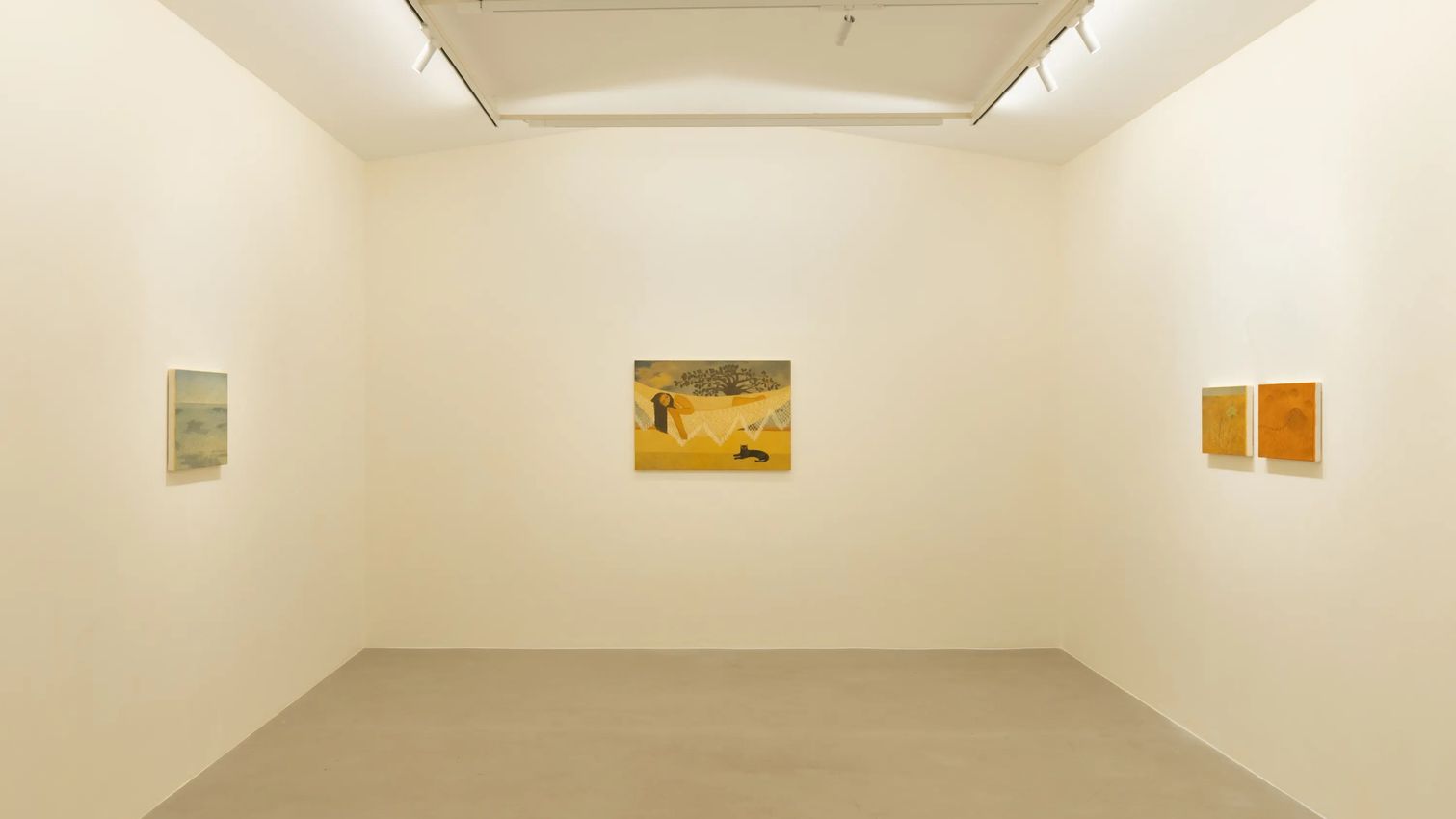
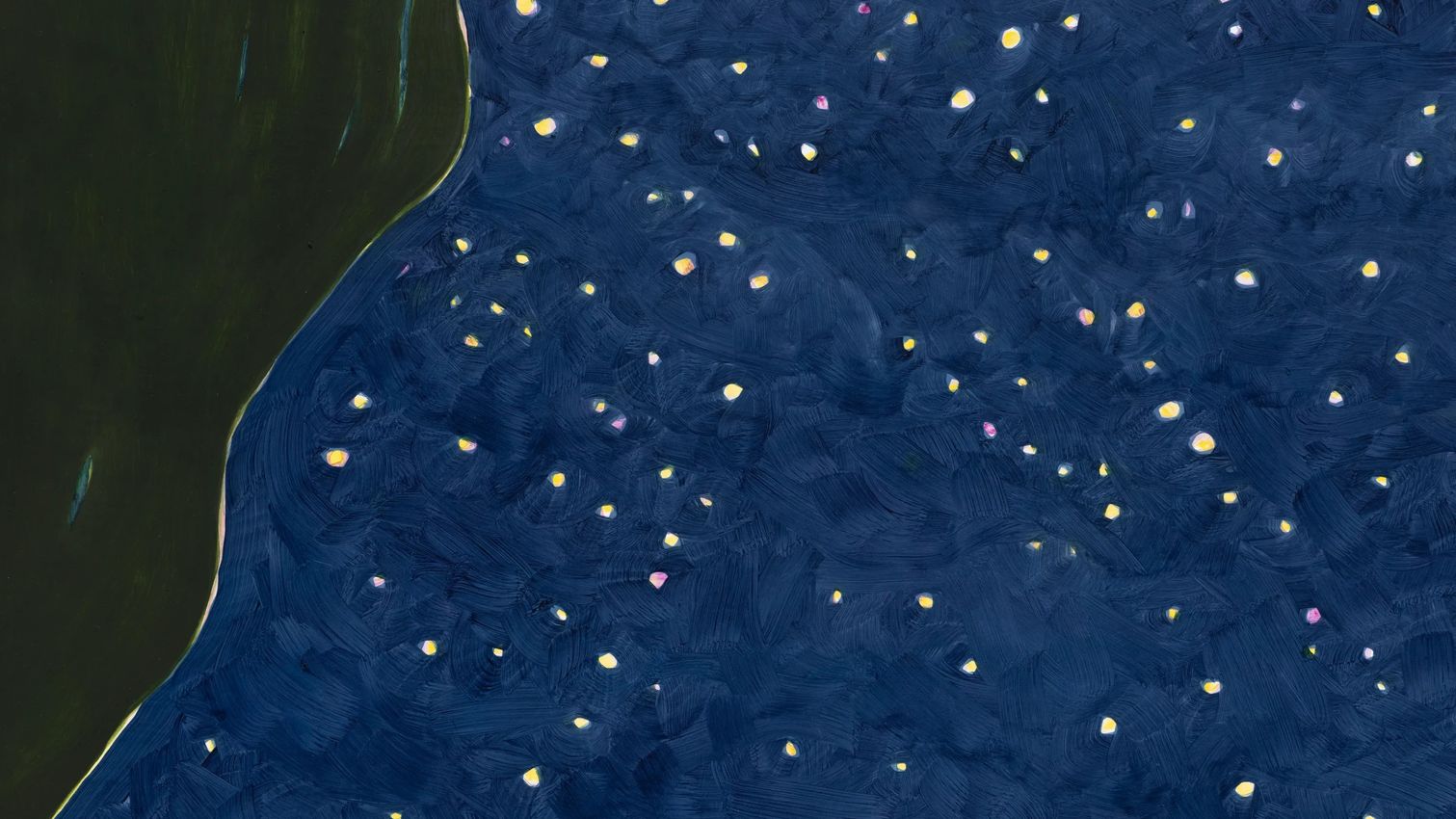
Onto the beach’s level horizon would later be superimposed a palm branch falling in the foreground, the foam of the waves, or rocks. The composition always leaves plenty of open space for large planes of colour, and the forms – moons, birds, or stars, which evoke more than they represent – rarely emerge at the centre of the painting. We move from dawn to dusk and into night. Leite uses colour as a signifier. It is colour that carries the emotional weight of the painting, for it is through colour that Leite manages to capture the most fleeting and poignant moments. Those we would like to hold onto when it is always too late.
It is so fitting that Patricia Leite’s work is on display in Paris, on the Place des Vosges, for it seems to me to share much with that of Proust, one of the writers who best described the city. Proust, who built his work on involuntary memory and who expressed better than anyone else the pleasure found neither in the present nor in the past but in the chance encounter between the two. Nothing but a moment of the past? Much more perhaps; something which being common to the past and the present, is more essential than both. (...) But is not that discovery, which art may enable us to make, most precious to us, a discovery of that which for most of us remains forever unknown, our true life, reality as we have ourselves felt it, and which differs so much from that which we had believed that we are filled with delight when chance brings us an authentic revelation of it?
Patricia Leite’s works have the power to connect us to such epiphanies, which are both delightful and poignant. Portuguese speakers call this saudade, and Pessoa is its undisputed poet: I’m walking down a street. The smell of bread from a bakery nauseates me with its sweetness, and my childhood rises up from a distant neighbourhood, and another bakery emerges from that fairyland which is everything we ever had that has died.
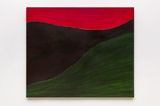
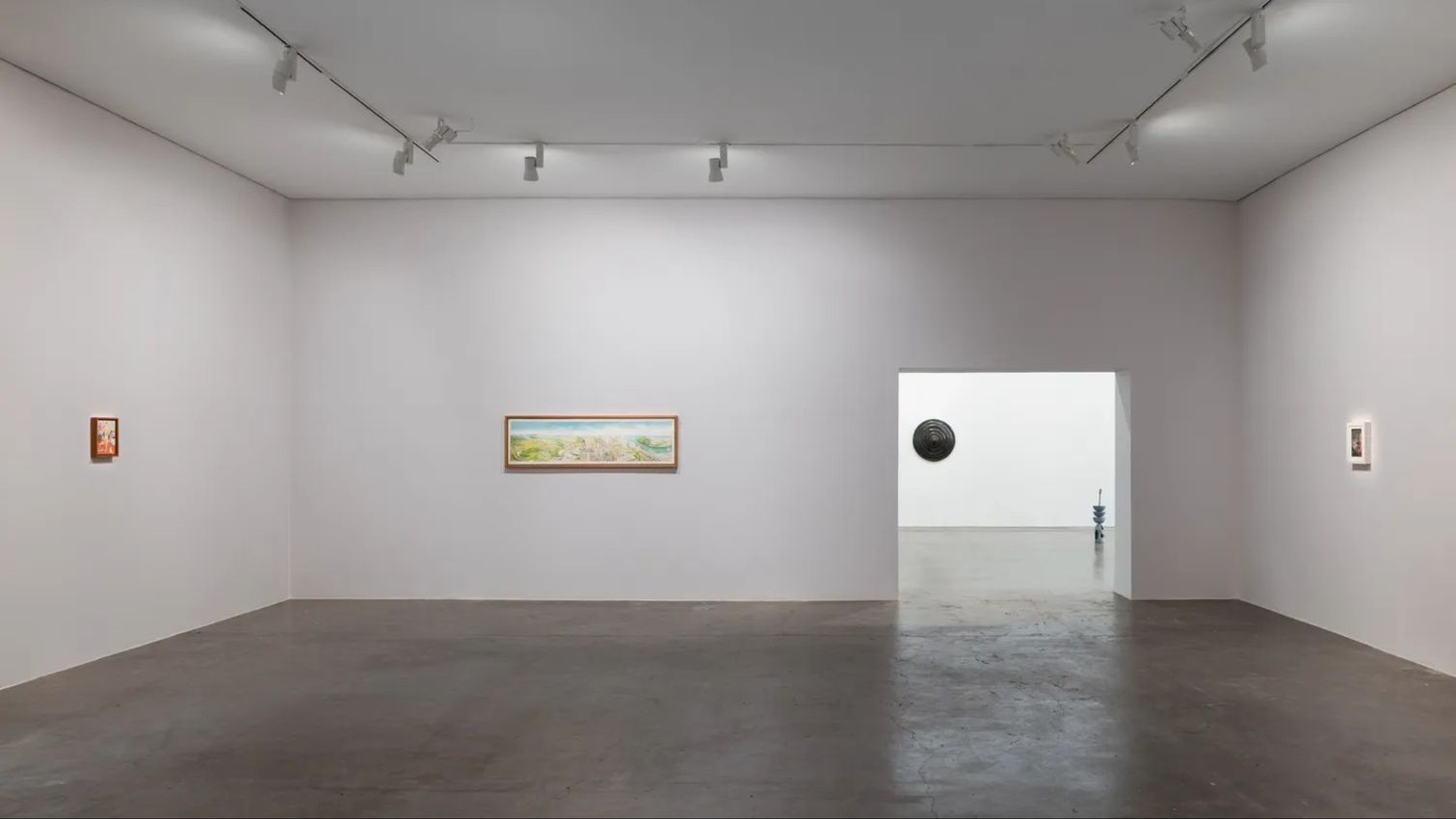
The shades of pink in the sky of Minguante | Waning (2026, all works from this year), the pink and grey dawn of Travessia II | Crossing II, and the blue afternoon of 17:00 horas serve as links between the artist’s memories and our own. Patricia Leite is Brazilian, and her work reflects this both in its history and in its subjects, and when she paints Paris (Nuvem rosa de Paris | The Pink Cloud of Paris) or the Chapel of the Rosary in Vence (Vitral (D’après La Chapelle du Rosaire)), she paints them from the world where she shaped her gaze; she paints them, always, from Belo Horizonte.
– Anne Pontégnie
Navigating various references, Patricia Leite gives an outlet to her memories and latent affections through an extremely peculiar pictorial exercise. Bucolic scenes from trips or images extracted from videos that caught her attention trigger a process towards paintings that come into existence in a rare combination between seriousness and leniency. In her cohesive body of work, we find recurring echoes and resonances from themes and styles that are well represented in the history of art, such as landscape painting and pop art elements. However, these resources are always used as a support to express intimate manifestations that could be in a diary or in a map with organically collected and carefully edited images.


A respected voice in contemporary art discourse.
Focusing on ambitious storytelling and insightful art-world commentary. Ocula Magazine publishes in-depth interviews, critical essays and timely analysis on the artists, exhibitions and ideas driving the global art world.
Learn more about Ocula Magazine
Showcasing the best of the art world.
Ocula partners with galleries from around the world to highlight their artists, artworks and exhibitions. Gallery membership is by application and invitation, with each member vetted by an independent panel.
Learn more about Ocula Membership

Specialises in the sale of major artworks.
Led by a team with deep ties to the world’s leading auction houses, galleries and collectors. Ocula’s advisory team offers bespoke services to high-net-worth clients from around the world who are looking to acquire the best of contemporary and modern art.
Learn more about our team and services