





EMMA WEBSTER
b. 1989, United StatesEmma Webster is a contemporary British American painter known for large-scale, otherworldly landscape paintings that merge traditional oil techniques with virtual reality and 3D model–based image construction. She lives and works in Los Angeles.
Early Life and Education
Born in 1989 in Encinitas, California, Webster grew up between the United States and the United Kingdom, an upbringing that sharpened her sensitivity to differing landscape traditions and atmospheres. She completed a BA in Art Practice at Stanford University in 2011 and an MFA in Painting at Yale University in 2018, and previously worked in interactive advertising design for clients such as YouTube and Google—a trajectory that underpins her fusion of art-historical references with technologies ranging from Oculus headsets to VR software like Blender.
Artistic Practice
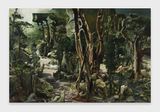
Webster creates immersive, fictional landscapes built from models rather than direct observation of nature. She constructs scenes as physical maquettes or in virtual reality, using headsets and 3D software to sculpt terrain, light, and atmosphere from within the space. These worlds are then translated into large oil-on-linen paintings with sweeping perspectives, dramatic lighting, and unstable horizons. Her work draws on Romantic painting, Baroque theatrical illusion, cinematic set design, and game-engine aesthetics, reflecting how nature is increasingly experienced through screens, simulations, and mediated images.
Themes and Imagery
Across her series, Webster treats the landscape as a stage where psychological, ecological, and technological tensions play out. Phosphorescent foliage, levitating rock formations, and dense mists suggest environments that are both enchanted and under threat. By combining analogue painting with digital world-building, she explores environmental anxiety, the artificiality of scenic views, and the status of landscape in a post-digital age. Her imagery often hovers between genesis and catastrophe, inviting viewers to consider whether they are looking at primordial worlds, speculative futures, or virtual simulations.
Interactive Digital Experience
For her 2026 solo exhibition at Petzel, Rues and Leaves Them Alone, Emma Webster created a new body of paintings presented alongside an interactive digital experience that, for the first time, would allow viewers to step directly into her constructed worlds. Developed from theatre-inspired maquettes that are translated into digital models and then into oil on linen, these works push her fusion of plein-air landscape, still life, and virtual creation to a new level. Rolling hills, livestock, and flora appear as fantastical, meticulously staged scenes in which the pastoral turns mystical and the provincial becomes strangely charged. The accompanying interface extends the paintings beyond the canvas further dissolving the boundary between physical and digital reality.
Exhibitions and Recognition
Webster has presented solo exhibitions with international galleries including Perrotin, Petzel, Jeffrey Deitch, Alexander Berggruen, Carl Kostyál, and others, with shows in cities such as Paris, Hong Kong, Tokyo, New York, Los Angeles, Brussels, London, and Miami. Her work has appeared in museum and institutional group exhibitions in the United States and Europe and has entered public and private collections. She has been the subject of features and reviews in major art and culture publications, and her practice has been discussed in relation to contemporary landscape painting, VR-based image-making, and post-digital figuration.
Solo Exhibitions
- Rues and Leaves Them Alone, Petzel (2026)
- That Thought Might Think, Petzel, New York (2025)
- Vapors, Perrotin, Hong Kong (2025)
- Enough Ecstasy, Perrotin, Art Basel, Miami (2023)
- Intermission, Jeffery Deitch, Los Angeles (2023)
- Green Iscariot, Alexander Berggruen, New York (2021)
- Weltlandschaft, Carl Kostyál, London (2021)
Group Exhibition
- Alien Shores, White Cube Bermondsey, London (2025)
- das gelbe Licht 6 Uhr nachmittags, Galerie Max Hetzler, Berlin (2023)
- Fire Figure Fantasy: Selections from ICA Miami’s Collection, Institute of Contemporary Art Miami (2022)
- You Me Me You, Nicodim, Los Angeles (2022)
- Stockholm Sessions, Carl Kostyál, Stockholm (2021)
Collections
Webster’s work is part of various public collections around the world, including the Centre Pompidou, Paris, France; Los Angeles County Museum of Art (LACMA), Los Angeles, California; Institute of Contemporary Art, Miami, Florida; Museum of Contemporary Art San Diego, San Diego, California; Pérez Art Museum Miami, Miami, Florida; Columbus Museum of Art, Columbus, Ohio; Yuz Museum, Shanghai, China; The Warehouse, Dallas, Texas; and the Groeninghe Art Collection, Bruges, Belgium.
Critical Reception
Emma Webster’s work has received international acclaim in publications including Artnet News, Frieze, and The New York Times.
Website and Instagram
Emma Webster’s website can be found here, and her Instagram can be found here.
Emma Webster FAQs
Who is Emma Webster the artist?
Emma Webster is a British-American contemporary painter based in Los Angeles, known for large-scale, otherworldly landscape paintings that fuse traditional oil painting with virtual reality and 3D modelling. Born in 1989 in Encinitas, California, she studied at Stanford University and Yale University and exhibits internationally with galleries such as Perrotin, Petzel, Jeffrey Deitch, Alexander Berggruen, and Carl Kostyál.
What medium and techniques does Emma Webster use?
Emma Webster primarily works in oil on canvas or linen, but her process begins with digital world-building. She constructs maquettes and virtual landscapes using VR headsets and 3D software, stages them with theatrical lighting, then translates these scenes into paintings using classical oil techniques, combining analogue mark-making with digitally conceived compositions.
How does Emma Webster use virtual reality in her paintings?
Emma Webster uses virtual reality as a tool for sketching and composing landscapes from the inside out. By sculpting terrain, light, and atmosphere in VR, she can invent impossible perspectives and physics—such as levitating rocks and distorted horizons—which she then reinterprets in oil paint, blurring boundaries between virtual space and physical painting.
What are the themes in Emma Webster’s landscape paintings?
Emma Webster’s paintings explore how we construct, perceive, and emotionally respond to nature in a mediated, post-digital world. She creates fictional landscapes that investigate illusion, memory, spectacle, and environmental anxiety, questioning the authenticity of scenic views shaped by screens, simulations, and cultural imagination.
Is Emma Webster’s art influenced by climate change and the environment?
Environmental concerns are central to Emma Webster’s practice. Although her landscapes are invented, they are haunted by ecological anxiety, artificial light, and synthetic atmospheres that evoke a world increasingly distanced from untouched nature. Her paintings act as psychological and symbolic landscapes reflecting collective fears around climate change, extinction, and environmental degradation.
Where has Emma Webster exhibited her work?
Emma Webster has exhibited widely in the United States, Europe, and Asia. Solo exhibitions have been held in New York, Los Angeles, Paris, Hong Kong, Tokyo, Brussels, London, and Miami, including shows at Perrotin, Petzel, Jeffrey Deitch, Alexander Berggruen, and Carl Kostyál, alongside group and institutional exhibitions at contemporary art museums and foundations.
Is Emma Webster collected by museums and institutions?
Yes, Emma Webster’s paintings are included in public and private collections, including museum and foundation holdings. Institutions have collected her work for its innovative approach to contemporary landscape painting and its integration of VR-based image-making into the tradition of oil on canvas.
What influences Emma Webster’s painting style?
Emma Webster’s style draws on Romantic landscape painting, Baroque theatrical illusion, stage and set design, CGI and video-game aesthetics. She merges art-historical references with digital tools to create staged, fantastical environments where the pastoral becomes mystical and the boundary between reality and simulation remains deliberately unstable.
Ocula | 2026




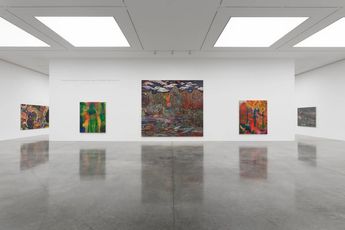
Explore Emma Webster's Exhibitions









Explore and Follow Artists Shaping Contemporary Art
A respected voice in contemporary art discourse.
Focusing on ambitious storytelling and insightful art-world commentary. Ocula Magazine publishes in-depth interviews, critical essays and timely analysis on the artists, exhibitions and ideas driving the global art world.
Learn more about Ocula Magazine
Showcasing the best of the art world.
Ocula partners with galleries from around the world to highlight their artists, artworks and exhibitions. Gallery membership is by application and invitation, with each member vetted by an independent panel.
Learn more about Ocula Membership
Specialises in the sale of major artworks.
Led by a team with deep ties to the world’s leading auction houses, galleries and collectors. Ocula’s advisory team offers bespoke services to high-net-worth clients from around the world who are looking to acquire the best of contemporary and modern art.
Learn more about our team and services