




ALLAN D'ARCANGELO
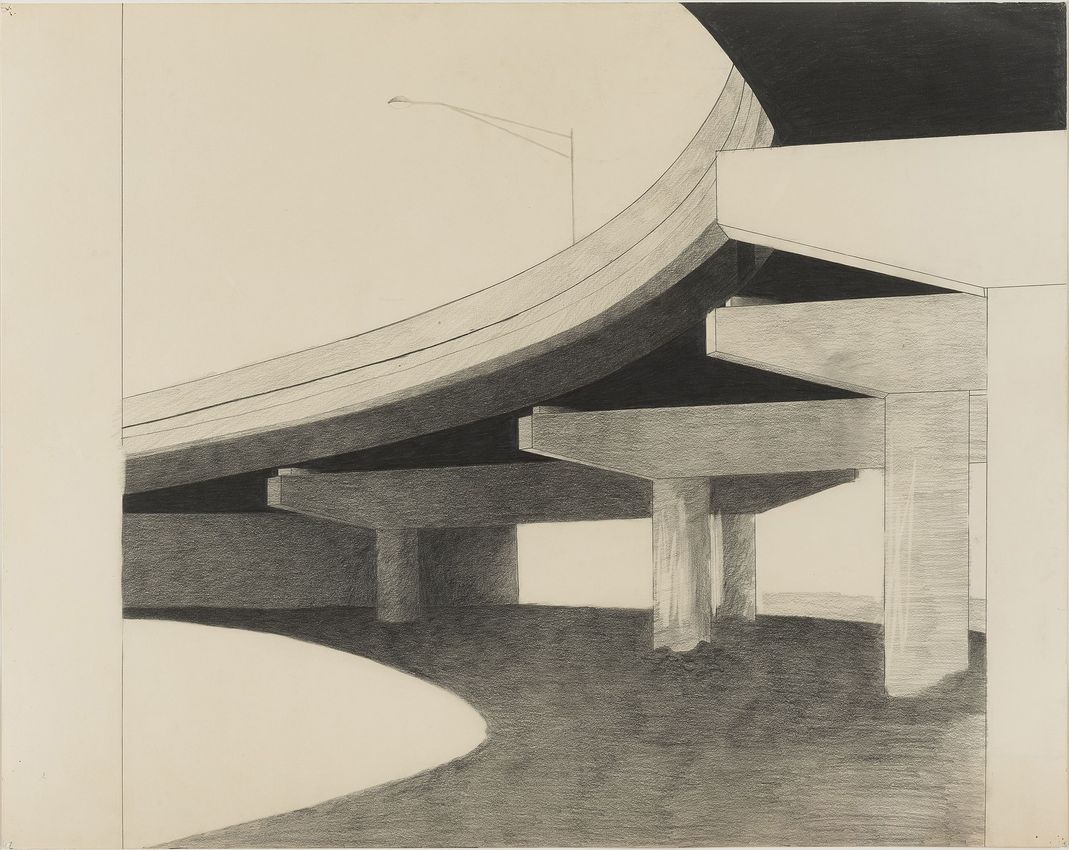
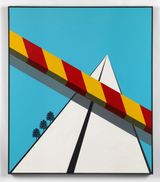
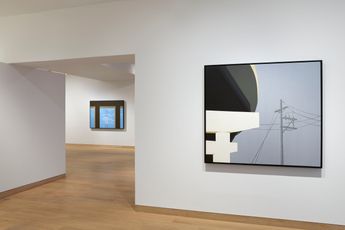
1930-1998, United StatesAllan D’Arcangelo (b. 1930, Buffalo, New York; d. 1998, Manhattan, New York) is well-known for his paintings of landscapes deeply embedded in the American experience. His work from the early 1960s references American highway culture and the semiotics of road signage; later using vernacular imagery to render desolate urban industrial landscapes. His painting is in part a reaction against the mysticism of Abstract Expressionism, but also recalls the representational abstraction of the American Precisionists in the 1920s, such as Ralston Crawford and Charles Sheeler, who were using European Cubist and Futurist tropes to explore industrial America. D’Arcangelo is retrospectively associated with Pop art through his use of contemporary imagery, flatness of image, and conceptual approach to picture-making, however D’Arcangelo’s work is more serious and politically engaged. He was concerned with exploring the notion of the image, and constructed visual illusions that specifically critiqued the changes happening within contemporary American society. His early highway paintings refer to the road as a symbol of man’s intervention in the natural world, our increasing separation from it and ultimately ‘from ourselves’.
After joining the army in the mid-1950s, D’Arcangelo used the GI Bill to study painting at Mexico City College from 1957–1959, under artist and art historian John Golding. In 1959, D’Arcangelo returned to New York City, and it was at this time that his painting assumed a cool, removed aesthetic reminiscent of Roy Lichtenstein and Andy Warhol. Following his first solo exhibition in New York at Fischbach Gallery in 1963, his work was included in the Bienal de São Paulo in 1967. D’Arcangelo received the Guggenheim Fellowship in 1987, after showing extensively throughout his career at significant institutions including Whitney Museum of American Art, New York; Royal Academy of Arts, London;Kunsthalle Düsseldorf; and Walker Art Center, Minneapolis. His works are part of several important collections worldwide, such as Centre Pompidou, Paris; Gemeentemuseum Den Haag, The Netherlands; Hirshhorn Museum and Sculpture Garden, Smithsonian Institution, Washington, DC; Museum of Modern Art, New York; Solomon R Guggenheim Museum, New York; and Tate, among many others.
Text courtesy Waddington Custot.






Explore and Follow Artists Shaping Contemporary Art
A respected voice in contemporary art discourse.
Focusing on ambitious storytelling and insightful art-world commentary. Ocula Magazine publishes in-depth interviews, critical essays and timely analysis on the artists, exhibitions and ideas driving the global art world.
Learn more about Ocula Magazine
Showcasing the best of the art world.
Ocula partners with galleries from around the world to highlight their artists, artworks and exhibitions. Gallery membership is by application and invitation, with each member vetted by an independent panel.
Learn more about Ocula Membership
Specialises in the sale of major artworks.
Led by a team with deep ties to the world’s leading auction houses, galleries and collectors. Ocula’s advisory team offers bespoke services to high-net-worth clients from around the world who are looking to acquire the best of contemporary and modern art.
Learn more about our team and services