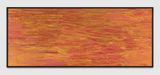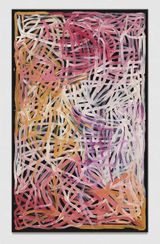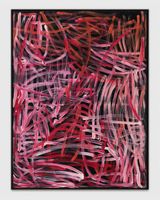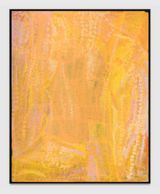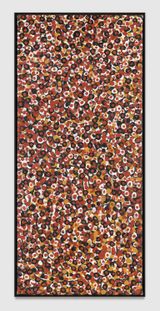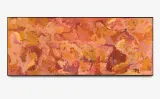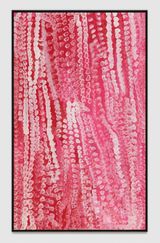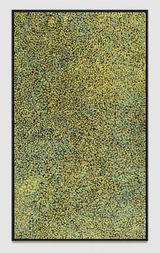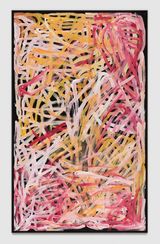
Pace will present a solo booth of paintings by Emily Kam Kngwarray, one of Australia’s most celebrated artists, at the inaugural Frieze Abu Dhabi. The presentation will include a selection of never-before-exhibited paintings alongside works that featured in the gallery’s recent exhibition Emily Kam Kngwarray: The Turning Season held in New York.
The works on view span the artist’s entire career, from her early batik textiles and paintings through to her later colorist canvases and abstractions inspired by the anwerlarr yam.
A member of the Anmatyerr people of Alhalker in Australia’s Northern Territory, Kngwarray grounded her practice in Indigenous Australian knowledge systems and a profound custodial connection to ancestral lands. Her expansive worldview encompassed the histories, relationships, topography, and plant life of the surrounding environment. Working in the remote Central Desert community then known as Utopia, she drew deeply on Anmatyerr spirituality, cultural traditions, and the landscape that shaped her life. Kngwarray’s paintings, characterized by layered brushstrokes and dabs of paint, embody the vibrancy and rhythm of the natural world, reflecting her acute sense of its dynamic and pulsating nature. Centered on imagery from her homeland, the artist often portrayed root systems and life cycles of plants.
Kngwarray drew much of her creativity from The Dreaming—a cultural worldview and comprehensive framework that structures and narrates relationships among individuals, families, ancestral history, future descendants, and the land and spirits. Her artistic journey was shaped by her role in ceremonial traditions, expressed through dance, chant, and the painting of bodies with natural materials such as ground ochre, charcoal, and ash. As an Elder of the Anmatyerr people and a custodian of sacred land, she developed a complex and potent visual language, which translated across her vibrant batiks and later paintings on canvas that brought her international acclaim.
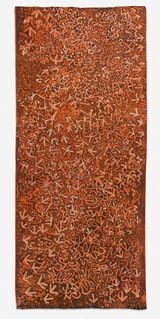
Kngwarray first worked in batik, an Indonesian textile dyeing technique introduced to a group of Alyawarr and Anmatyerr women from the Utopia region in the Northern Territory in 1977. Kngwarray was an original member of the Utopia Women’s Batik Group, and she made unique experimentations and developed her own personal style in works such as the untitled batik on silk from 1981 on view in Pace’s presentation. By the late 1980s, when she was in her 70s, she transitioned to painting on canvases.
“I did batik at first, and then after doing that I learned more and more and then I changed over to painting for good,” Kngwarray said. “I didn’t want to continue with the hard work batik required—boiling the fabric over and over, lighting fires, and using up all the soap powder over and over. That’s why I gave up batik and changed over to canvas—it was easier. My eyesight deteriorated as I got older, and that’s another reason I gave up batik on silk. It was better for me to just paint.”
Aboriginal and Torres Strait Islander readers are advised that this profile contains the name of a person who has passed away.


A respected voice in contemporary art discourse.
Focusing on ambitious storytelling and insightful art-world commentary. Ocula Magazine publishes in-depth interviews, critical essays and timely analysis on the artists, exhibitions and ideas driving the global art world.
Learn more about Ocula Magazine
Showcasing the best of the art world.
Ocula partners with galleries from around the world to highlight their artists, artworks and exhibitions. Gallery membership is by application and invitation, with each member vetted by an independent panel.
Learn more about Ocula Membership
Specialises in the sale of major artworks.
Led by a team with deep ties to the world’s leading auction houses, galleries and collectors. Ocula’s advisory team offers bespoke services to high-net-worth clients from around the world who are looking to acquire the best of contemporary and modern art.
Learn more about our team and services