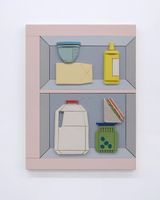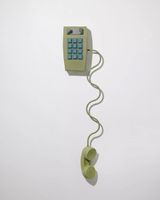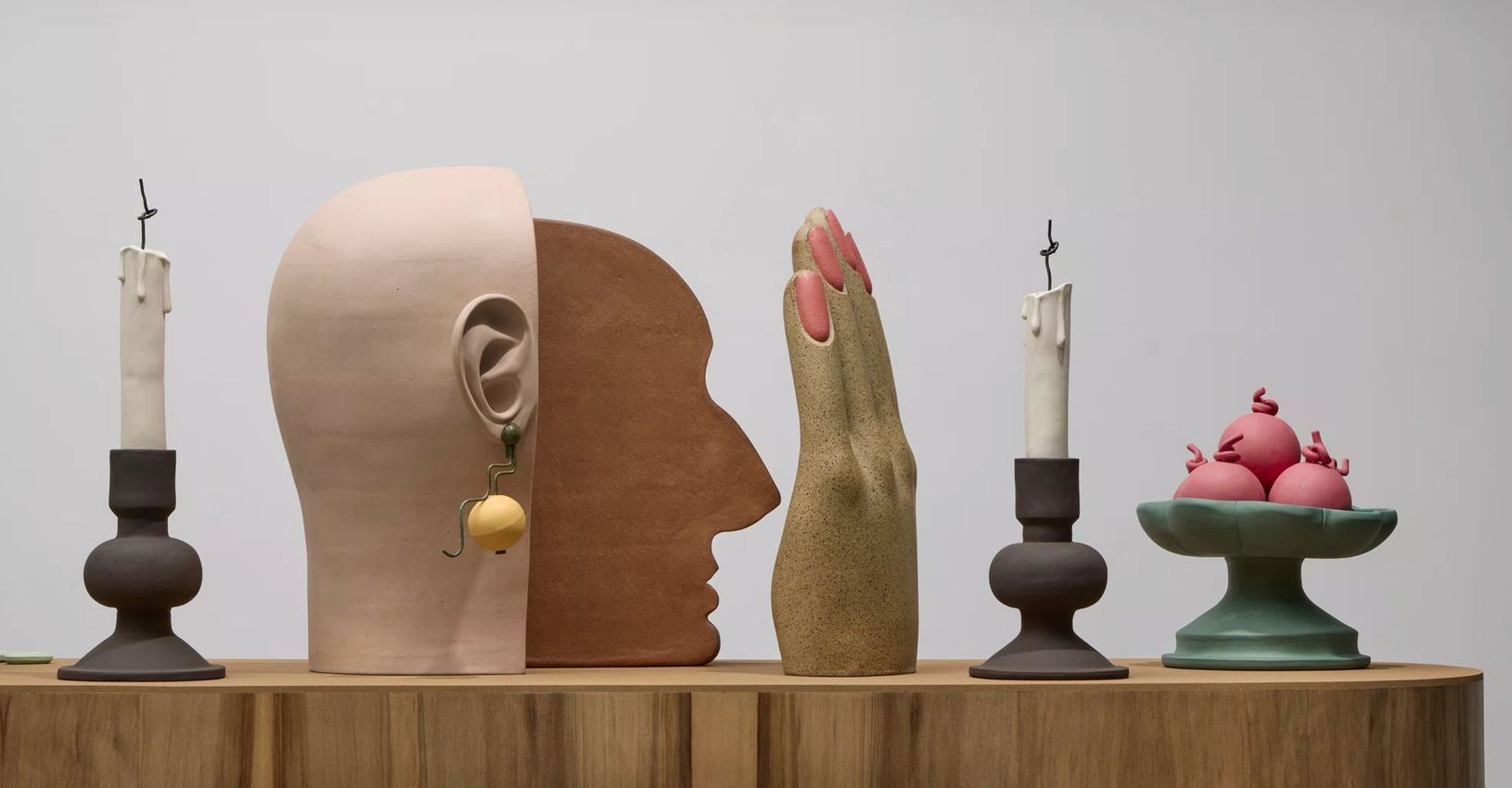
Pace is pleased to announce the first solo exhibition of works by Genesis Belanger in London at its Hanover Square gallery, on view from October 9 to November 9.For In the Right Conditions we are Indistinguishable, Belanger will probe the shifting complexities of self-curation, domestic labor, and our relationship with nature through fourteen new sculptural groups. These works, rendered in the artist’s most saturated palette to date, mark an exciting evolution of subject and material in Belanger’s practice.
Working across porcelain and stoneware, metal, wood, and painting, New York based Genesis Belanger creates tableaux that draw from, and critique, the aesthetics of capitalist production and consumption. Her work is characterised by an idiosyncratic visual language that repurposes everyday objects into often seductive, yet unsettling, surrogates for human emotions and societal anxieties. Informed by her experience as a prop-styling assistant, Belanger’s installations mimic the semiotic strategies of advertising—using beauty, nostalgia, and humour to evoke psychological responses. Yet, in Belanger’s hands, these familiar symbols are recontextualised, shifting from tools of persuasion to agents of critical reflection.
For her exhibition at Pace, Belanger will present a series of installations that transform the gallery space into a labyrinth of altered everyday vignettes. Throughout this staging, motifs repeat and evolve, each configuration offering new perspectives on the themes of the work. Complicating notions of interiority and exteriority, elements of domestic furniture—a vanity table, the contents of a fridge, and a vacuum cleaner—will be punctuated by life-size trees bearing porcelain cherries and melons. These eerily anthropomorphic objects suggest narratives about the human condition while also exploring nature’s reduction to backdrop. In works like the mosaic 16 Bit Eden (2024), where video game-like pixelation merges with floral motifs, depictions of the natural world are relegated to embellishments, reflecting our desire to commodify and shortcut direct engagement with organic reality.
The absence of the human body is a recurring theme in Belanger’s work. While never explicitly present, its remnants and suggestions permeate the scenes. In Sentimental Attachment (2024), manicured fingers form the teeth of a green comb, evoking a tactile sensuality that is both intimate and disconcerting. This absence is felt throughout the exhibition, where everyday objects—groceries, candles, and pills—become proxies for the body, reflecting the complexities of identity, desire, and the labor associated with maintaining both.
Throughout the installations, symbols of fecundity and fulfilment call attention to the body as an instrument of consumption. Fruits and cakes, rendered in a state of near-grotesque perfection, straddle the line between the delicious and the disturbing. The oversized cakes of I Had to Try Them All (2024), for instance, with bites taken out of them, suggest excessive indulgence. The playful seduction of tongue-tied cherry stems atop pristine fruit grows increasingly compulsive and absurd with each identical repetition.
The symbolism extends to the motif of pills, whose colouring mirrors those of the cakes. This juxtaposition underscores the duality of consumption—where nourishment and medication, pleasure and necessity, coexist in tension. Pills, as objects, are deeply personal yet ubiquitous, representing both the promises of modern medicine and the burdens of a society increasingly reliant on pharmaceutical solutions. In Belanger’s work, these pills become symbols of the extreme measures we take to manage and escape the pressures of contemporary life.
Working primarily in ceramics, Belanger employs techniques that emphasise the tactile, hand-made quality of her work, in deliberate contrast to the mass-produced objects her sculptures often mimic. She mixes pigment directly into the clay before rolling it out into flat sheets and shaping them into three-dimensional forms. This labor-intensive process imbues each piece with a sense of individuality and imperfection, resisting the homogenisation of consumer goods.
In addition to ceramics, Belanger has incorporated a range of materials—fabric, wood, metal—into her new sculptures. For example, Cause and Effect (2024), a stoneware vacuum cleaner made with silk cashmere suit material, elevates the mundane object to a status of luxury while also questioning the gendered expectations associated with domestic tools. By articulating her conceptual investigations through the very medium of her work, Belanger sharpens her exploration of how context shapes our understanding of nature, labor, and identity.
Genesis Belanger creates surreal, subversive sculptures that blend pop cultural iconography with references to advertising, domestic life, and the history of art to challenge how femininity, consumption, and control are encoded in contemporary visual culture.


A respected voice in contemporary art discourse.
Focusing on ambitious storytelling and insightful art-world commentary. Ocula Magazine publishes in-depth interviews, critical essays and timely analysis on the artists, exhibitions and ideas driving the global art world.
Learn more about Ocula Magazine
Showcasing the best of the art world.
Ocula partners with galleries from around the world to highlight their artists, artworks and exhibitions. Gallery membership is by application and invitation, with each member vetted by an independent panel.
Learn more about Ocula Membership

Specialises in the sale of major artworks.
Led by a team with deep ties to the world’s leading auction houses, galleries and collectors. Ocula’s advisory team offers bespoke services to high-net-worth clients from around the world who are looking to acquire the best of contemporary and modern art.
Learn more about our team and services