Press Release

New York – Pace is pleased to present an exhibition of new site-specific sculptural installations and paintings by Torkwase Dyson, whose multidisciplinary practice spans painting, sculpture, performance, film, and drawing. Titled ALiquid Belonging, the artist’s upcoming exhibition is concerned with embodied experiences that refuse brutinfrastructure in the legacy of Modernism in favor of new spatial expectations that inspire liveness andacknowledgements of multisensory belonging. This forthcoming presentation will mark Dyson’s first solo show atPace’s 540 West 25th Street gallery in New York, on view from November 11 to December 17.

For many years, the artist has understood water as a geography with an indelible tie to architecture and infrastructure. Growing up in Southeast Chicago, living in Mississippi, and studying the intractable damage of extraction have inspiredDyson to explore different water ecosystems by diving in the global south. The artist’s diving practice is in conversationwith her research surrounding relationships between environmental liberation, structural violence, and the bodies ofwater that make up most of the planet. Her art, which often examines the meanings of poetic movement assertinghumanity, is deeply informed by these ideas and practices. Through her dispersals of abstract forms, Dyson invitesviewers into spatial and perceptual practices that affirm improvisation, indeterminacy, and migration.

Dyson’s unique curvilinear and rectangular hypershapes, which can be found in her work across mediums, speak to infrastructures of liberation and resistance. Dyson’s art is guided by her working philosophy of Black CompositionalThought, through which she considers the ways that architectures, geographies, throughways, enclosures, paths, andother physical and non-physical spaces are composed and inhabited by Black and brown bodies throughout history.Black Compositional Thought, in the artist’s words, also ‘considers how properties of energy, space, scale, and soundinteract as networks of liberation.’

For Dyson, A Liquid Belonging is an experiment in shifting scales. The new, monumental sculptures that will be on view across two floors of Pace’s New York gallery reflect the artist’s expansions of her theories on movement, geography,perception, and material. These site-specific, never-before-seen sculptures will occupy the entirety of Pace’s first andseventh floor exhibition spaces. The dynamic abstractions that constitute these works—which Dyson forges from herdistinctive vocabulary of shapes, geometries, lines, and edges—address how individuals negotiate and negate varioussystems and spatial orders.

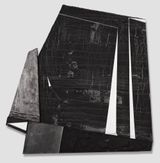
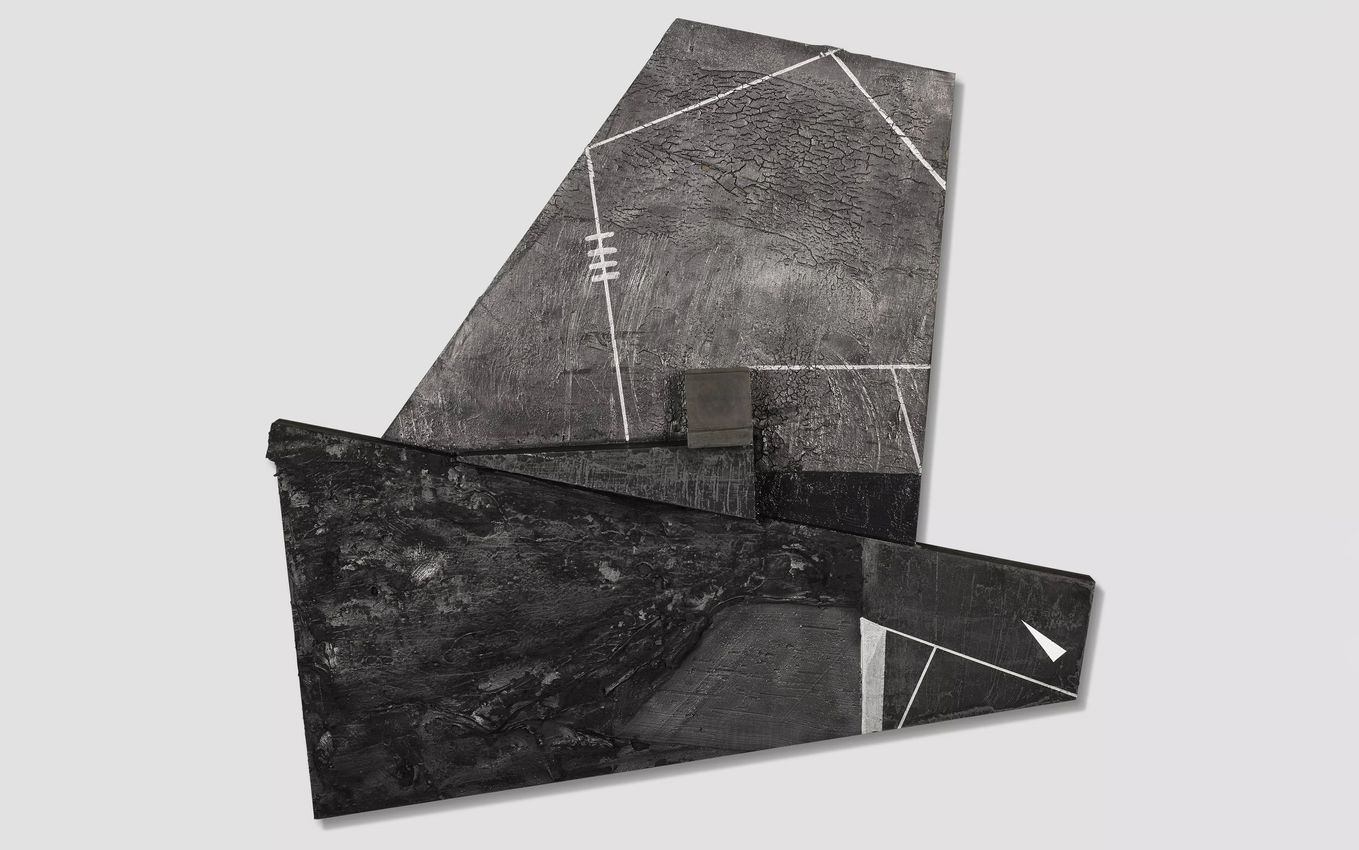
Dyson considers the juxtapositions between her touch of hand and use of industrial materials ‘discursive refusals’ that range from the intimacy of mark making to new world building. The multifaceted, sprawling, steel and graphitesculptural installation that will be presented on the gallery’s first floor is made up of shifting weights, textures, andforms to meditate on the connections between scale and movement, enactments of precarity, and the social andpolitical impacts of the climate crisis.

With Dyson’s interest in the inherent possibilities of a multiscalar approach to environmental liberation this installation engages histories of racial and global capitalism, trade, and extraction across oceans, waterways, cities, industries, andother built and natural environments.

Pace’s seventh floor will showcase a new trapezoidal installation made of wood. Descending from the building’s eighth floor balcony and cutting diagonally across the gallery space, this work will invite viewers to pass under and around it,like a pathway.

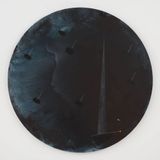
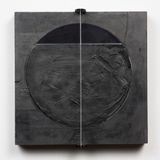
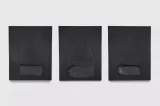
Presented alongside these installations, Dyson’s new paintings reflect her embodied experiences of shifting scales between space, time, and distance. The artist’s two-dimensional works are constructed as part of an exacting,deliberate process involving the production of dense layers and washes, expressive marks, and diagrammatic lines andplanes. The paintings featured in Dyson’s upcoming exhibition use modules to create conditions of line, weight, andtactility. In her paintings, Dyson employs gravity as a material in its own right, bringing that unremitting force intocontact with the liquid surfaces of her canvases to cultivate new effects and atmospheres. In some of her works, steelwires come very close to the canvases, evoking the cartographies of routes and passageways. Here, the dynamicsbetween the paintings and installations are expressions of shifting scales in relation to time and space.

In recent years, Dyson has been the subject of solo exhibitions at the New Orleans Museum of Art and the Hall Art Foundation at Schloss Derneburg in Germany. Her work currently figures in the traveling group exhibition A Movementin Every Direction: Legacies of the Great Migration, which will open at the Baltimore Museum of Art on October 30. In2023, the artist will participate in the Manchester International Festival in the United Kingdom; the Counterpublictriennial in St. Louis; and Desert X in Palm Springs.

Torkwase Dyson (b. 1973, Chicago, Illinois) describes herself as a painter working across multiple mediums to explore the continuity between ecology, infrastructure, and architecture.

Examining environmental racism as well as the history and future of black spatial liberation strategies, Dyson’s abstract works grapple with the ways in which space is perceived and negotiated, particularly by black and brownbodies. In 2019, Dyson’s solo exhibition I Can Drink the Distance was on view at The Cooper Union, New York, and herwork was also presented at the Sharjah Biennial.

In addition to participating in group exhibitions at the Smithsonian National Museum of African Art, Washington, D.C.; Whitney Museum of American Art, New York; The Museum of Modern Art, New York; and California African AmericanMuseum, Los Angeles, Dyson has had solo exhibitions and installations at Colby College Museum of Art, Waterville,Maine; Graham Foundation for Advanced Studies in the Fine Arts, Chicago; Schuylkill Center for EnvironmentalEducation, Philadelphia; and Suzanne Lemberg Usdan Gallery, Bennington College, Vermont.

Read More
About the Artist

Torkwase Dyson describes herself as a painter working across multiple mediums to explore the continuity between ecology, infrastructure, and architecture.

View Artist Profile

Also Exhibiting at Pace Gallery

About the Gallery

Pace is a leading international art gallery representing some of the most influential artists and estates of the 20th and 21st centuries, founded by Arne Glimcher in 1960.

View Gallery Profile
Address
540 West 25th Street
New York
United States
Opening Hours
Tuesday – Saturday
10am – 6pm
(1)
New York 540 West 25th Street
Pace Gallery
540 West 25th Street, New York, United States
+1 212 421 3292
http://www.pacegallery.com

Opening hours
Tuesday – Saturday
10am – 6pm
The art world in focus