Lontano dal Mare
Curated by Milovan Farronato
Patricia Low Contemporary, Gstaad is delighted to present Lontano dal Mare, a two-person exhibition with works by Iva Lulashi and Thomas Braida; both painters are shown for the first time at the gallery.
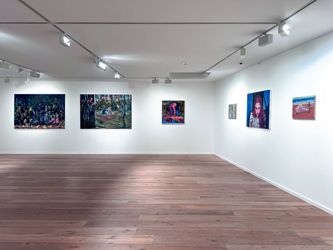
The exhibition Lontano dal Mare unfolds like a Surrealist exquisite corpse: not a simple dialogue between two painters, Iva Lulashi and Thomas Braida, but a device of unforeseen continuities, of lines flowing from one image into the next without either artist truly knowing where the other will lead them. As in the celebrated Surrealist games—wherae each hand, drawing blindly after the previous one, carried the image onto another plane, adding a new meaning, at times inexplicable, instinctive, even spiritual—so Iva Lulashi and Thomas Braida build the exhibition as a chain of intuitions that call to one another, contradict one another, mirror one another.
Their paintings never share the same physical space, never overlap: what matters is not the direct intervention on each other’s work, but the response that unfolds, refracts, and sparks from one canvas to another, in an instinctive and affective way. Between the Albanian-born, Italy-based paintress and the Friulian painter, who first met during their years at the Venice Academy, a long-shared horizon takes shape, where each work opens onto the next, like a piece of combinatory literature.
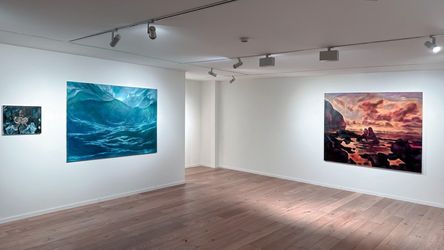
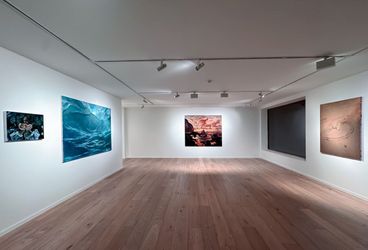
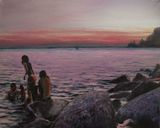
Lontano dal Mare is both a horizon and a perspective. Seas crossed by symbolic presences, creatures, and landscapes suspended between myth and contemporary reality. Paintings like fossils of an uncertain time, floating or sinking, between distant horizons and sudden flashes of light. An ideal dialogue between the ancient and the new. Lontano dal Mare is a painting exhibition born out of a distance: the distance from a place, a time, a memory that persists like an intermittent reflection. ‘Far’ is what one no longer possesses yet still exerts a magnetic pull, like a horizon that never stops calling. In this sense, the exhibition is nostalgic: it is a threshold. A space where looking from afar also means imagining, remembering, holding one’s breath as if in apnea beneath a waterline that, though it does not exist, continues to exert its pull.
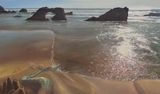
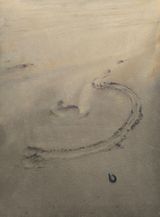
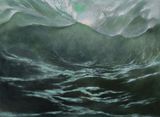
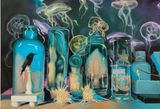
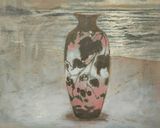
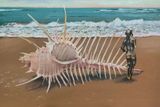
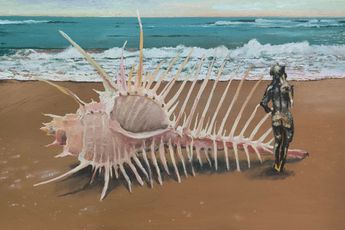
The imagery of Thomas Braida inhabits this boundary between surface and depth, emergence and disappearance. His seascapes are suspended, almost abandoned scenes: small things left on the sand. A shell beside a figurine, a vase with a floral déco pattern, scattered remnants like clues to a story that never fully reveals itself. In a nearly monochrome painting, a word—or perhaps only a symbol—appears inscribed in the sand: an erased memory, a broken seal, the echo of a voice the tide is about to swallow. And then, suddenly, the great wave: a wall of water that could submerge everything, draw every image back into apnea, rewrite the scene from the beginning. In Braida’s paintings, the horizon is only seemingly a peaceful place: it is an unstable line, an oscillation, a possibility of disappearance.
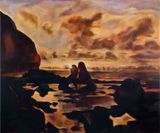
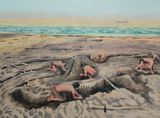
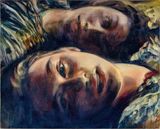
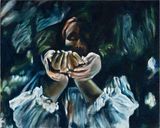
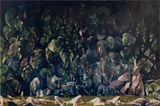
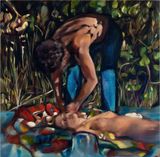
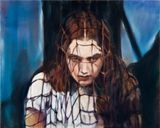
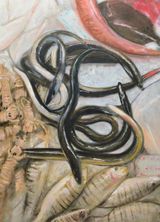
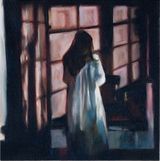
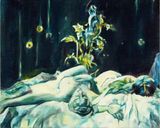
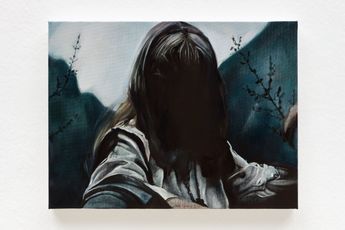
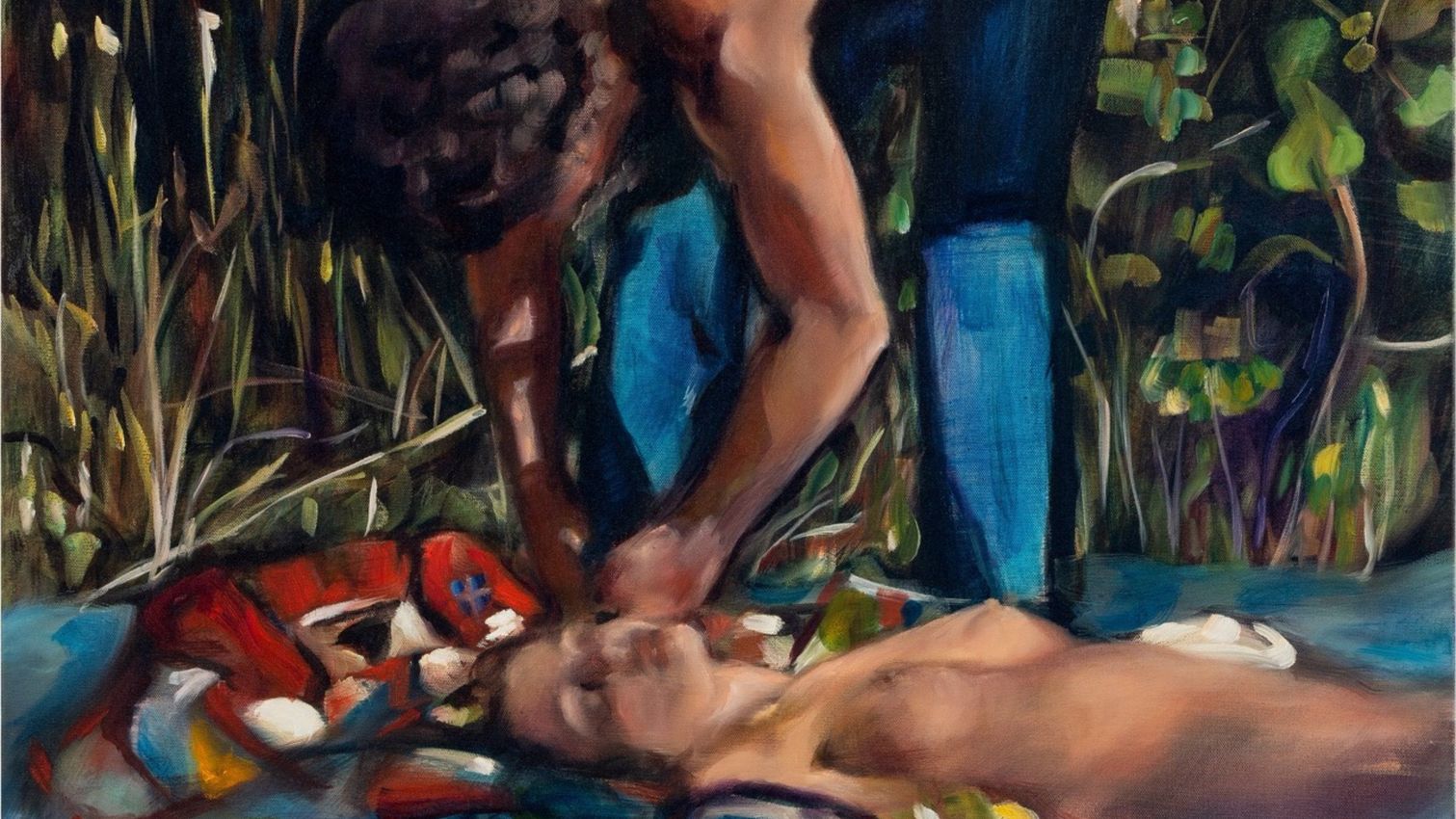
Iva Lulashi, on the other hand, denies water in order to set it on fire, as if fire were its unconscious. Her paintings are saturated with a heat that rises from beneath the surface: the pictorial matter pulses, flares, engulfs the figures in a visual magma that is both memory and desire. When the seascape appears — and it appears rarely — it becomes an unreal, blazing vision: a landscape mottled with reds and oranges, where the sun at its zenith erases all shadows. It is unclear whether it is dawn, dusk, or the absolute noon of demons — that suspended, sacred, unsettling moment in which everything vibrates before fixing into form. Two kneeling figures, enigmatic as sphinxes, seek and touch each other, immersed in a light that seems to come from a memory too intense to be looked at with open eyes. Lulashi’s images are seen through an eyelid that opens and closes too quickly: an image given already on the verge of vanishing.
It is within this tension that the exhibition finds its territory: a sentimental and poetic dialogue between two gazes. The reference to Cesare Pavese’s Dialogues with Leucò—particularly the dialogue between Calypso and Odysseus—is not a literary pretext but a key. Here myth becomes contemporary: Calypso accepting her horizon and Odysseus unable to stop; the weariness of destiny; the impossible return; the desire to hold the instant still and the stubborn refusal to do so. Immortality as the acceptance of the moment; mortality as the nostalgia for a future.
Lontano dal Mare is this: a place where what has been does not return but continues to ask to be seen. A landscape that burns and withdraws. A wave about to arrive and that perhaps will never arrive. A distance from which images emerge like dreams, or like memories that, though far away, never cease to touch the shore.
Courtesy Patricia Low Contemporary. Text: Milovan Farronato.


Established in Gstaad, Switzerland in 2005, Patricia Low Contemporary is one of the main destinations for contemporary art in the famed Alpine resort. With 20 years of exhibition practice and having held around 100 shows in Gstaad (the shows in Geneva and St. Moritz outposts not included), Patricia Low has been central to putting it on the contemporary art map.
The focus is primarily on introducing the most prominent international artists to our audience, with an emphasis on the legacies of Neue Wilde, Contemporary German Painting, Young British Art, Contemporary Photography, Post-Feminism, and Pop as well as putting together historic exhibitions featuring works from the secondary market.
Patricia Low has built strong relationships with the international artists she represents or has invited to show in the Swiss Alps, among them established practitioners like Jonathan Meese, Katharina Sieverding, Herbert Brandl, Peter Halley and Gilbert & George as well as rising artists like Richard Kennedy, Anouk Lamm Anouk and Brian Rochefort.
On April 1st, 2023, Patricia Low Venezia has opened its doors on Canale Grande with a solo exhibition by L.A. based artist Amy Bessone.
Ideally situated in Dorsoduro, Venice’s museum quartier, the XVI century palazzo is adjacent to Ca Rezzonico and directly across Palazzo Grassi. Becoming part of the fabric of this city feels like a privilege to Patricia and opens a new chapter for her gallery.
A respected voice in contemporary art discourse.
Focusing on ambitious storytelling and insightful art-world commentary. Ocula Magazine publishes in-depth interviews, critical essays and timely analysis on the artists, exhibitions and ideas driving the global art world.
Learn more about Ocula Magazine
Showcasing the best of the art world.
Ocula partners with galleries from around the world to highlight their artists, artworks and exhibitions. Gallery membership is by application and invitation, with each member vetted by an independent panel.
Learn more about Ocula Membership

Specialises in the sale of major artworks.
Led by a team with deep ties to the world’s leading auction houses, galleries and collectors. Ocula’s advisory team offers bespoke services to high-net-worth clients from around the world who are looking to acquire the best of contemporary and modern art.
Learn more about our team and services