





BERNARD FRIZE
b. 1954, FranceBernard Frize is a French abstract painter, born in 1949, best known for rule-based, serial paintings that test how far systems, colour, and chance can take painting beyond individual expression. His practice has been widely recognised through major museum retrospectives and participation in key biennials.
Practice and Approach
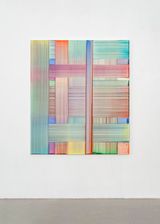
Frize’s paintings are built from predefined protocols: how brushes are loaded, how many colours are used at once, how strokes are laid down, how a canvas is divided, or whether assistants participate. Once a rule is set, he follows it to exhaustion, allowing drips, overlaps, and slips to register where the system meets the resistance of paint.
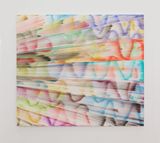
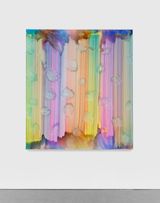
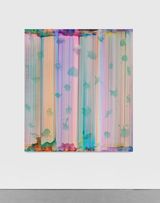
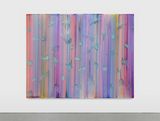
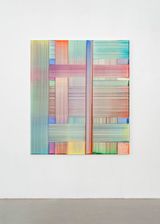
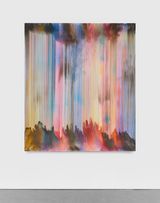
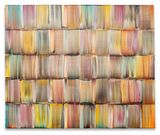
He is known for serial works that use segmented brushes to pull several colours at once across the canvas, looping, weaving, or braiding into dense abstract fields. Other series stretch the idea of line and grid, using stripes, interlacings, and marbled surfaces to show how modest procedural shifts generate very different images.
Key Works and Series
An early landmark is ST 77 (1977), a painting built from innumerable perpendicular coloured lines that introduced his process-oriented approach: one set of rules generating multiple works, like a form of manual “programming.” This work has since become a touchstone, often used to open exhibitions and retrospectives because it encapsulates his shift from expression to procedure.
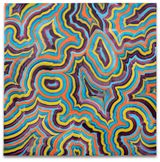
From 1987 to 2001, Frize developed a series using a wide brush divided into several compartments, each loaded with a different colour, which he dragged in continuous gestures across the canvas. Works such as Extension 2 (1990), Aran (1992), and the large-scale Spitz (1991) produce marbled bands and interlaced ribbons of paint; critics have described following their paths as almost impossible, highlighting how a simple device yields dizzying visual complexity.
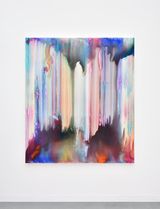
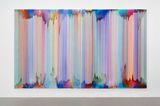
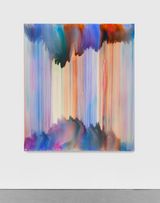
Later series continue this logic with different constraints: one-stroke paintings made with strapped-together brushes, grids whose lines are allowed to slip or pool, and recent works like Geller (2024) where vertical strokes stop short of the canvas edge to leave a “veil” of latency. Across these examples, Frize’s “signature” lies less in a consistent image than in the way each series pushes a specific process to its limits.
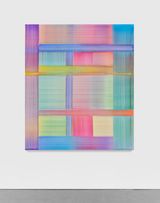
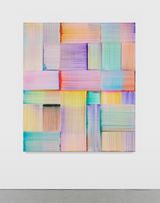
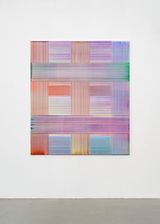
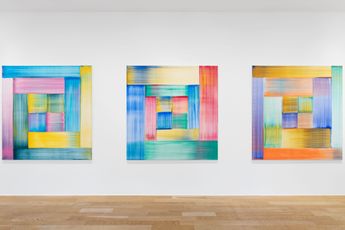
In 2026, the exhibition Les 26 at Perrotin, Paris, unveiled a new body of square-format paintings built from brushstrokes in three distinct widths, woven into gridded structures through layering and juxtaposition that systematically permute stroke size and colour. The works are organised as three nested squares, constructed from twelve strokes that lock into a measured cadence, overlaying a four-count rhythm of the outer square with a three-count rhythm created by the internal nesting. With each pass of the brush, fresh colour is laid over still-wet layers, partially veiling what lies beneath and generating moiré-like vibrations and translucent overlaps that resolve into a softly diffused, chromatic haze.
Seminal Exhibitions and Recognition
Frize’s importance has been cemented by major institutional exhibitions, particularly his retrospective Sans Remords at Centre Pompidou in 2019. Bringing together more than 70 works from 1976 onwards, the show was organised in six segments that deliberately mixed series and periods, mirroring the artist’s own interest in chance and variation while underlining the consistency of his rule-based approach.
That Paris moment was echoed by the concurrent exhibition Maintenant ou jamais at Galerie Perrotin, which focused on more recent series and highlighted how his procedures continue to evolve. Earlier, Frize had already built a strong institutional profile with solo shows at Centre Pompidou, S.M.A.K. in Ghent, Kunstmuseum Bonn, MUMOK, and others, as well as participation in the Venice Biennale, São Paulo Biennial, and Sydney Biennale.
These exhibitions, along with prizes such as the Fred Thieler Prize for Painting and the Käthe Kollwitz Prize, have positioned Frize as a key figure in contemporary abstraction. They also underline how his method-driven practice—first crystallised in works like ST 77 and extended through series like Extension 2 and Aran—has become a reference point for artists and institutions interested in process-based painting.
Bernard Frize FAQs
What is Bernard Frize best known for?
Bernard Frize is best known for abstract, process-based paintings generated through fixed rules and serial procedures rather than spontaneous gesture. He often uses segmented brushes, assistants, and strict working protocols to let systems and chance shape each canvas.
What themes does Bernard Frize’s work explore?
Bernard Frize’s work explores authorship, control, and the mechanics of painting—how decisions, repetition, and material behaviour produce images. Instead of using abstraction for direct emotional expression, Frize treats it as a laboratory for testing the limits and possibilities of the medium.
Where can I see Bernard Frize’s paintings?
Bernard Frize’s paintings are held in major public collections including Centre Pompidou, Tate, Kunstmuseum Basel, MUMOK, MUDAM, the Art Institute of Chicago, and MOCA Los Angeles. They are exhibited internationally with galleries such as Marian Goodman, Perrotin and others across Europe and beyond
Ocula | 2026

View Bernard Frize's Artworks



















Explore Bernard Frize's Exhibitions









Explore and Follow Artists Shaping Contemporary Art
A respected voice in contemporary art discourse.
Focusing on ambitious storytelling and insightful art-world commentary. Ocula Magazine publishes in-depth interviews, critical essays and timely analysis on the artists, exhibitions and ideas driving the global art world.
Learn more about Ocula Magazine
Showcasing the best of the art world.
Ocula partners with galleries from around the world to highlight their artists, artworks and exhibitions. Gallery membership is by application and invitation, with each member vetted by an independent panel.
Learn more about Ocula Membership
Specialises in the sale of major artworks.
Led by a team with deep ties to the world’s leading auction houses, galleries and collectors. Ocula’s advisory team offers bespoke services to high-net-worth clients from around the world who are looking to acquire the best of contemporary and modern art.
Learn more about our team and services