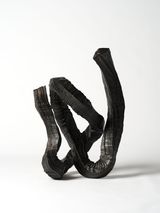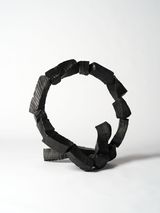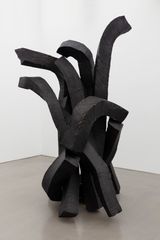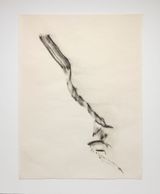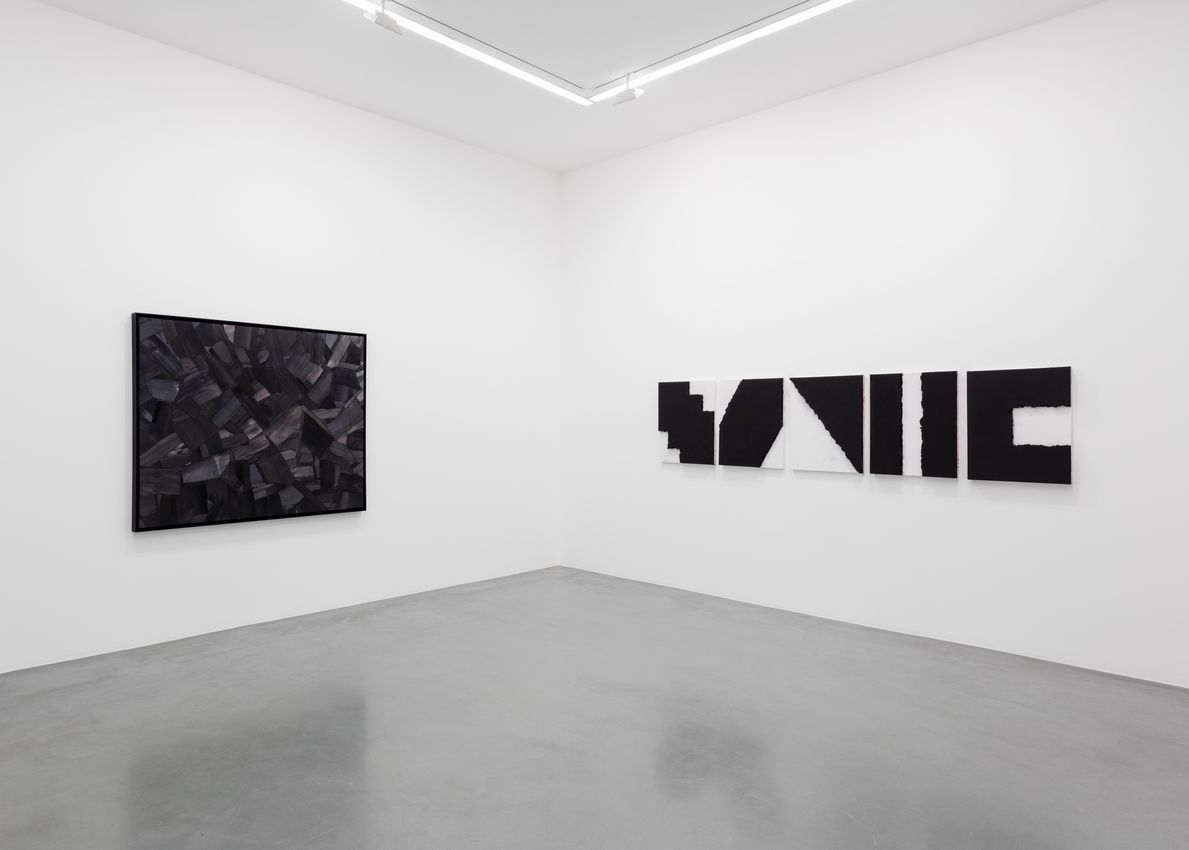
For this second exhibition at the Perrotin gallery in Paris and the fifth in this same gallery on the international scene, Lee Bae has chosen to show five series of works as well as a large installation, all recounting his last twenty years of work.
We find the series ‘Issu du feu’, with its famous paintings made with pieces of charcoal; ‘Landscape’, defined by these large abstract landscapes radically separated into two spaces, one white, the other black; ‘Untitled’, composed of canvases designed with charcoal ink and acrylic medium. And we discover two new series, never before shown in France: the first, ‘Brushstroke’, composed of large-scale papers from which emerge shapes painted in charcoal ink; and the second, ‘Issu du feu (White lines)’, characterised by pieces of charcoal on canvas topped with small white lines.
The ensemble reminds and highlights that—whatever the medium, the techniques, the disciplines—Lee Bae’s work, since its beginnings in 1990, affirms the same purpose: the quest for black. Black in all its states, in all its forms, in all its lights, in all its depths and even sometimes in its reflections.
In ‘Issu du feu’, black—the blacks, we should say, as Lee Bae represents their range from deep black to almost light gray—evoked by the multiple pieces of charcoal that the artist juxtaposes and sticks together, reveals itself under multiple facets: he plays with its shine, with it iridescent effects, with its pearly aspects born from the impression of movements on the surface.
In ‘Untitled’ it is the opposite: black is shown in its depths, born from the density of the charcoal ink used to draw shapes and heightened by the contrast with the white surfaces that define their outlines. Like a black hole, the tones of black pull the eye into endless perspectives—a call that we also feel with the ‘Landscape’ series, whose radical geometric compositions, sometimes like cliff edges, create an echo between black and white to further intensify their juxtaposition.
In his recent large works on paper, Lee Bae puts movement in his blacks and deploys the gradations of their transparency. Contrary to the ‘Untitled’ series where each shape is meticulously drawn several times superimposed, in Brushstroke, each shape or symbol drawn in charcoal ink is the result of a single gesture, without possibility of remorse and of an absolute brilliance that combines both mental concentration and corporeal control. Close to calligraphy, this writing, which in its way relates to a traditional method, testifies at the same time to a highly contemporary spirit and an immanent touch and presence.
For ‘Issu du feu (White lines)’, Lee Bae resumes his compositions with pieces of charcoal, but he forms a pattern and punctuates them on the surface with small lines in white oil pastel, like commas on a blackboard. In this way, he puts black in the background and gives it even more perspective.
Finally, in his installations, always made with burnt wood or charcoal, Lee Bae puts black in relief. He puts it in a ball, in a bundle, or in a point to show that black can also be perceived as modeled, as protuberance. And that whatever its aspect, this color with its innumerable nuances allows him to speak about time, space, energy, body, soul. And thus, about life.
Text by Henri-François Debailleux, December 2021.
Lee Bae’s monochromatic practice is a formal and immersive quest into the abysses of blackness. Subtly blurring the lines between drawing, painting, sculpture and installation, he has shaped his abstract aesthetics across categories to grant the non-colour tangible depth and intensity. Until the mid-2000s, he worked exclusively with raw charcoal to create minimal and refined, mosaic-like assemblages of charred wooden shards or chunks on canvases, as well as larger sculptural arrangements of carbonised trunks. Obtained by burning wood and used to revive fire, charcoal offers a powerful metaphor for the cycle of life that has further inspired him to open his exploration onto the fourth dimension of time. While he has moved on to solely working with carbon black, a substance close to soot, Lee Bae’s latest series of pictorial works crystallises random elemental gestures, which he practices beforehand with Indian ink on paper, into thick layers of translucent acrylic medium resembling wax.


Emmanuel Perrotin founded his first gallery in 1989 at the age of 21. He has opened since then over 17 different spaces, with the aim of continuing to offer increasingly vibrant and creative environments to experience artists work. He has worked closely with his roster of artists, some since more than 25 years, to help fulfil their ambitious dreams and projects.

A respected voice in contemporary art discourse.
Focusing on ambitious storytelling and insightful art-world commentary. Ocula Magazine publishes in-depth interviews, critical essays and timely analysis on the artists, exhibitions and ideas driving the global art world.
Learn more about Ocula Magazine
Showcasing the best of the art world.
Ocula partners with galleries from around the world to highlight their artists, artworks and exhibitions. Gallery membership is by application and invitation, with each member vetted by an independent panel.
Learn more about Ocula Membership

Specialises in the sale of major artworks.
Led by a team with deep ties to the world’s leading auction houses, galleries and collectors. Ocula’s advisory team offers bespoke services to high-net-worth clients from around the world who are looking to acquire the best of contemporary and modern art.
Learn more about our team and services