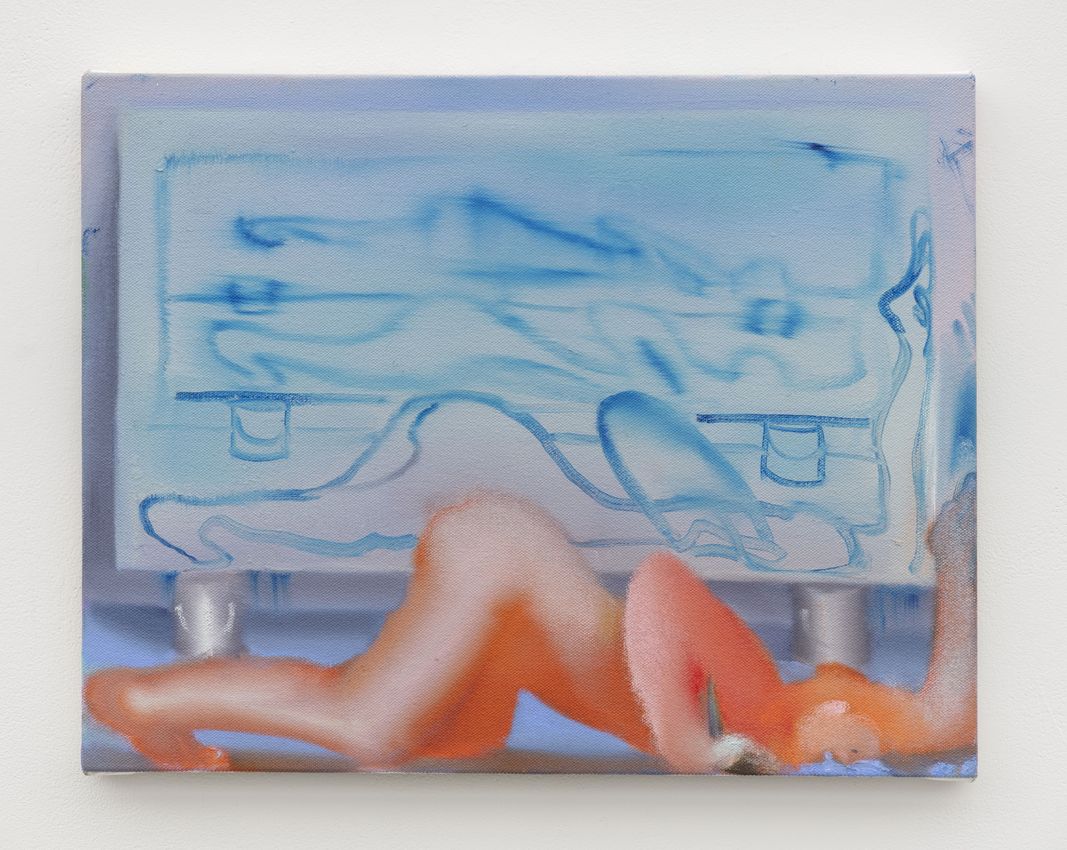
Elizabeth Glaessner often begins a new painting with a pour of oil paint. As it pools on the surface of her canvases, it becomes something to which she can react; she pushes, spreads, layers, builds up, or wipes away paint to create mysteriously ethereal figures that consume her compositions. Industrial brushes, handles, and squeegees are all implements to shift paint into full, leggy figures, typically nude. Bright, saturated colors meet more muted or earth tones; facial features and other minute details emerge through a convergence of formal relationships. These figures are often depicted in moments of movement or transition (perhaps swinging a club, floating in a body of water, mid-embrace, or looking and merging with their own reflections.) Glaessner’s process, like the figures she comes to depict, is about transformation.
“Head Games,” an exhibition of fifteen of Glaessner’s small paintings alongside two of larger scale, demonstrates the strength and scope of her painterly aesthetic. Pictorialism, process, and performance converge in these works, revealing not only her facility with the oil medium but also how our perception of ourselves and others depends on a play of imagination and reality. Seldomly exhibited altogether, the small-scale paintings offer a survey of Glaessner’s particular process, and a glimpse inside her mind.
Glaessner often thinks through ideas with repetition. Born in Palo Alto, California, Glaessner was raised in Houston, Texas before moving to New York in 2007. Houston’s climate is hotly swampy, a coastal city with proximity to Galveston Bay and the Gulf of Mexico. Walking around can feel as if stepping through a mist. With Glaessner often and repeatedly blurring her compositions with a careful swipe of a large brush, it can seem as if these figures are submerged in water or a haze, and it’s tempting to see this as Houston’s influence on Glaessner’s vision. But more directly, a 2019-2020 stay at Galveston Artist Residency, situated between the Bay and Gulf, where the sky and water meet, galvanized Glaessner’s work. There, she had time to focus and replicate ideas–playing with them– so as to understand her own work.
These new paintings continue several longtime thematic interests of Glaessner’s, including narratives from Western literature and Greek mythology alike. Nut (or Nwt), the Egyptian deity; goddess of the visible sky is frequently alluded to in several compositions through an arched body. Other mythic beings are recontextualized, such as Pygmalion and Galatea in “Mimesis” wherein a tiny third figure observing the scene skews the perspective, suggesting the artificiality of both Pygmalion and Galatea. Snippets of stories, texts, and poems fill Glaessner’s studio. As she made these works, poems by Georg Trakl and Sylvia Plath hung on her studio walls; all of these texts reflected on the singularity of transformation. But rather than mere interpretation or retelling of these texts, Glaessner’s paintings distill their essence as she reenvisions them using a lucid and adroit formalism.
The intimate scale of these works enables especially close examination, offering glimpses into not only the enigmatic stories of these paintings but also Glaessner’s process. Though requiring less physicality than her largescale works, the smaller paintings are nevertheless just as gestural and material. Careful looking reveals how she fashions her visceral textures through meticulous application of layers and layers of paint, which are then manipulated to reveal sumptuous rugged surfaces. Several works here are enriched with small glass beads Glaessner mixed with paint to give both oil and canvas something to resist. Or, perhaps the initial pour is spread all over the canvas in a slick coating of color. Brushwork is a reaction, as line and shape take form in response to one another.
This call-and-response is aesthetically implied in the bending and crawling position that several figures here assume. On all fours, these figures oscillate between carnal or childlike, their pose derived from Blake, Cranach, and model horses alike. Several works include pairs of trios of such figures as if the larger one has spawned the smaller ones, such as Grass Play or Head Games. Or, as in Creature, the figure fills almost the entirety of the picture plane, its head tilted upward with a haunting, searching look in its eyes. Their body is aqua-green, a color found throughout these paintings, as in Sphinx with arms and Sirens. In both, a strip of light sandy brown lines the bottom edge, as if the sphinx figure is lying in the sand of an ocean floor, and a phantasmic smaller figure seems to float behind them, caught in the rhythms of the sea. These works, almost mirror-sized, are a means through which to experiment and explore poses, figures, and forms before they transform into larger paintings. In this way, “Head Games” invites an experience of Glaessner’s vision.
—Leah Triplett, Director of Exhibitions & Contemporary Curatorial Initiatives at the Pennsylvania Academy of the Fine Arts, Philadelphia, PA, United States

A respected voice in contemporary art discourse.
Focusing on ambitious storytelling and insightful art-world commentary. Ocula Magazine publishes in-depth interviews, critical essays and timely analysis on the artists, exhibitions and ideas driving the global art world.
Learn more about Ocula Magazine
Showcasing the best of the art world.
Ocula partners with galleries from around the world to highlight their artists, artworks and exhibitions. Gallery membership is by application and invitation, with each member vetted by an independent panel.
Learn more about Ocula Membership

Specialises in the sale of major artworks.
Led by a team with deep ties to the world’s leading auction houses, galleries and collectors. Ocula’s advisory team offers bespoke services to high-net-worth clients from around the world who are looking to acquire the best of contemporary and modern art.
Learn more about our team and services