Press Release

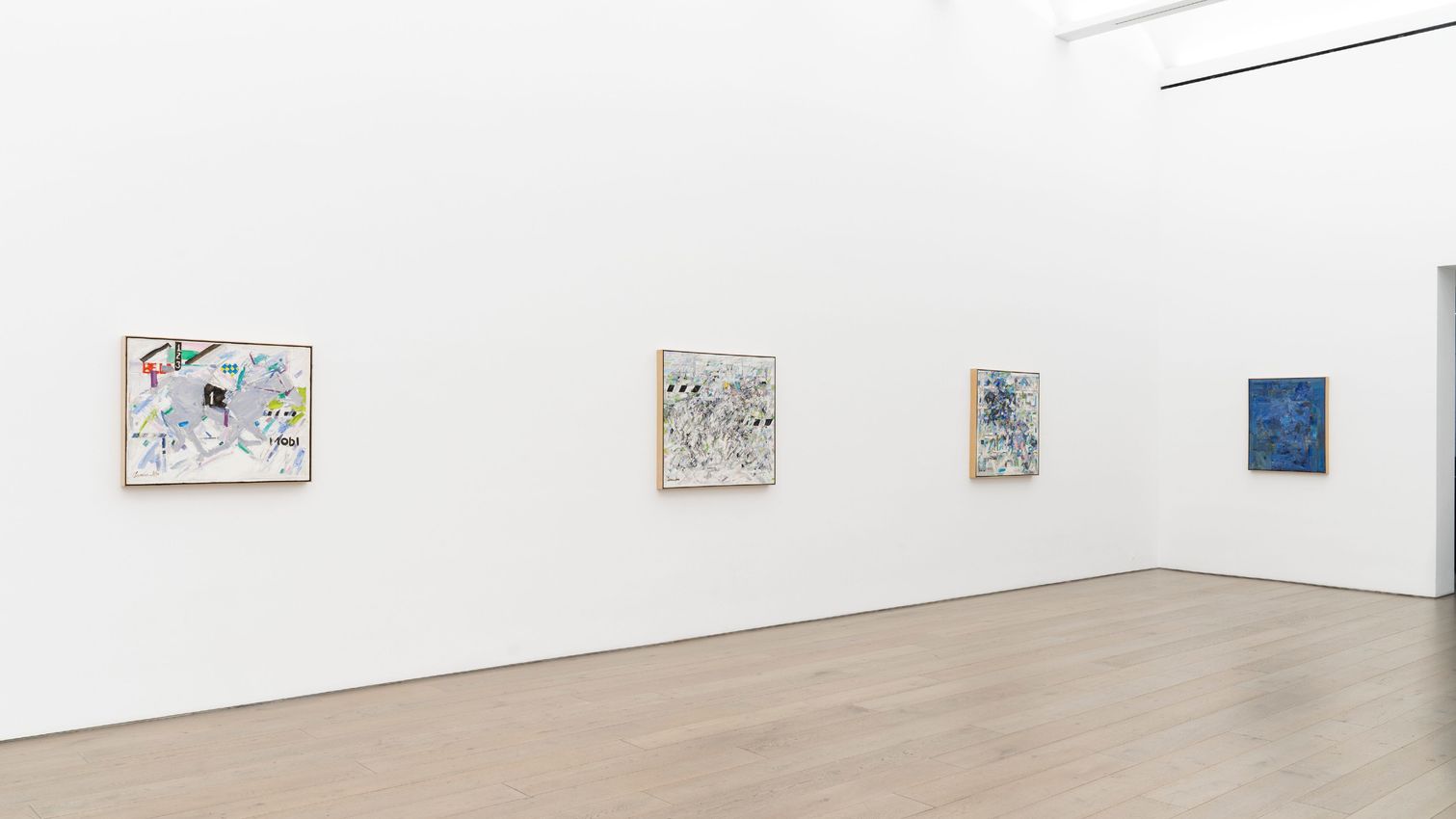
Perrotin is pleased to announce representation of the Nancy Graves Foundation with an exhibition of work by the artist at Perrotin New York, curated by Director Ylinka Barotto. Nancy Graves (b. Pittsfield, MA 1939 - d. New York, 1995) was a prominent twentieth-century American artist who worked across disciplines, including sculpture, painting, drawing, and film. With a specific interest in archaeology, cartography, and natural history, Graves carefully researched and then translated scientific information into an abstract gestural language by reducing sources to their essential forms. The exhibition at Perrotin, titled The Illusion of Motion, explores the trajectory of the artist’s practice over the course of two decades, unfolding chronologically from 1971 until the mid-80s, and including never before seen paintings and little-known archival material.

Nancy Graves achieved critical acclaim in New York in the late 1960s. In 1969, at the age of 29, she became the youngest artist to be featured in a solo exhibition at the Whitney Museum of American Art, where she debuted her renowned wax, polyurethane, and fur Camels installation. At this time, she gained prominence as a post-Minimalist sculptor for her innovative use of materials. In the following decades, Graves continued to reference the real world, conducting in depth research as a basis for her practice.

Born in Massachusetts, Graves grew up going to the Berkshire Museum, where she was exposed to artefacts, maps, zoology and taxidermied animals that were presented alongside fine art. She graduated from Vassar College in 1961 before earning her MFA in painting from Yale University, where she studied under Alex Katz and alongside classmates Chuck Close, Brice Marden, and Richard Serra. After graduating in 1964, she received a Fulbright scholarship to study in Paris and then traveled to Italy, where she first developed her sculptural language. While in Florence, Graves was introduced to sculptor Clemente Susini’s wax anatomical models, renowned for vivid and realistic depictions of partially dissected corpses. This encounter prompted Graves to investigate the liminal space between art and science.

In the 1970s, Graves’ large-scale paintings translated her wide- ranging interests in disciplines such as anthropology, palaeontology, and scientific observation into intricate compositions that embraced pointillism. In Indian Ocean Floor, I (1972), she drew upon bathymetric recordings of the ocean floor by satellites that revealed previously unknown topographies on our own planet. Graves’ detailed renderings of this data recontextualise the map as a site where abstraction and representation overlap. In Camouflage Series #4 (1971), she was inspired by images of fish camouflaging themselves against the ocean floor. Graves’ rendering of information raises questions about the authenticity and legibility of scientific sources.

Expanding her painterly practice, her black-ground paintings depict void-like backgrounds overlaid with brightly coloured illustrations. In these abstractly composed works, she layered archaeological artefacts—such as prehistoric cave markings, mythological busts, maps of burial sites—and technological advances—such as satellite imaging, NASA photography, and circuit boards. In Discoid-Foliate (1982), she depicted an early circuit board in yellow paint. In Archaeo (1982), Graves pulled from a range of references: in pink, the outline of wolves hand- painted from caves in Altamira, Spain; in green, the profile of the Nefertiti bust from Tell el-Amarna in the collection of the Berlin Museum and, on the bottom right, rendered in bright yellow, a 1950s diagram that recorded saccadic eye movements when observing the same bust. Sourcing motifs from antiquity to modern technology, she alluded to a convergence of time in which past and present are intrinsically interconnected.

In the 1980s, Graves’ work combined painting and sculpture in an ongoing exploration of movement. She began producing gestural watercolours, inspired largely by her study of Matisse in France. Each artwork was completed in a single eight-hour long sitting, utilising a wet-on-wet watercolour technique that required an immediacy similar to a performance. Her interest in kinetic movement inspired a collaboration with Trisha Brown Dance Company in 1985, for which she designed sets and costumes for the critically acclaimed “Lateral Pass” performance. From the mid-1980s onward, Graves began attaching protruding aluminium elements, which extended her pictorial motifs and brushstrokes, creating pieces that hovered between two mediums.

Finally, the exhibition will present a suite of sculptures made using the ancient lost-wax technique of cire perdue. Graves became one of the first contemporary artists to experiment with bronze casting, whereby she organised cast bronze objects, typically food and plants, into asymmetrical sculptures that addressed notions of balance and space.

Graves’ varied interests led her to explore fields not strictly tied to the realm of art, generating work that sought out new languages of expression. Combining her use of unconventional materials with a keen eye for formal artistic composition, Graves’ practice has constantly defied categorisation while staying relevant through time.

Nancy Graves has been featured in notable museums worldwide such as the Brooklyn Museum, New York; Hirshhorn Museum, Washington, D.C.; National Gallery of Canada, Ontario; Museum of Modern Art, New York; Fort Worth Art Museum, Texas; among many others. Her work is in the permanent collections of a number of prominent museums worldwide, including The Metropolitan Museum of Art, New York; Museum of Modern Art, New York; Solomon R. Guggenheim Museum, New York; The Whitney Museum of American Art, New York; Los Angeles County Museum of Art; Art Institute of Chicago; Museum of Contemporary Art, Los Angeles; Philadelphia Museum of Art; San Francisco Museum of Modern Art; Smithsonian American Art Museum, Washington, DC; Walker Art Center, Minneapolis; Museum Ludwig, Germany; Centre Pompidou, France.

Read More
About the Artist

Nancy Graves was a pioneering American artist celebrated for her diverse and experimental practice across sculpture, painting, printmaking, drawing, and film.

View Artist Profile

Also Exhibiting at Perrotin

About the Gallery

Emmanuel Perrotin founded his first gallery in 1989 at the age of 21. He has opened since then over 17 different spaces, with the aim of continuing to offer increasingly vibrant and creative environments to experience artists work. He has worked closely with his roster of artists, some since more than 25 years, to help fulfil their ambitious dreams and projects.

View Gallery Profile
Address
76 rue de Turenne
Paris
France
Opening Hours
Tuesday – Saturday
10am – 6pm
(1)
Paris 76 rue de Turenne
Perrotin
76 rue de Turenne, Paris, France
+33 1 42 16 79 79
http://www.perrotin.com

Opening hours
Tuesday – Saturday
10am – 6pm
The art world in focus