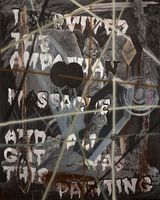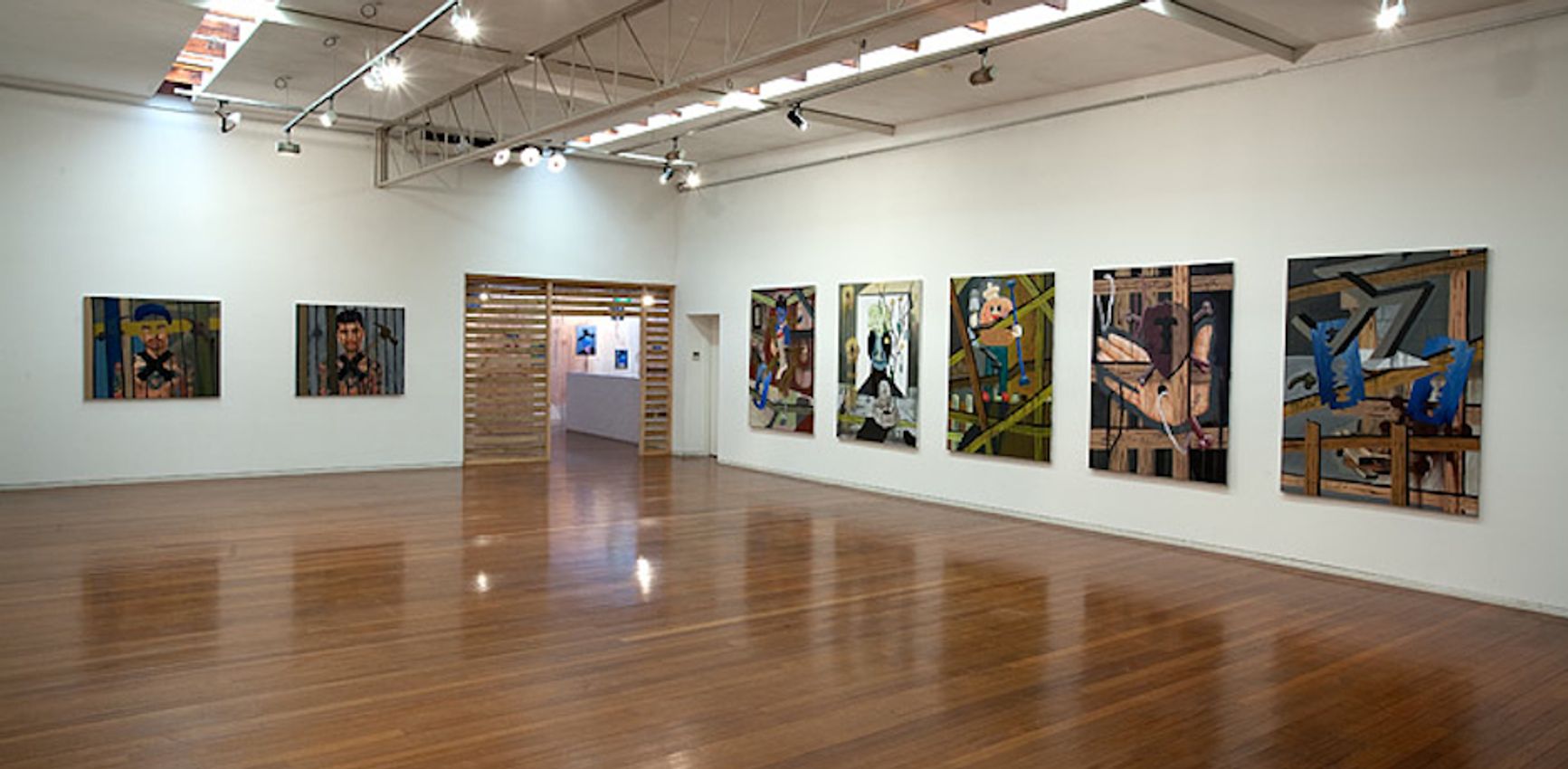
David Griggs’ initial attraction to Manila was that it encompasses a painting culture in both urban and art practices. Perhaps the latter springs from one of the city’s ideas of development which involves “painting over things.” Facades of new establishments, built mostly on concrete, are given a paint finish. At the same time, to mend dilapidated constructions does not mean reconstructing their disintegrated parts but instead involves a decision on giving them a new slather of colour. Overall, Manila is a mural city mapping territories by the surface.
It is in the capital centre that Griggs adopted a more sophisticated, if not new, manner of painting. Drawing from the sensorial glut of Manila, Frat of the Obese uncovers Manila’s palette and unpicks its imagery and events. The seriality in the works informs the excess present in the metropolis, establishing an uncertainty as to whether this exorbitance is the city gorging itself or the city’s waste.
This new series allows neither room to be sparse nor a perspective linear enough to trace how each element harmonizes with another. As with the plywood that alludes to uneven, low-ceilinged spaces in Manila, one rather has to duck through them to realize each painting’s depth.
As much as the works from Frat of the Obese are founded on recurring images from Griggs’ atlas of the place in which he has situated himself to for the last two years, these icons merely form the axis which his language navigates. Painting for him operates more on the syntax of elements – blending incongruous emblems and slogans, making portraits while making a return to basic forms.
Siddhartha Pérez, 2011
In David Griggs’ graffiti-trash canvases, tattooed skeletons and religious rituals collide with gun-toting cartoon characters and the Ku Klux Klan. Griggs’ journey into this street carnival of politics and spirituality began at the age of eighteen, while photographing scenes of Indian and Nepalese poverty for an underground newspaper. Later, he spent time with refugees on the Thai-Burmese border. But it was the cacophonous confluence of cultures experienced during a 2005 residency in Manila that really revolutionised his practice. Griggs’ recent paintings are a personal response to what he saw in the Philippines: death, violence, poverty, religion and sex, all writ on the huge scale of Manila’s candy-coloured advertising banners. In a ‘reverse collage’ process riffing on the city’s visual complexity, Griggs commissioned banner painters to translate selected travel photographs into paintings, which Griggs then tagged with tattoo imagery, skulls, text and other symbolic elements.

Established in Sydney by influential Australian art dealer and gallerist Roslyn Oxley and her husband Tony Oxley in 1982, Roslyn Oxley9 Gallery is one of Australia’s leading commercial galleries.

A respected voice in contemporary art discourse.
Focusing on ambitious storytelling and insightful art-world commentary. Ocula Magazine publishes in-depth interviews, critical essays and timely analysis on the artists, exhibitions and ideas driving the global art world.
Learn more about Ocula Magazine
Showcasing the best of the art world.
Ocula partners with galleries from around the world to highlight their artists, artworks and exhibitions. Gallery membership is by application and invitation, with each member vetted by an independent panel.
Learn more about Ocula Membership

Specialises in the sale of major artworks.
Led by a team with deep ties to the world’s leading auction houses, galleries and collectors. Ocula’s advisory team offers bespoke services to high-net-worth clients from around the world who are looking to acquire the best of contemporary and modern art.
Learn more about our team and services