Press Release

SETAREH X is excited to announce Consequences, an upcoming exhibition of Johannes Raimann and Fynn Ribbeck. Consequences features two artists who engage with photography as a dispositif and examine its technological-material conditions and political implications (Raimann), as well as its role as a reservoir of collective memory and the question of the (un)biased innocence of images (Ribbeck). Part of the conceptual history revolves around the promise of photography as a trace of truth: Due to the inherent act of directly transmissioning the physical, it seems to testify a piece of reality, a quality that has been described as photography’s transparency.

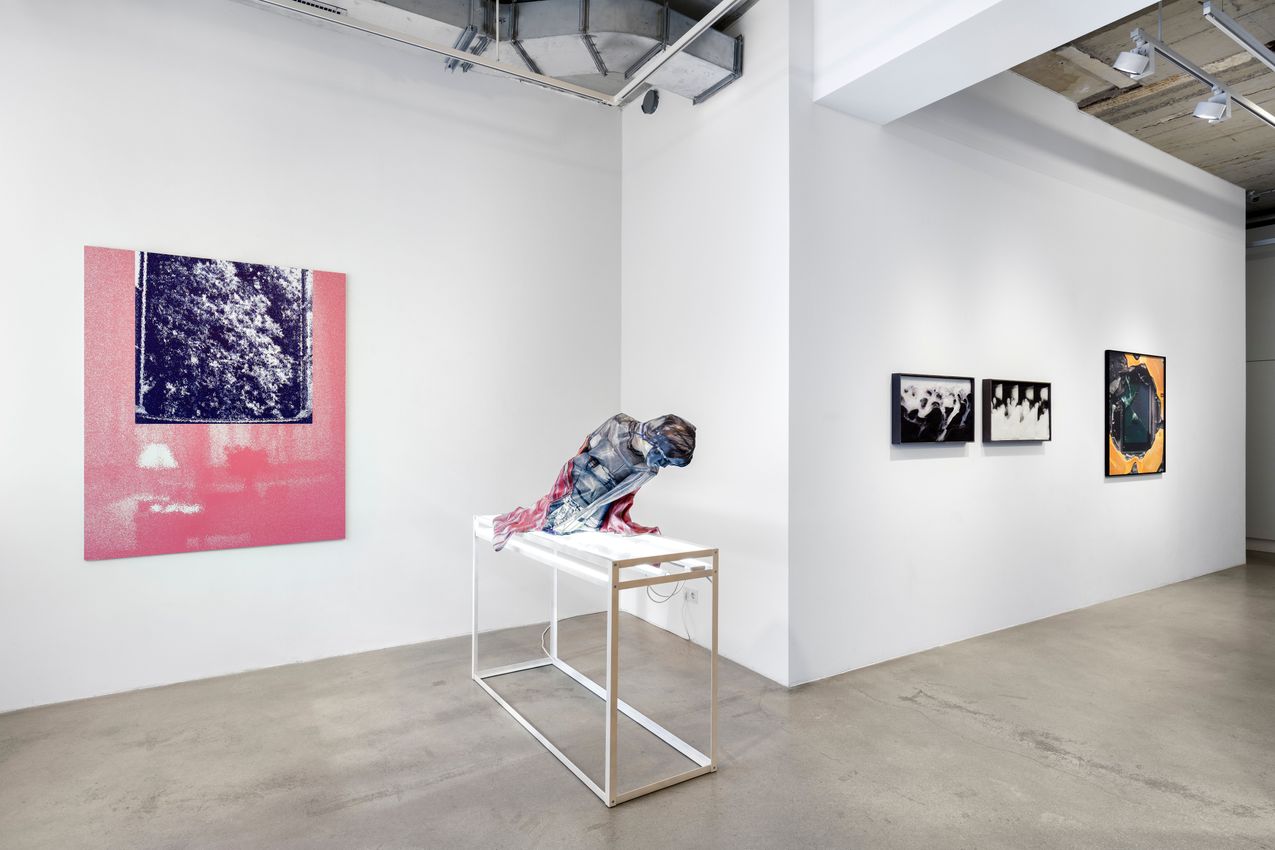
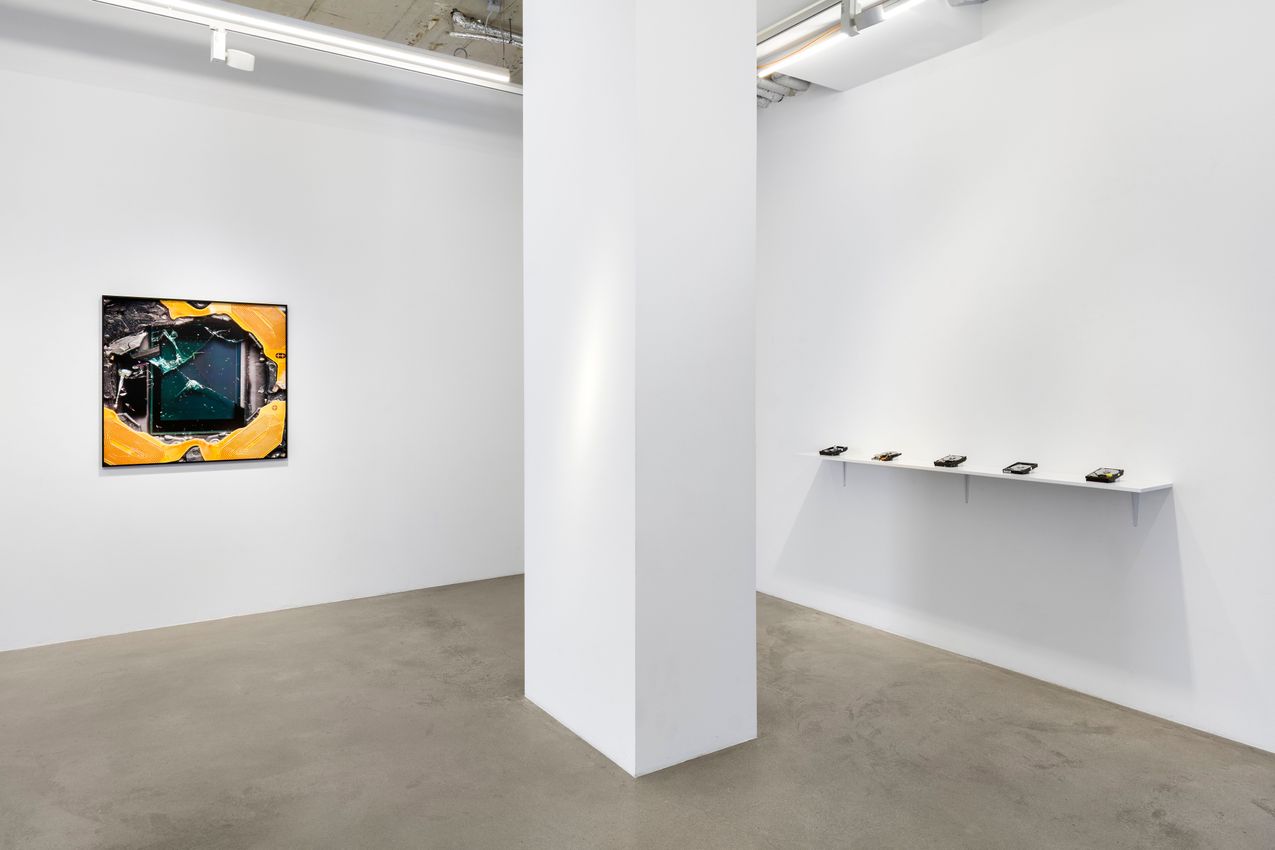
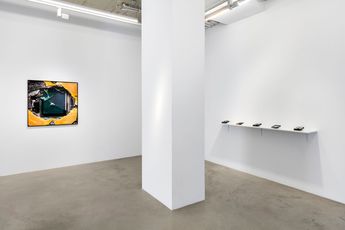
In the diametrically opposite direction are the works of Johannes Raimann, which look into the interior of the camera, intensively highlighting the opacity of the material components, through its own gaze. Sensor of Impact is the result of the sensor of a cellphone camera making one image out of ca. 480 individual shots in a meticulous process, blowing up the subject of the image to a size that both melds and confuses the familiar and the unfamiliar. We are rarely aware of the complex technologies and ideological implications embedded in the tools, instruments for our everyday, that guide our perception of the world, in which various mechanisms of control and normalisation create a network of sightlines. In the shattered surface of Sensor of Impact, physical and biopolitical power collide.

Remarkably, the shot combines two different topoi of seeing and, in this way, links the visual with the tactile. The rectangular outline can thus be understood as a view from a window—and thereby refer to the tradition of panel painting—as well as a topographical view from a bird’s-eye perspective. Raimann’s approach is akin to an archeological one, uncovering layer by layer the underlying materialities of technological sediments.

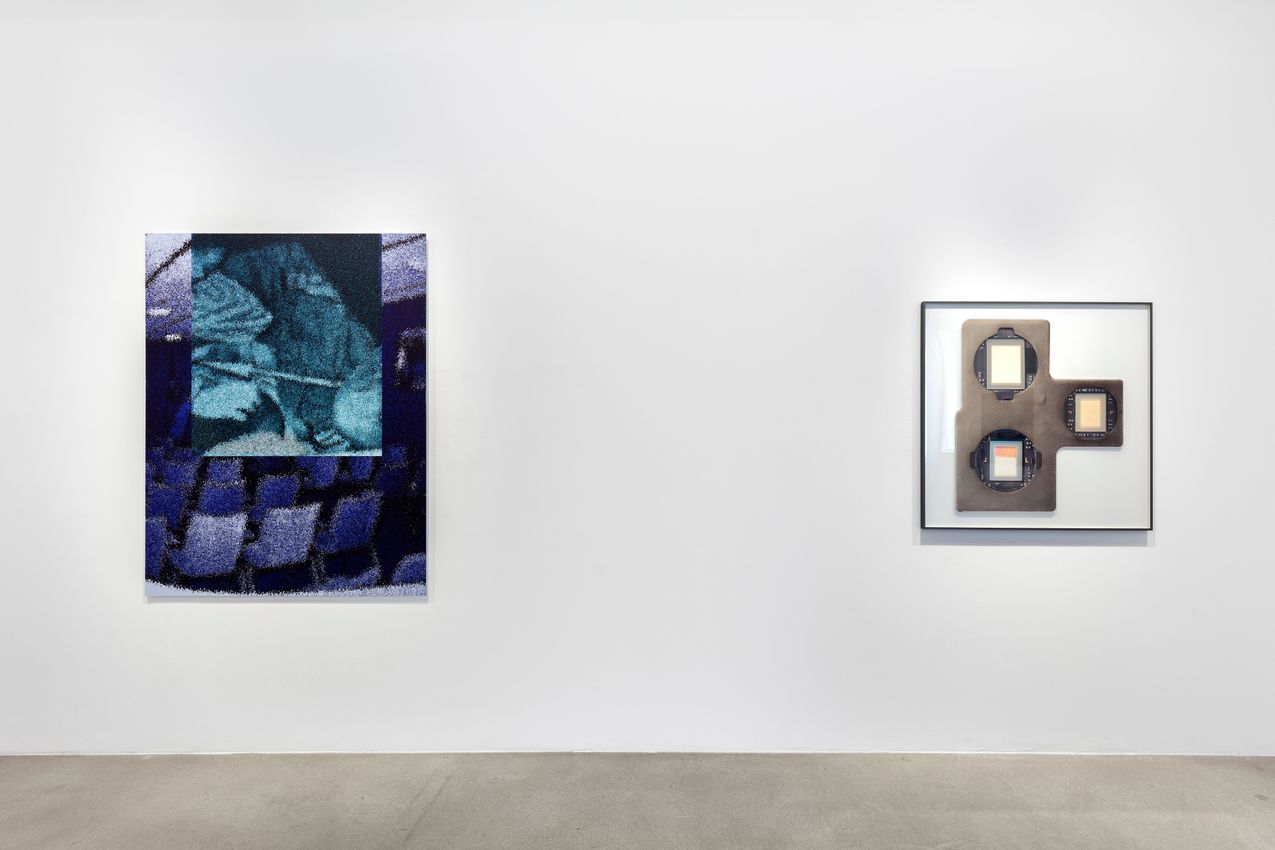
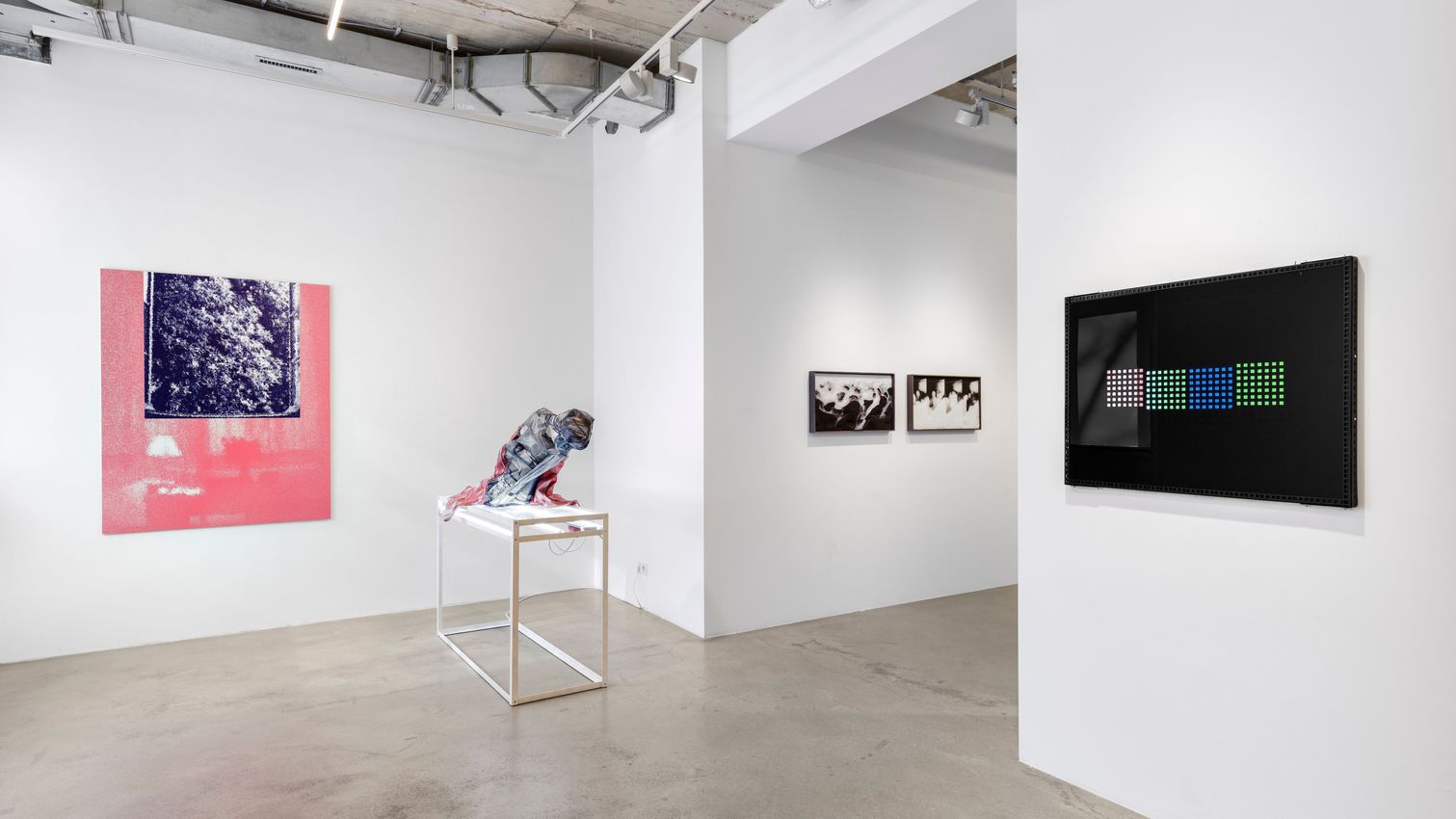
The same tectonic structure can be found in the work camera module iphone 11 pro, which reproduces a photographic frame. The rectangular parts represent sensors coated with iridescent foil, whose colour effect depends on the respective point of view. This effect, which in itself is not reproducible, questions the claim to objectivity in photography at arguably the most central point.

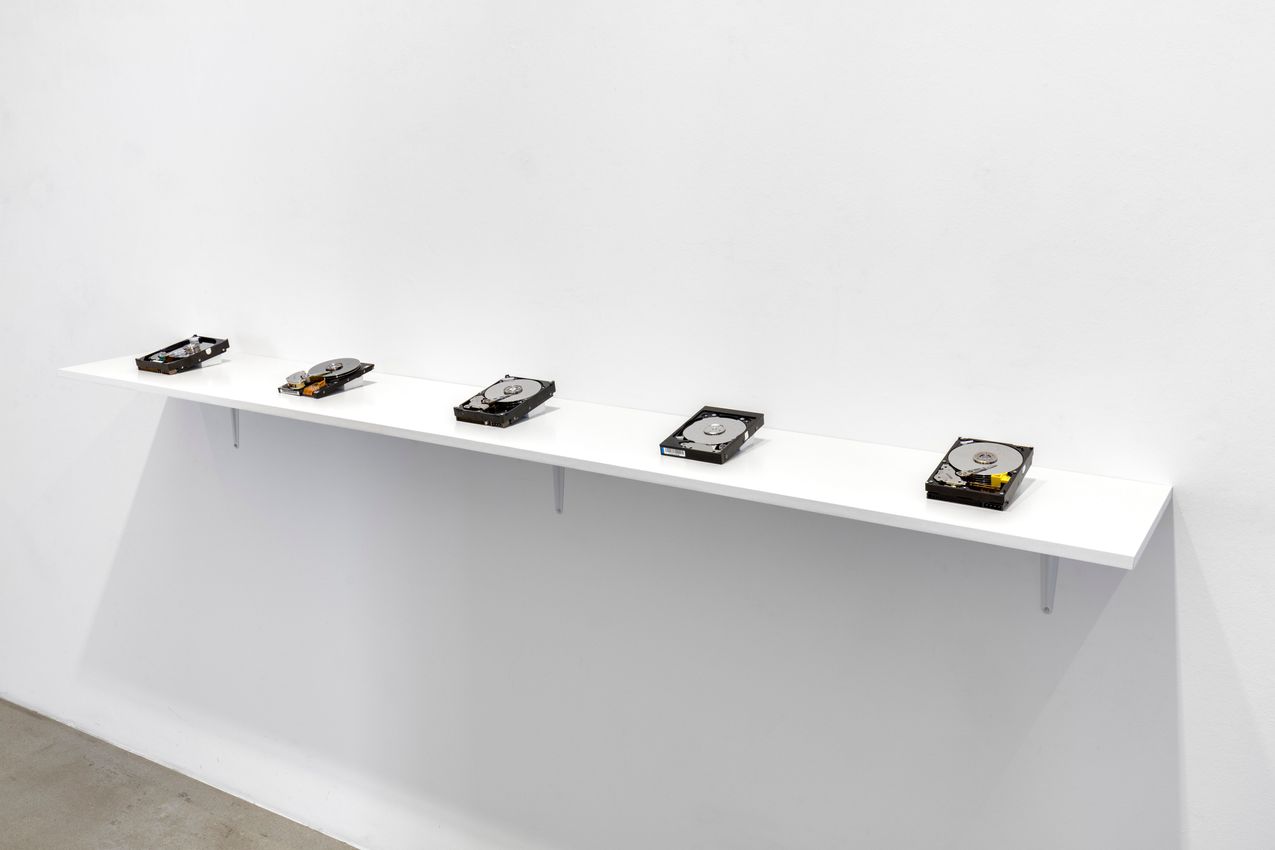
In the series the undeciphered meaning of ... historical, undeciphered documents are engraved onto the surface of discarded hard drives. They carry a secret that eludes our current knowledge, yet it radiates onto the object, relativizing it as a testimony of one scientific paradigm among many. The reflective surface evokes an immediate tactile desire, which simultaneously reflects back onto us.

This contrast is found in the works Suchmaschine 1 and Suchmaschine 2, between the slightly creased, glittering rough opacity of the sheet metal and the cool transparency of the glass surface. The latter is framed by an industrial-looking rail, referencing the frames of data centres. The checkerboard pattern refers to the Bayer-Sensor and exposes the characteristic of the grid that makes it a myth of modernity, namely, its ability to refer to nothing but itself, even to the point of absurdity, a claim to absoluteness, which is also alluded to in the title.. The staggered arrangement of Suchmaschine 2 can be understood as an analysis in the original sense of the word, a dissection and elementalisation, that constitutes the foundation of materialism. What is there beyond matter? Hard to say—like in an archeological excavation, only new sediments continually emerge from under the surface.

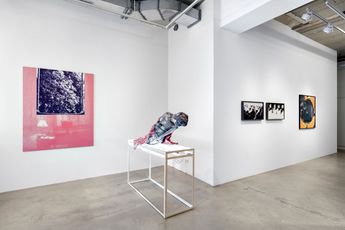
Fynn Ribbeck’s starting point for the exhibited works were photographs from the publicly accessible Stasi archive, which were digitally edited and combined into collages reminiscent of the shape of floppy disks. In the case of the aluminium print titled, Zimmer, Süd, the front of the two picture planes shows an escape that led to an arrest. We search in vain in the tangled surface for clues to the consequential event. If photography serves a similar function to that of images and memory, then it is worth questioning how much we can trust it in this regard. For the archive image itself is already a staged reconstruction of the events, and thus a piece of fictional truth, in which—if one examines the inserted arrow in the image—symbolic and iconic representation levels exist seamlessly side by side. This is further emphasised by the blur Ribbeck creates by digitally overdriving the noise of the silver grain, a phenomenon of analog photography. The image appears blurry, distant, eluding our grasp vaguely like a memory that has just crossed the threshold of the conscious.

In Zimmer, Nordwest, the spatial continuum of the background plane is also interrupted by the floating foreground: The view from the window becomes an abrupt intrusion into reality, where an abyss begins to brew, one that outright concerns the private sphere. The truly uncanny aspect of the Stasi photographs is the frightening harmlessness that confronts us, which is all too similar to our own living rooms. Viewing these photos also means recalling our very personal, semi-aware visual memory and overlaying them with our own memories. The photo archive here appears as a digital twilight state, a fluid in-between zone of compression and displacement, where public and private images glide into each other.

The sculpture Monument, sewn together from pieces of artificial leather, references the symbolic image of toppled statues. However, in this case, it is not a well-known figure, but an anonymous protagonist made from various archival images, printed onto individual parts of the sewing pattern. Due to the hollow space and the material properties, the object possesses a particular sculptural quality that encompasses both the real and the imaginary. Through the collapsed surfaces along the cut edges, it points beyond the boundaries of its current appearance to its own conceptual existence, which nonetheless remains subject to physical laws.

Abzug I and Abzug II are wax reliefs. The malleable material is played against the totalitarian aesthetic of socialist wall reliefs and coloured, which causes the human figures -like the rest of the works taken from the Stasi archive- to ghostly emerge from the negative space of the image, stepping into the glaring overexposure.

Read More

Installation Views

Artists Exhibiting

Also Exhibiting at SETAREH

About the Gallery

Founded in 2013, SETAREH is a gallery with locations in Düsseldorf and Berlin that specializes in contemporary and modern art, showcasing a dynamic exhibition program and diverse presentations at leading art fairs.

View Gallery Profile
Address
Königsallee 27-31
Düsseldorf
Germany
(1)
Düsseldorf Königsallee 27-31
SETAREH
Königsallee 27-31, Düsseldorf, Germany
The art world in focus