


Press Release
Artists:
Uri Aran, Tim Bučković, Alex Cuffe, Richard Frater, Zac Langdon-Pole, Clare Milledge, Joshua Petherick, André Piguet, and Isadora Vaughan (curated by Jack Willet)


When the supposed plague-laced arrows of Apollo pierced and infected the flesh of Saint Sebastian, martyr
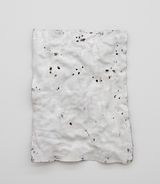
or not, pestilence was all encompassing and not even a sacrifice could cease its expansion; the arrows will continue to pierce, to unground the surface they rupture. From the heavens down and from the depths to the plane, this epidemic act of ungrounding partially devours and then infects the solid, inviting in a void ridden with plague. The ground under our feet is ungrounded, it is porous, and those pores are filled with a plague of unknowing and the unknown; all we can do is hope to find a new prayer, a new martyr, to pour fresh asphalt into the cracks of our well-worn road of contemporary uncertainty.

Themes of ungrounding and decay embody our present and are discussed almost as gospel in Reza Negarestani’s Cyclonopedia: Complexity with Anonymous Materials, an oil-ridden bible of speculation and horror. Though it should be noted that these and other themes are less so speculative, but rather frame elements of a ‘horror of contemporaneity’. For what is this contemporary age if nothing but horrific? We truly have no comprehension of our current condition, it is unknown to us, and as Lovecraft noted: “The oldest and strongest emotion of mankind is fear, and the oldest and strongest kind of fear is fear of the unknown.”(1)

What we do know is what was ‘then’ — that which is pre our present. Certainly some moments are cloaked behind a foggy lens, but it is eternally clear that the ‘known’ is always attempting to be relevant, to endure, to remain present. This is part of why the present is so hard to truly comprehend and why it is horrific. Our contemporary plight — our ‘solid’ state — is forever being tunnelled by the past, creating voids within the solid, leaving a surface that is ungrounded. We are not stable in this state.

The perception of the present as solid is due to its actuality; we may not entirely understand our time but we do know that it is there, it is real, it is now, hence it is solid — we can grasp it, feel it. Whereas the past is not graspable, it is gone, emitted into the endless void that creates the very architecture of the solid state we reside within. The void (the past) is the architect of the solid (present), the darkness that provides the border for the light to shine through. But there are faults within the architecture, the architect has not built the walls thick enough and holes begin to appear.


Negarestani calls this architectural action ‘() hole complex’, or to be more specific: “a machine [that] facilitate[s] the awakening and return of the Old Ones through convoluted compositions of solid and void.”(2) In this instance the poromechanical ungrounding of the earth is situated more in terms of petropolitics and the power of oil over capitalism, but equally () hole complex is a machine that facilitates the horror of contemporaneity. This continually turning poromechanical machine incites the uprising and emergence of the void via vermicular tunnelling of the solid, and it does not permit a rigid platform for humankind to move forward upon, not even the circumstances to properly develop our current moment in the history of the earth and everything. An ideal example of this is the West’s ceaseless attempt to build a ‘new world’ upon the surface of the Middle East. Their physical and philosophical entities only exist long enough for formative structures to be risen — idols, attempting to be new gods — then destroyed by the cultures of the past that will not give in to the contemporary condition. Returning these forms to the horizontal, as “every verticality, is a manifest idol, the desert [on the other hand], as militant horizontality, is the promised land of the Divine.”(3) The Middle East it seems is beyond the horror of contemporaneity, instead existing in an even more blackened state of deceiving and altering unknown presentness.

1913 could be noted as the moment when the poromechanical machine reached a state of overdrive; from roughly this year forward comprises the deepest and darkest element of the void that is ungrounding our present. The actions from here and into the remainder of the 20th century have undoubtedly shaped our current solid, most of all the culture it contains, with all its conceptually rich schools of thought, politics and artistic production, it is as if the cultural labelling-gun of reason was gradually morphed into the stickers of slacker stupidity. Seeing how many ‘posts’ and ‘isms’ could be added, which of course has led us to adopt a similar touch, seeing how many reiterations we can offer words like ‘Internet’. Much like the ‘if’, ‘but’ and ‘um’ of many a conversation, these added extras are signs of an unknown state. Indeed, some of these ‘um’ moments did result in relevance, but their continued use only adds to the void that attempts to unground our endeavour to build a stable contemporary solid. The events and movements of the 20th century do not want to be forgotten, nor do many others all the way back to the big bang, but this ceaselessness is not their answer to remain relevant, they have no right to relevance, only to legacy and inspiration. Yet there is no recognition of this, no quiet death, instead there is forced access via poromechanics and vermicular lines, and with enough push and shove the ungrounded solid is soon surrendering itself to the pestilent void.

It could be viewed that the desire for contemporaneity (or some type of idealist utopian future) was placed in another type of acceleration machine in the Soviet Union, which allowed for () hole complex to churn at a faster rate, coincidentally resulting in the walls of the Soviet solid being thicker, and the void's desire to unground it being stronger. It would seem that the horror of contemporaneity was reached sooner in the Soviet Union than the West. A small group of filmmakers in 1980s Leningrad recognised this plague; the artists of ‘Necrorealism’ referred to “an absent presence and a present absence, the ambivalence, the insolubility, of the relationship between life and non-life, the double meaning of necrorepresentation.”(4) They put forward “the possibility of rejecting reality, if reality is perceived not as an omnipresent absence, but as the lethal proximity of a terrible and peculiar necroreality.” As the Soviet age went into decline, alongside many of its leaders, the Necrorealists attempted to represent this somewhat non-representational moment of passing, a decaying point in time, recognising the destruction of socialist realism and all the things it stood for by its own hand, it was devouring itself. Like the snake biting its tail, the USSR was in an act of the eternal return, trying to move forward but not without its past. These artists were remarkably able to capture the ungrounding of the Soviet Union, their films were the personification of () hole complex, of the machine that was tunnelling, giving rise to the pestilent void.

A condition of ‘zombiefication’ has transfigured our contemporary solid state, it is both the aftermath and a continuation of the ungrounding process; contemporaneity now “perpetuates itself on the substratum of survival, in order to indefinitely postpone death and absolute disappearance.”(5) The ungrounded and porous solid survives as a decaying entity, not able to die but nor truly alive, a state that makes the configuration of solid and void even more radically blurred. Our solid seems somewhat doomed and speculation is the only thing that can start to re-fill the holes. For the beauty of speculation is that it attempts to know, to find meaning, and thus may hold the capabilities for the creation of a new machine, one of 'outside openness' that can attempt to restore our solid state. Unlike the chthonic form of devouring without invitation, the openness that Negarestani’s fictitious character Dr. Hamid Parsasni speaks of can take the form of a god or avatar, which suicidally submits to the earth where it's corpse can best contaminate the solid. Though in order for such submission to occur the earth and human must first become ‘good meals’ for the descending ‘dead god’, adequately prepare oneself to make the “restrictive ground a direct passage to openness.”(6) This fall to the unground from the outside to spread a new form of decay (openness) can then be seen as the planting of the seed upon new-ground, the start of building upon something sincerely solid to establish a truthful contemporary state. But we must become a lure for the epidemic openness, allowing the unground to interlock with it, and then hope to survive its ruthless opening.

If we were to give light to speculation, it is perhaps an accelerationist machine that is needed to make the contemporary solid a good meal for openness — thinking of the “political heresy” that it is. The generalised overview of accelerationism sees the “only radical political response to capitalism is not to protest, disrupt, or critique, nor to await its demise at the hands of its own contradictions, but to accelerate its uprooting, alienating, decoding, abstractive tendencies.”(7) Like the Soviets, maybe our key form of speculation is to propel the system in the hopes of bringing forward true openness. All of this said however, this speculative notion of accelerating our current capitalist system may not turn us into the desired meal for the outside, unable to fix our issues with the void. It is not the most expeditious option, but true to our current state of horror, if we are not to at least attempt to speculate on a differing future (some type of avant-garde embracing utopia) we are destined to rot in our present. Surely our solid state has no desire to sit in waiting for this horror of ungrounding contemporaneity to fully overrun us, but maybe speculation is just that and nothing will come to fruition. We could well be out of options, be truly and deservingly terminal, and should welcome the endless tunnelling, bringing forth the return of the Old Ones. “Ph'nglui mglw’nafh Cthulhu R’lyeh wgah’naglfhtagn.”(8)

Jack Willet
  1. Lovecraft, Howard Phillips: Introduction in ‘Supernatural Horror in Literature’; New York: Dover Publications, 1973, p. 3
  2. Negarestani, Reza: ‘Cyclonopedia: Complexity with Anonymous Materials’; Melbourne: re. press, 2008, p. 44
  3. Negarestani, Reza: ‘Cyclonopedia: Complexity with Anonymous Materials’; Melbourne: re. press, 2008, p. 18
  4. Mazin, Viktor: ‘Cabinet of Necrorealism: Infit and’ in Necrorealism: Context, History, Interpretations; Pittsburg: Pittsburg Russian Film Symposium, 2001, p. 32
  5. Negarestani, Reza: ‘Cyclonopedia: Complexity with Anonymous Materials’; Melbourne: re. press, 2008, p. 182
  6. Negarestani, Reza: ‘Cyclonopedia: Complexity with Anonymous Materials’; Melbourne: re. press, 2008, p. 204
  7. Avanessian, Armen & Mackay, Robin: Introduction in ‘#Accelerate: The Accelerationist Reader’; Falmouth: Urbanomic, 2014, p. 4
  8. Lovecraft, Howard Phillips: The Call of Cthulhu in ‘The Call of Cthulhu and Other Weird Tales’; London: Vintage Classics, 2011, p. 74

Also Exhibiting at STATION

About the Gallery

Established in Melbourne in 2011, with a second space opened in Sydney in 2019, STATION is dedicated to presenting an engaging, conceptually-driven exhibition program, with the aim of fostering rigorous, critically-engaged contemporary art practices. STATION represents a broad stable of established and emerging Australian and international artists. We are committed to bringing Australian contemporary art practices to international audiences and presenting opportunities for our artists to be positioned within a broader global dialogue.

View Gallery Profile
Address
9 Ellis Street
South Yarra
Melbourne
Australia
Opening Hours
Tuesday – Saturday
10am – 5pm
(1)
Melbourne 9 Ellis Street, South Yarra
STATION
9 Ellis Street, South Yarra, Melbourne, Australia
+61 3 9826 2470
http://stationgallery.com

Opening hours
Tuesday – Saturday
10am – 5pm
The art world in focus
