The art world in focus
Subscribe to our newsletter for news and insights on artists, galleries and exhibitions.
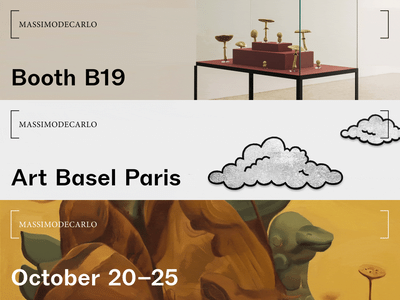

After launching Pavilion in Taipei this January and taking it to Hong Kong (above) in March, Seoul is the initiative’s third city in nine months. Photograph: Ben
Amid the busiest period in Seoul’s art calendar, alternative art fair Pavilion has today opened its inaugural edition in the South Korean capital—and it has done so at a deliberately slower pace.
Until 6 September, 17 non-profits will occupy three converted warehouse and factory buildings at Kumsung Cultural Space in Yongsan. Without individual booths, artworks will be dispersed throughout the site in a layout more reminiscent of an institutional exhibition than a fair, and will be accompanied by talks and performances.
Pavilion belongs to a growing lineage of alternatives to the conventional art fair, including Basel Social Club, Tokyo’s Onsen Confidential and Seoul’s own Our Week. Its founders, Willem Molesworth and Ysabelle Cheung, have also previously developed two related initiatives in Hong Kong: Supper Club (2024–2025) and Unscheduled (2020–2021). After launching Pavilion in Taipei this January and taking it to Hong Kong in March, Seoul is the initiative’s third city in nine months.
“The best relationships, careers and networks all take time to form,” Molesworth told Ocula. He describes Pavilion’s commitment to “slow growth” as a response to the hype that can send artists’ prices soaring, while leaving collectors with little lasting attachment to their work.
A multi-city structure, he argues, instead allows such relationships to accumulate over time. It is “a practice that requires repetition”, he said.
Instead of moving a fixed roster between cities, each edition of the fair brings together a largely different local and regional community. For Pavilon Seoul, 14 participants are new to the event, and eight are based in the city.
However, Pavilion does see recurring exhibitors, too. As an example of relationships continuing after the event, Molesworth points to River Art Gallery in Taichung, which participated in Taipei and Hong Kong and has since invited Pavilion Hong Kong curator Jims Lam to organise a group exhibition.
Alongside local connections, Molesworth also cites a more measurable benefit. “Typically two-thirds of our galleries make sales,” he explained.
However, for Seoul non-profit YPC Space, sales—while welcome—are not the main reason to participate.
The collectively organised project hopes to bring the work of So Minkyung, known for her illustrations on exhibition texts, to new audiences. Jiwon Yu, co-founder of the space, told Ocula that, by taking part in Pavilion, the hope is to achieve this “without having to fully adopt the logic of a commercial gallery or art fair”.
“Visibility by itself is quite abstract,” Yu told Ocula. “What we are looking forward to is encounters, and possible connections that might develop beyond the event and contribute to an artist’s ability to continue making work.”
Pavilion takes its name from the structures found in gardens and parks—according to the event’s organisers, the title speaks to the event’s commitment to locality, adaptation and neighbourly collaboration in East Asia. Galleries and art spaces participating in the Seoul edition include PHD Group (Hong Kong), Sangheeut (Seoul), Norito (London) and Brownie Space (Shanghai).
Founder and director of Sangheeut Hyejin Jee said: “During Frieze Seoul and Kiaf, the city attracts an incredible international art community, but I always felt there was room for more independent, community-driven initiatives alongside the main fairs. I hope this becomes a starting point that encourages more alternative formats and independent, collaborative initiatives to emerge in Seoul in the years ahead.”
A respected voice in contemporary art discourse.
Focusing on ambitious storytelling and insightful art-world commentary. Ocula Magazine publishes in-depth interviews, critical essays and timely analysis on the artists, exhibitions and ideas driving the global art world.
Learn more about Ocula Magazine
Showcasing the best of the art world.
Ocula partners with galleries from around the world to highlight their artists, artworks and exhibitions. Gallery membership is by application and invitation, with each member vetted by an independent panel.
Learn more about Ocula Membership
Specialises in the sale of major artworks.
Led by a team with deep ties to the world’s leading auction houses, galleries and collectors. Ocula’s advisory team offers bespoke services to high-net-worth clients from around the world who are looking to acquire the best of contemporary and modern art.
Learn more about our team and services