




ASHLEY BICKERTON
1959-2022, BarbadosAshley Bickerton was a maverick of contemporary art whose genre-defying practice spanned sculpture, painting, photography and digital media—critiquing consumerism, identity and the mythos of the ‘artist’ with a satirical edge.
Early Years
Ashley Bickerton was born in Barbados in 1959 and spent much of his youth moving across continents—an experience that later informed his lifelong interrogation of cultural hybridity and constructed identity. He studied at the California Institute of the Arts and earned his MFA from the Whitney Independent Study Program in New York in 1985.
In the mid-1980s, Bickerton emerged as a central figure in New York’s Neo-Geo movement, alongside artists like Jeff Koons and Peter Halley. While associated with this group’s critique of consumer culture through sleek, industrial aesthetics, Bickerton resisted categorisation. Disillusioned with the New York art scene, he relocated to Bali in 1993, where he remained until his death in 2022. The move marked a pivotal turn in his work, introducing a riotous fusion of global visual vocabularies, from tourist kitsch and pop surrealism to oceanic myth.
Artworks
Ashley Bickerton’s artworks traversed painting, sculpture and multimedia, combining industrial materials with tropical excess to examine the commodification of art and life.
Commodity Critique
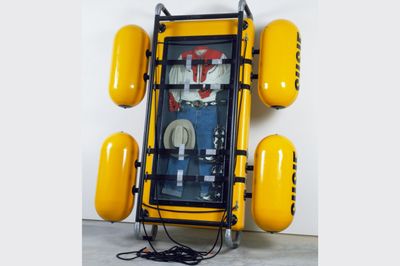
Bickerton’s early works, created in 1980s New York, exemplify his critique of consumer culture and the branding of identity. Sculptures like Tormented Self-Portrait (Susie at Arles) (1987–88) are boxy wall-mounted constructions wrapped in slick surfaces, featuring corporate logos, hazard symbols and barcodes. These assemblages parodied both Minimalist aesthetics and the contemporary art market’s obsession with value and authorship. Framed as “self-portraits”, they dissected how individuals become products under capitalism. Though aligned with the Neo-Geo movement, Bickerton’s works were more acidic and self-reflexive than celebratory, always aware of their own place in the system they skewered. This period established him as a leading postmodern provocateur.
Balinese Hybrids
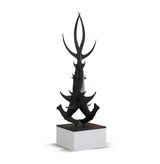
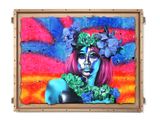
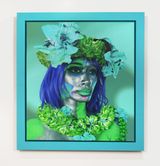
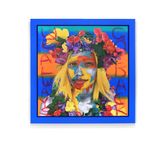
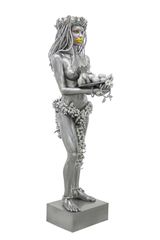
After moving to Bali in 1993, Bickerton’s art exploded into new forms—incorporating wood carving, inlay, metal, shells and vivid airbrushing to create works that hybridise the local and global. Busts like Green Head with Inlay 1 (2005) and Silver Head with Inlay (2006) are grotesque, futuristic relics that simultaneously honour and parody Southeast Asian craft traditions. These artworks blur boundaries between sculpture and painting, the sacred and the synthetic. Bickerton reimagined the tourist souvenir as a site of cultural tension—ornamental, fetishised, and disturbingly seductive. These works complicate notions of authenticity, suggesting that all contemporary art is, in some way, a product of entangled global economies and imagined paradises.
Oceanic Obsessions
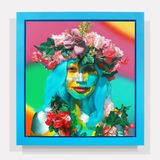
In later years, Bickerton’s artworks often returned to the ocean—both as a personal anchor and as a potent symbol of environmental and cultural erosion. In the photographic tableaux of Ornamental Hysteria (2017), glossy, hyper-staged figures pose in saturated tropical settings, their bodies encrusted with shells, chrome and coral. These surreal compositions reference fashion photography, pulp erotica and ecological doom, reflecting on the tourism industry’s glossy facade. Bickerton’s ocean is not utopian—it is polluted, commodified and on the verge of collapse. The surface beauty of these works masks deeper anxieties about extinction, voyeurism and the limits of art’s power to reckon with global catastrophe. These tensions—between seduction and critique, complicity and resistance—also course through a later interview with the artist for Ocula, in which he speaks candidly about working from Bali and confronting the environmental stakes of his seascapes.
Exhibitions
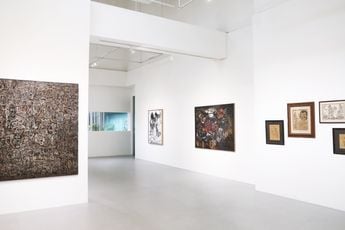
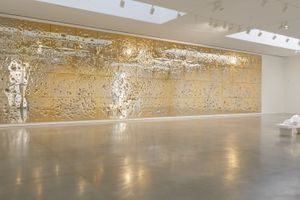
Ashley Bickerton has been the subject of both solo and group exhibitions at important institutions. A selection of important exhibitions is provided below.
Solo Exhibitions
- Susie’s Mother Tongue, Gagosian, West 21st Street, New York (2023)
- Seascapes at the End of History, Lehmann Maupin, New York (2022)
- Landscapes, Seascapes, and Interiors, Various Small Fires, Los Angeles (2021)
- Ashley Bickerton, The FLAG Art Foundation, New York (2017)
- Walls and Paintings, Dirimart Gallery, Istanbul (2015)
- ... in paradise, White Cube, London (2001)
Group Exhibitions
- In Search of the Miraculous, The FLAG Art Foundation, New York (2022)
- The Greek Gift, DESTE Foundation for Contemporary Art, Hydra (2021)
- Amplituhedron, K11 Art Foundation, Hong Kong (2018)
- Brand New: Art and Commodity in the 1980s. Hirshhorn Museum, Washington, D.C. (2017)
- Human Interest: Portraits from the Whitney’s Collection, Whitney Museum of American Art, New York (2016)
Critical Reception
Ashley Bickerton’s practice has been featured in leading publications including Frieze, Gagosian Quarterly, and The Guardian.
Ashley Bickerton FAQs
What is Ashley Bickerton known for?
Ashley Bickerton is best known for his bold and often biting critiques of contemporary art, capitalism, and identity. His artworks—ranging from sleek Neo-Geo constructions to flamboyant Balinese hybrids—blend industrial materials, branding motifs and hand-crafted elements to challenge the boundaries between art and commodity. He created visually arresting, multilayered pieces that skewered both Western consumer culture and romanticised notions of the exotic. Bickerton’s refusal to settle into a signature style made him a unique and influential voice in late 20th and early 21st-century contemporary art.
Why did Ashley Bickerton move to Bali?
Ashley Bickerton moved to Bali in 1993 as a radical rejection of what he saw as the commercial insularity of the New York art scene. Disenchanted with the art market’s commodification and careerist expectations, he sought an environment where he could reinvent his practice away from art-world trends. Bali provided a fertile ground for experimentation, allowing Bickerton to fuse local craftsmanship, tropical imagery and global critique. This move catalysed a major transformation in his work and defined a new chapter of vibrant, trans-cultural contemporary art production.
What themes does Ashley Bickerton explore in his art?
Ashley Bickerton’s art explores complex themes including commodification, ecological destruction, cultural appropriation, tourism, and the unstable nature of identity in a globalised world. He interrogated the way contemporary art itself functions within capitalist systems—often turning a critical eye on his own role as an artist. His Bali-period artworks frequently address the fetishisation of the ‘exotic’ and the fantasy of paradise, while his later photographic works reflect deep concerns about environmental degradation, beauty and decay. Across all media, Bickerton’s art blends satire with spectacle to provoke critical reflection.
Ocula | 2025
View Ashley Bickerton's Artworks
















Explore Ashley Bickerton's Exhibitions





Ashley Bickerton in Ocula Magazine









Explore and Follow Artists Shaping Contemporary Art
A respected voice in contemporary art discourse.
Focusing on ambitious storytelling and insightful art-world commentary. Ocula Magazine publishes in-depth interviews, critical essays and timely analysis on the artists, exhibitions and ideas driving the global art world.
Learn more about Ocula Magazine
Showcasing the best of the art world.
Ocula partners with galleries from around the world to highlight their artists, artworks and exhibitions. Gallery membership is by application and invitation, with each member vetted by an independent panel.
Learn more about Ocula Membership
Specialises in the sale of major artworks.
Led by a team with deep ties to the world’s leading auction houses, galleries and collectors. Ocula’s advisory team offers bespoke services to high-net-worth clients from around the world who are looking to acquire the best of contemporary and modern art.
Learn more about our team and services