





Ashley Bickerton: Full Circle
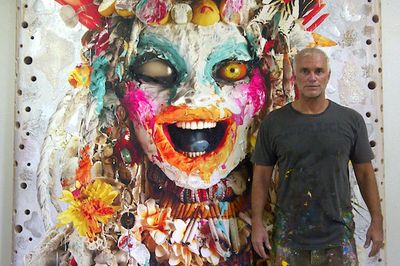
Ashley Bickerton. Courtesy the artist.


In conversation, Ashley Bickerton cites David Ostrowski as a painter he follows—it’s an unexpected point of reference. Ostrowski’s work, often characterised by gestures of reduction, erasure, and a cultivated incompleteness, seems far removed from Bickerton’s materially exuberant practice. Since emerging in late-1980s New York as a key figure in the so-called Neo-Geo milieu, Bickerton has built a career on excess: from the industrially fabricated “wall contemplation units” emblazoned with corporate logos that secured his early reputation, to later works layering digital imagery, found objects, and thick impasto into riotous, often grotesque compositions.
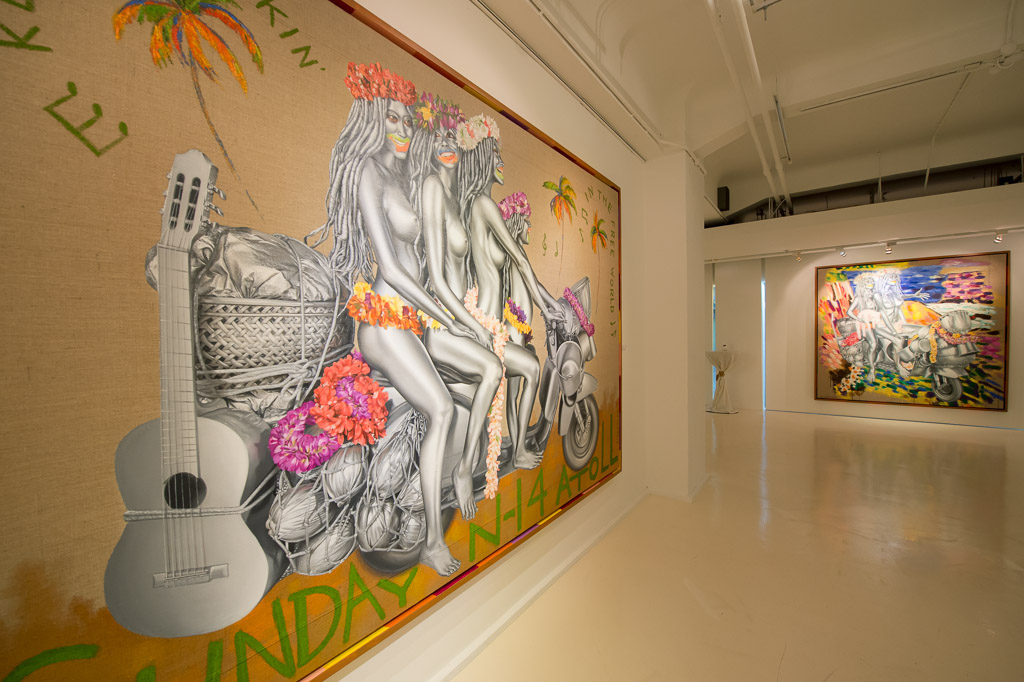
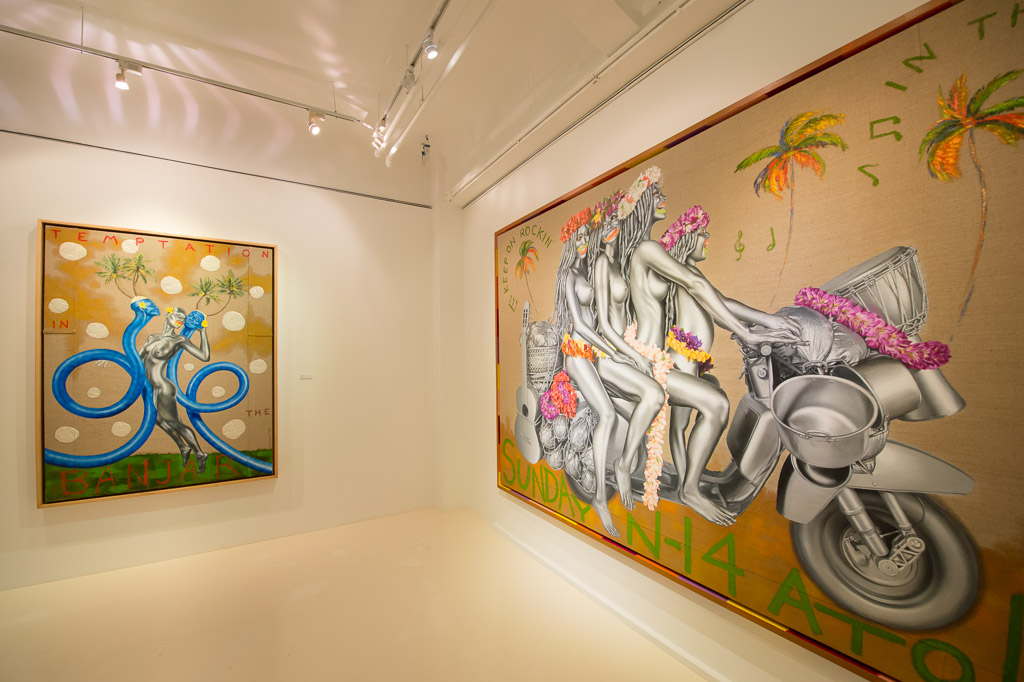
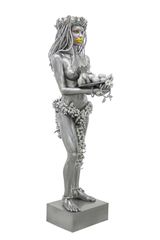
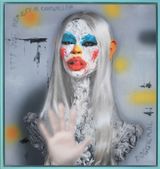
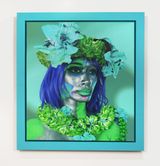
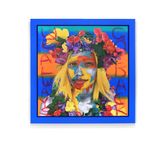
A 2013 exhibition at Lehmann Maupin, New York, presented his Medusa-like Madonnas—figures rendered in lurid colour, with coiled, dreadlock-like hair, distended features, and accumulative surface effects that verge on the baroque. More recent paintings continue this trajectory, staging hyper-saturated, apocalyptic island scenes that oscillate between seduction and collapse, drawing on Bickerton’s long engagement with Bali, where he has lived and worked since the early 1990s.
Yet the invocation of Ostrowski begins to make sense when understood less in terms of surface and more as a shared inquiry into the conditions of painting itself. Beneath Bickerton’s maximalism lies a sustained conceptual preoccupation: how painting constructs meaning through signs, styles, and the circulation of images. His work has consistently tested the limits of authorship, identity, and representation—whether through the branded self of the Logo series or the hybridised, culturally entangled figures of later paintings. In this light, Ostrowski’s strategies of subtraction and refusal can be seen not as oppositional, but as a parallel effort to destabilise painterly conventions from within.
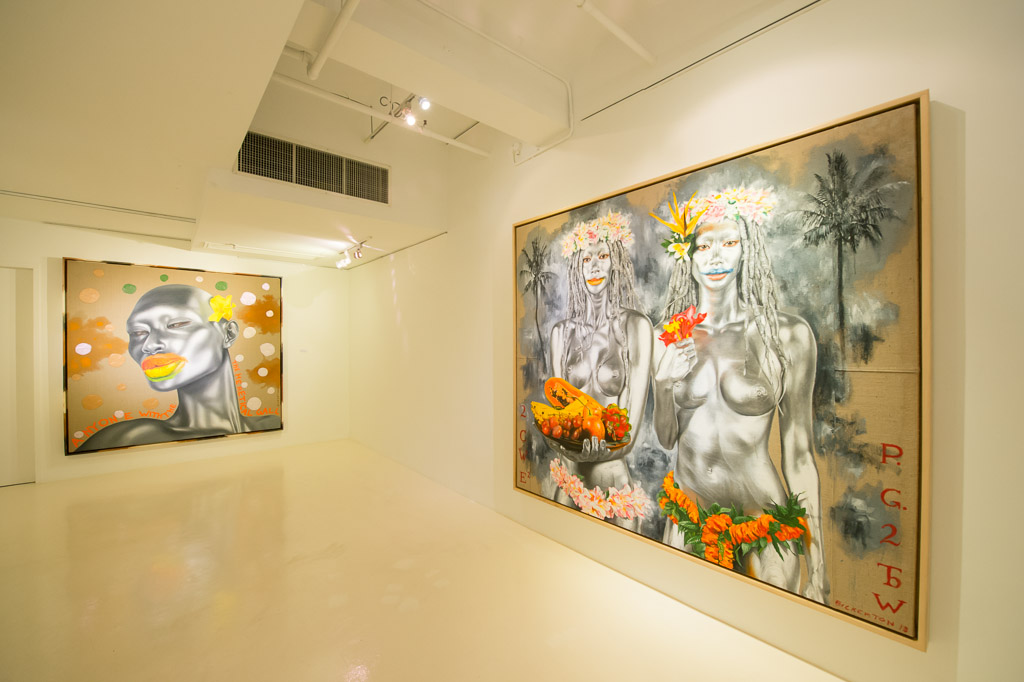
When I meet Bickerton in Singapore during Art Stage, we sit before a large double portrait of his wife. Bare-breasted, her body painted silver, she appears twice within the same frame, her exaggerated lips and stylised features echoing the protagonists of his recent works. A tropical backdrop—part idyll, part artifice—unfolds behind her, while passages of raw canvas remain exposed. The painting, Bickerton explains, “riffs” on both Gauguin’s Two Tahitian Women (1899) and Warhol’s Silver Double Elvis (1963), staging a collision of art-historical reference points that oscillates between homage and parody. Still, he worries he may have pushed too far.
That anxiety—of being misread, or worse, read only at the level of kitsch—is not new. While Bickerton acknowledges that such references may not be immediately legible, his concern runs deeper: that the work’s conceptual underpinnings might be overlooked entirely. Early pieces such as Tormented Self-Portrait (Susie at Arles) (1987–88), now in the collection of the Museum of Modern Art, New York, established his reputation as a critical voice within Neo-Geo. First shown in the landmark 1988 Sonnabend Gallery exhibition alongside Jeff Koons, Peter Halley, and Meyer Vaisman, the work proposed a model of portraiture constructed through corporate logos—a self assembled from the branded debris of late capitalism.
Nearly four decades on, Bickerton’s practice has undergone multiple, often dramatic transformations—from the austere conceptualism of the Logo works to the materially dense, tropicalised excess of his later paintings. Yet the underlying project has remained remarkably consistent. His work continues to mine the image-world for its signs and symbols, staging a restless inquiry into what constitutes an artwork and how meaning is produced, performed, and destabilised. Seen in this context, his interest in Ostrowski feels less like a contradiction than a recognition of a shared terrain: painting as a site of ongoing negotiation, where both addition and erasure serve to unsettle its terms.
An extract of Anna Dickie‘s conversation with Ashley Bickerton is provided below.
AD: I read you are going to re-visit Tormented Self-Portrait (Susie at Arles)?
AB: I have got into arguments about this—even with my own gallery. They think I might be exploiting it. I divorced myself from a lot of my early work. I ran away from it. I didn’t want anything to do with it. I hated it. I dumped it. And little by little I realised that it never really left. All of the plays are still there. More and more recently I have realised that at the root of everything—that work, and this work here, is parody. The work is still always about the question of what is an artwork. What is an art object? It is still about turning painting inside out.
I hated the way my old work imprisoned me and that is why I struggled so hard to break out.
AD: Do you mean imprison in terms of the label, Neo Geo? In terms of your grouping with the ‘fantastic four’?
AB: Yes, in both the literal and figurative sense. I was boxed by the box. And that was hard. And then also, years where every intro written about me started ‘Ashley Bickerton, who came up in the East Village as part of Neo Geo with Jeff Koons, Peter Halley’. It was the thorn in my side.
AD: You spent many years escaping that label—but how do you now want to be defined?
AB: I feel I strayed too far from my conceptual roots. My work has been grounded in that history. I got to the point where ... actually take for example Artsy! They put my work with ‘kitsch’!
AD: But your work does use kitsch, and I suppose your involvement with that definition gets generated from Artsy’s complex genome system?
AB: Yes, but God, I have seen kitsch and I have suddenly realised that wasn’t what I wanted it to be. I wanted to re-establish my conceptual roots. When I was doing paintings of overgrown gruesome, bombastic figures and then the images and the frames turned gold. If you just saw them in isolation, you wouldn’t know I was the artist I was. And so with the twenty-fifth anniversary of the Logo piece, I wanted to navigate and investigate the two languages. I have been in this game for a long time now, and I have come full circle. I want to put it all together. Now there is enough track and territory laid down, I can step back and see the overarching language, not the disparate parts.
AD: So revisiting Tormented Self-Portrait—it’s about reflecting on what you have always been saying?
AB: Yes. So for all the naysayers who say don’t do it, well tough. I have good reason to do it. —[O]
Main image: Ashley Bickerton. Courtesy the artist.


















A respected voice in contemporary art discourse.
Focusing on ambitious storytelling and insightful art-world commentary. Ocula Magazine publishes in-depth interviews, critical essays and timely analysis on the artists, exhibitions and ideas driving the global art world.
Learn more about Ocula Magazine
Showcasing the best of the art world.
Ocula partners with galleries from around the world to highlight their artists, artworks and exhibitions. Gallery membership is by application and invitation, with each member vetted by an independent panel.
Learn more about Ocula Membership
Specialises in the sale of major artworks.
Led by a team with deep ties to the world’s leading auction houses, galleries and collectors. Ocula’s advisory team offers bespoke services to high-net-worth clients from around the world who are looking to acquire the best of contemporary and modern art.
Learn more about our team and services