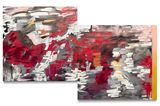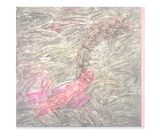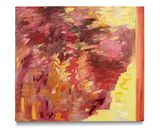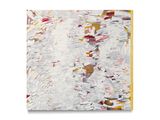
Sundaram Tagore Gallery is pleased to present an expansive exhibition of paintings and drawings by veteran abstractionist Judith Murray (b. 1941, New York). Active in New York since the 1970s, Murray belongs to a leading generation of women artists whose work is receiving renewed critical attention.
Early in her career, Murray forged an independent path outside the confines of specific art movements. When Minimalism and Conceptual art were gaining ground in New York, she reaffirmed new possibilities in painting. Her vibrant color-driven canvases combined elements of gestural abstraction with the purity of non-objective painting.
Raised in Miami, Murray moved to New York in 1958 to study at Pratt Institute under the painter Walter Tandy Murch. She received early recognition when the legendary dealer Betty Parsons—known for championing Jackson Pollock, Mark Rothko, and Barnett Newman—gave her a solo show at Parsons-Truman Gallery in 1976. A review of the show in the SoHo Weekly News, one of the most influential voices chronicling cultural life in New York at the time, described Murray as “A Nonconformist Painter.” Two years later, curator Alanna Heiss, a pioneer in the alternative space movement, invited Murray to mount a solo show at The Clocktower in 1978, one of New York’s foremost experimental art spaces.
Murray later participated in various exhibitions at P.S.1 Contemporary Art Center (now known as MoMA PS1) and the 1979 Whitney Biennial. Most recently, in 2025, her oil paintings and graphite drawings were showcased in the exhibition Judith Murray: Paradise Paradox at 447 Space in New York at the invitation of artists Sean Scully and Liliane Tomasko.
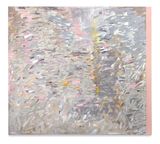
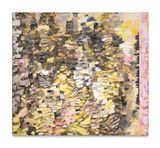
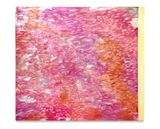
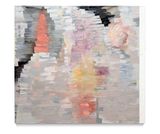
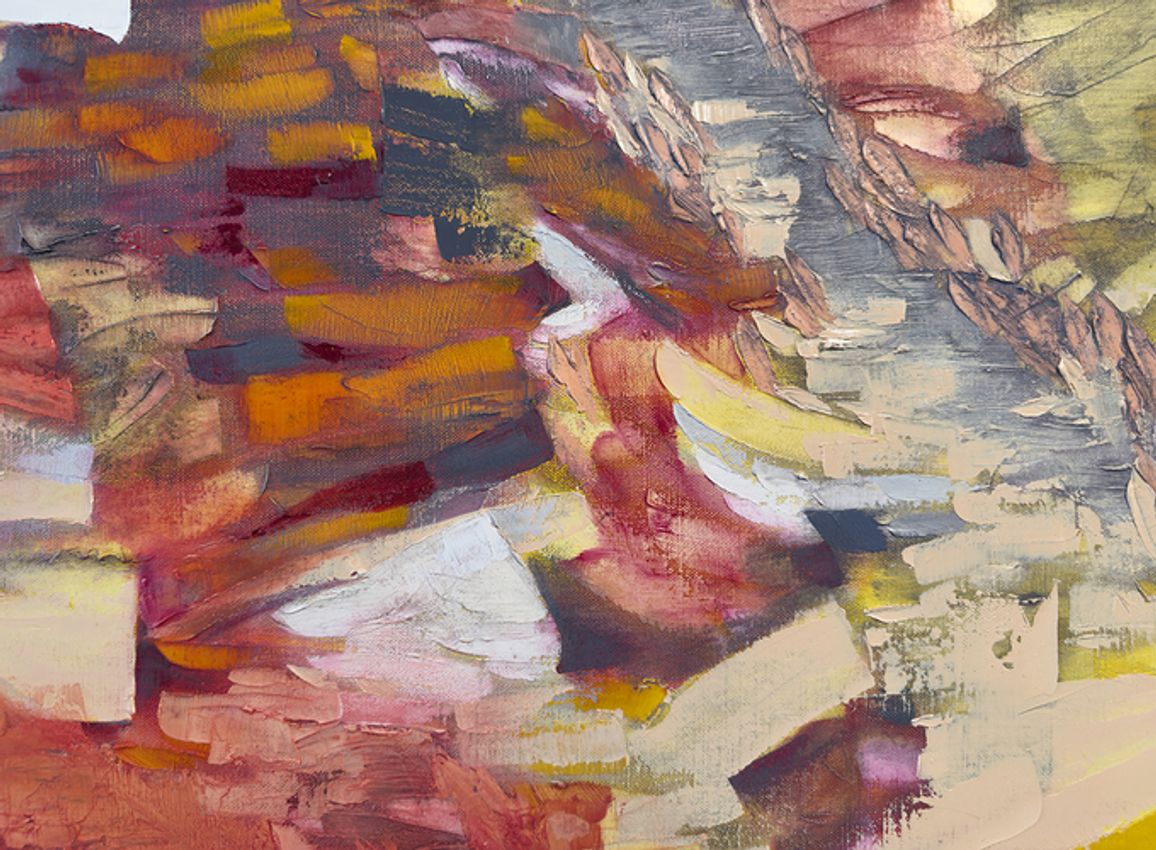
Since the 1970s, Murray has rigorously limited her palette to four colors: red, yellow, black, and white. But so skillful is she in mixing these hues that only the most observant viewer would realize it. Painting on large canvases in an off-square format that can reach up to eight by nine feet, she juxtaposes densely layered impasto brushstrokes—made with palette knives, brushes, and rags—with a single crisp vertical bar on the right side of the canvas. “The way I use oil paint is not only physical, but I also treat it as a sculptural medium,” Murray says. “The bar is the counter to everything else that’s going on. It’s the most modernist of all the elements. All the space moves back and forth in relation to it.”
Working in a similar vein as artists such as Ad Reinhardt and Robert Ryman—who also embraced formal constraints—Murray developed a distinct voice. Unlike their muted works, her vivid canvases are charged with intense colors and anchored by the persistent vertical bar, a structural element that is integral to all her compositions.
Throughout her life, Murray’s extensive travels have shaped her practice. As a child in the 1950s, she pored over National Geographic, fascinated by images of India and Africa. Later journeys to locations spanning prehistoric cave sites in India to remote jungle villages in South America affirmed her devotion to red, yellow, black, and white, which she found to be prevalent across diverse cultures. “I want the paintings to be universal like these colors,” she says, explaining her aim to cultivate a visual language that transcends geography.
EXHIBITION HIGHLIGHTS
Now 85 years old, Murray is still discovering new possibilities in painting. This exhibition features her latest body of paintings paired with a series of meticulous graphite drawings. While her gestural surfaces may appear spontaneous, there is an intense discipline and rigor to her work. She never uses an eraser in her drawings, and once she envisions how light will move across a painting, she carefully plans the composition, laying down decisive brushstrokes.
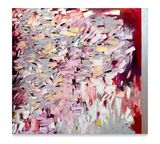
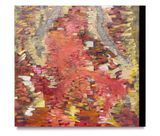
Painted at scale and with intense physicality, the paintings on view in this exhibition are replete with energy and optimism, defying any expectation of late-career restraint. Murray coaxes an impressive spectrum of colors from her limited palette—from the dreamy pinks and dove grays of Reflection, to the fiery oranges and sunny yellows of Coast. The lushness of both color and sumptuous textures suggests a lust for life, if not a surrender to pure pleasure.
As Alanna Heiss once put it, “Judith has a desire to make a painting you could lie on and literally fly away into heaven. I know this may sound like a teenage 1960s 45-record, but if you are in the right room at the right time, with the right light, with the right painting of Judith Murray’s, you have a possible chance of ‘lift off.’ ”
American artist Judith Murray has created a trademark language that is abstract and deeply expressive. Oil paintings from early in her career in the 1970s exhibited stark and incisive forms in red, white, yellow and black. The vertical bar down the right-hand edge of the canvas that first appeared in those paintings has become a permanent element in all her work, in effect anchoring the rest of the canvas to the picture’s frame.
Over the years, she has remained faithful to the use of only these four colors, mixing and combining them to produce a seemingly infinite variety of hues. The discipline of restricting her palette has given a kind of subliminal, even invisible, stability to her work. More recently, Murray has been creating large-scale paintings in which mostly short brushstrokes scramble and chase each other in lively patterns across the canvas.
In her latest paintings, scattered among the animated brushstrokes are abstract, eccentric geometric shapes in her basic four colors that combine these multiple compositional components to make a single statement.


Established in 2000 in New York City, Sundaram Tagore Gallery represents established and emerging artists from around the globe, specialising in work that is aesthetically and intellectually rigorous, infused with humanism and art historically significant. The gallery was founded with a mission to show that some of the best and most meaningful art was being created by artists deeply engaged in cross-cultural explorations. Our international roster of artists cross cultural and national boundaries, synthesising Western visual language with forms, techniques and philosophies from Asia, the Subcontinent and the Middle East. More than twenty years later, we continue to champion artists, particularly women and those from underrepresented cultures, whose work exemplifies our interconnectedness.

A respected voice in contemporary art discourse.
Focusing on ambitious storytelling and insightful art-world commentary. Ocula Magazine publishes in-depth interviews, critical essays and timely analysis on the artists, exhibitions and ideas driving the global art world.
Learn more about Ocula Magazine
Showcasing the best of the art world.
Ocula partners with galleries from around the world to highlight their artists, artworks and exhibitions. Gallery membership is by application and invitation, with each member vetted by an independent panel.
Learn more about Ocula Membership

Specialises in the sale of major artworks.
Led by a team with deep ties to the world’s leading auction houses, galleries and collectors. Ocula’s advisory team offers bespoke services to high-net-worth clients from around the world who are looking to acquire the best of contemporary and modern art.
Learn more about our team and services